




Generative AI in Healthcare Services

Gen AI India can provide higher-quality healthcare, accelerate patient diagnosis, and assist patients with their treatment and cost reduction through generative AI that is performed by professional teams.

Get Started
Trusted by Healthcare Leaders

List of Clients

Apollo Hospitals
Fortis Healthcare
Max Healthcare
Manipal Hospitals
Narayana Health
Columbia Asia
Medanta
AIIMS
PharmEasy
Practo
1mg
Dr. Reddy's
Overview

Transforming Healthcare Smarter, Faster with Generative AI Development Services

Healthcare Professional

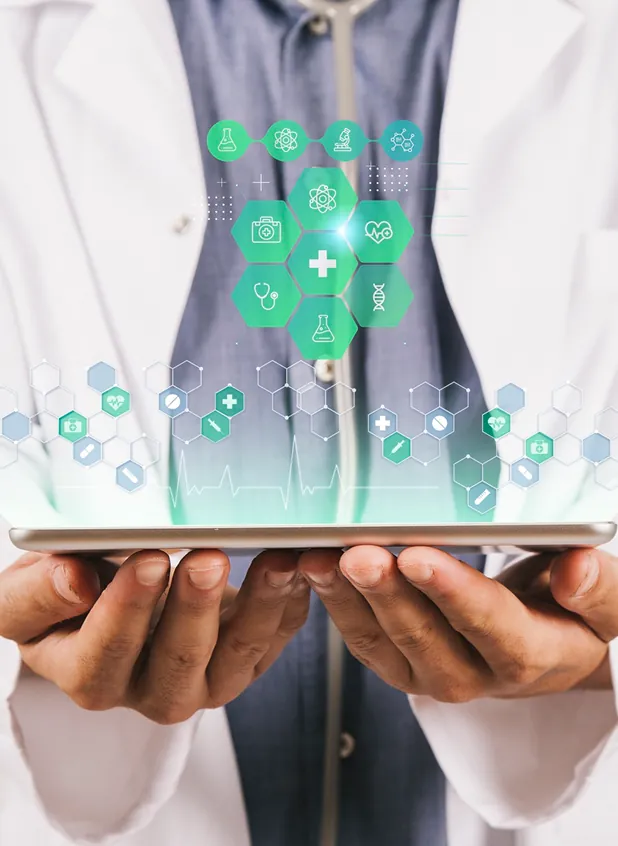
Generative AI healthcare services

The healthcare sector is changing at a very fast pace, and are contributing significantly to the change. With the assistance of AI-driven algorithms, hospitals, research labs, and digital health platforms now utilize AI-powered models to analyze medical records, identify risks, and assist in clinical decision-making, thus shortening time-to-diagnosis by up to 40% in most early adopters.

Gen AI India, being a Generative AI consulting company, assists healthcare organizations in extracting the value that lies behind patient records, imaging data, electronic health records, and real-time monitoring devices. Our Generative AI in healthcare services eases the complicated medical process and helps physicians with accurate information, starting with predictive analytics and automated report generation.

Generative AI in Healthcare Services We Deliver

At Gen AI India, we assist healthcare organizations in implementing AI in order to enhance patient outcomes, automate clinical processes, and improve decision-making. Our Gen AI healthcare solutions are designed to assist hospitals, diagnostic centers, telemedicine websites, and research organizations at any phase of digital development.

AI-assisted diagnostics & disease detection

Models that learn medical imaging and EHR patterns assist physicians in identifying anomalies sooner to curb diagnostic mistakes and enable them to make clinical decisions earlier.

Medical Data Visualization

Personalized treatment recommendations

We develop patient-specific AI models, which take into account the history of the patient, his or her genes, lifestyle, and response trends, and show physicians the way through the customized treatment.

Medical Data Visualization

Medical data summarization & automated report drafting

The structured and unstructured medical data are transformed into brief summaries, discharge notes, prescriptions, and clinical reports to ease the burden on the administration.

Medical Data Visualization

Risk scoring, risk monitoring analytics

Our systems predict patient degradation, chance of infection, risk of readmission, and treatment success to provide care teams with increased opportunity to act.

Medical Data Visualization

Virtual health assistants for patient support

Healthcare medical services can utilize generative AI to drive chat-based symptom checkers, appointment assistants, medication reminders, and aftercare directions to increase patient engagement.

Medical Data Visualization

Drug research acceleration & molecule generation

We support labs and pharma teams in data-enabled molecule design and research insights, improving the efficiency of experimentation.

Medical Data Visualization
Solutions

Our Key Models of Generative AI in Healthcare Services

Gen AI India collaborates with various underlying and specialty models capable of assisting medical teams to process the data about patients, make predictions, and extract insights that could aid in better care delivery.

Foundation Models for Multi-Modal Healthcare Data

Such models combine text, medical pictures, prescriptions, and sensor data and allow clinical decisions that include the full context of the patient. They are best suited to research and diagnostic conditions.

LLM-based Medical Knowledge Models

Healthcare language models based on literature and clinical guidelines, as well as anonymized patient data, can help clinicians summarize, evaluate history, and document, saving time on paperwork.

RAG (Retrieval-Augmented Generation) for Evidence-backed Answers

Combining real-time clinical data with medical guidelines, RAG guarantees the fact-based nature of the outputs and their compliance with hospital protocols that enhance reliability and reduce risks.

Vision AI Models for Imaging & Scans

The images analyzed by MRI, CT, X-ray, and pathology are all considered to find anomalies, tumor markers, and segmentation. Such models of Gen AI healthcare solutions can assist in decreasing diagnostic turnaround time and assist radiologists with the second-level review.

Generative Models for Drug Discovery & Molecule Creation

These models are ideal in pharma and life-science research and can produce molecule structures, predict drug response, and accelerate the experimentation cycle—enabling therapies to be introduced in a reduced timeframe.

Predictive Patient Outcome Models

These systems assess risk factors and recovery chances utilizing past trends, biosignals, vital signs, and treatment reactions, making it possible to intervene early and make individual care choices.

Benefits

How Generative AI Models Help in the Healthcare Sector?

Generative AI is transforming the medical ecosystem by increasing the utility of clinical data, decreasing the burden on administration, and making diagnoses more informed.

Earlier disease detection and reduced diagnostic delays

AI systems review scans, reports, and vitals to identify patterns that could otherwise be overlooked when manually reviewed; these systems assist clinicians in recognizing risks at the earliest stages.

More personalized treatment decisions

Rather than providing one-size-fits-all prescriptions, some can be made based on medical history, genetic background, allergies, lifestyle, and how she previously responded to treatment.

Quick and cleaner clinical documentation

General AI can write drafts of discharge summaries, radiology notes, etc., which can save doctors hours per week and maintain records of patients in an organized way.

Better patient monitoring & real-time alerts

Predictive modelling can help hospitals predict deterioration and intervene earlier to decrease emergency cases and enhance better outcomes in critical care.

Faster drug research and experimental testing

The generation of molecules, prediction of toxicity, and hypothesis modelling assist researchers to test their ideas more effectively without having to start afresh every single time.

Improved patient engagement and self-care support

AI-based assistants also coach patients in the post-discharge period, respond to inquiries, follow up, and remind patients of their medications, which helps to reduce the workload among the personnel.

Are You Ready to Introduce Intelligence into Your Healthcare Ecosystem?

Transform your healthcare operations with cutting-edge Generative AI solutions tailored to your needs.

Let's Connect!
Tech Stack

Generative AI Tools We Use for Healthcare Services

Our tech stack is a modern and enterprise-ready stack to develop high-performing, scalable, and secure Generative AI solutions. Each tool and platform is carefully chosen to match your business needs, data workloads, and long-term AI roadmap.

Large Language Model Frameworks

OpenAI GPT
Meta Llama Models
Google Med-PaLM

Computer Vision & Imaging Analysis Tools

MONAI
TorchVision
NVIDIA Clara

Bioinformatics & Drug Discovery Platforms

DeepChem
AlphaFold
ChemBERTa

Medical NLP & RAG Frameworks

Haystack
LangChain
Elasticsearch
Why Choose Gen AI

Why Should You Choose Gen AI India for Generative AI in Healthcare?

Gen AI India brings technical depth, healthcare understanding, and implementation experience, helping organizations adopt AI confidently and with measurable outcomes.

Deep healthcare domain understanding

We consult with healthcare specialists regularly, which implies that AI products align with the actual hospital processes, regulatory requirements, and patient care.

End-to-end execution—from idea to deployment

Whether it is data preparation and model design or testing, integration, and optimization, we manage all the lifecycle so your teams can concentrate on delivering care.

Strong focus on clinical reliability & data safety

On the frontline, we develop systems that are designed to be accurate, traceable, and compliant with regulatory requirements, something that medical use cases need, where even a single detail is critical.

Scalable AI architecture built for hospitals & research setups

Regardless of whether you operate a single clinic or a multi-facility medical network, our solutions will expand as your data, user traffic, and AI potential expand.

Proven capability across diagnostics, patient care & research

We provide practical experience in a variety of healthcare applications, including imaging interpretation, predictive warnings, and drug discovery.

Faster implementation with measurable ROI

Our deployment models assist institutions in lessening human involvement, enhancing response time to patients, and impacting shorter adoption periods.

Client Testimonials

What Our Healthcare Clients Say

FAQs

Frequently Asked Questions

Our services support diagnostic assistance, interpretation of radiology images, summary of medical documents, predicting risks in the patients, virtual assistant, RAG-powered knowledge retrieval, treatment recommendation modelling, and speeding up research on drug discovery. We work in this area of cutting manual work and increasing clinical accuracy.

You can tailor any models of healthcare to more quickly deploy them or create new models to apply them to the use case scenarios, such as pathology image analysis, disease progression forecasting, or pharmaceutical innovation, based on your data and objectives.

Yes. We have APIs, HL7/FHIR connectors, and secure data pipes with our tech stack to integrate with EHRs, HIS, PACS systems, wearable sensors, and telemedicine platforms. This is intended to enhance your workflow, not to replace the systems currently in operation.

All models undergo several stages of clinical validation, such as dataset testing, edge-case testing, physician testing, bias testing, and real-world simulation. It is only under these circumstances that accuracy should be at the approved threshold before we proceed to pilot testing in your environment.