
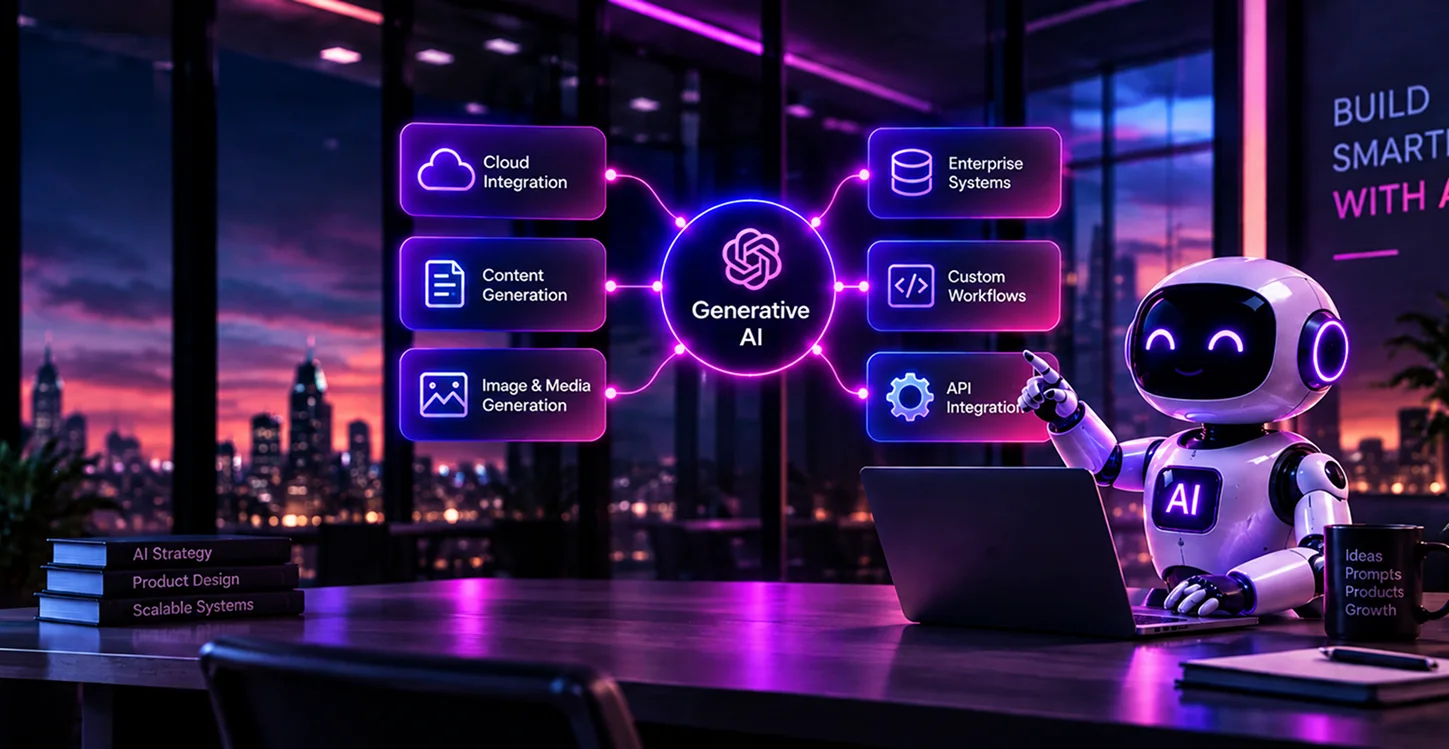
Generative AI Integration Services for Business Applications
Connect AI to the systems that run your business. Our Generative AI Integration Services integrate LLMs, APIs, enterprise data, CRM, ERP, SaaS platforms, and workflows to bring AI directly into your existing technology stack—without costly system rebuilds.
- LLM and API Integration
- CRM and ERP AI Connectivity
- AI Workflow and Data Integration
- Multi-Model Orchestration
What Generative AI Integration Means for a Business Application.
Generative AI integration is the engineering work that connects an LLM or AI model to the data, APIs, and systems your application depends on. Without it, the model works in isolation. With it, the model can read your data, act on business logic, and return responses grounded in what your business knows.
Integration vs Development
Building a generative AI application from scratch is development. Connecting a foundation model to your existing stack is integration. Most enterprise use cases sit in the integration layer: connecting GPT-4, Claude, or Gemini to the data and systems that make their output useful.
What Gets Connected
Integration scope typically covers the LLM or model of API, your internal data sources, authentication, the business application, and output handling. Each connection has its own data format, authentication requirement, error handling need, and latency consideration that needs to be designed explicitly.
Why Integration Is the Hard Part
Foundation models are well-documented and easy to call. The difficulty is grounding their output in your specific data, business rules, and system state. That grounding requires retrieval of architecture, context management, API design, and output validation that the model itself cannot provide.
RAG vs Fine-Tuning vs Prompt Engineering
Retrieval-augmented generation connects the model to your live data at a time of time. Fine-tuning trains the model on your domain. Prompt engineering shapes how the model behaves. Most enterprise integrations use a combination of all three. The right balance depends on your data freshness requirements, cost tolerance, and latency targets.
The AI Model is Running. The Business Data is Still Out of Reach
A generative AI model without access to your internal data, systems, and workflows produces generic output. The gap between a working AI prototype and a useful Generative AI Integration is almost always in the connectivity layer, not in the model itself.

-
Generic Answers, No Business Context
An LLM connected only to public training data cannot answer questions about your products, customers, or operations. It produces confident-sounding responses that are accurate in general and wrong for your specific business every time.
-
Data Sits in Silos the Model Cannot Reach
Customer data is in the CRM. Product data is in the ERP. Support history is in the helpdesk. The model has access to none of it. Without an integration layer that connects these sources, the model answers its training data rather than your actual business records.
-
Workflow Automation Stops at the Chat Interface
An AI assistant that can only respond in a chat window cannot update a CRM record, trigger a workflow, or push a status to an external system. Connecting AI output to business action requires API integration between the model, your application logic, and the downstream systems that need to be updated.
-
Multiple Models, No Coordination Layer
Using GPT-4 for one task and Claude for another without a routing layer creates duplicated logic, inconsistent behavior, and ballooning API costs. A multi-model architecture needs an orchestration layer to manage which model handles which task, with fallback and cost controls in place.
-
Security and Data Residency Uncertainty
Sending customer or financial data to an external LLM API without defined data controls creates compliance exposure. Integration design needs to address what data the model sees, how it is transmitted, and whether it can be logged or retained by the model provider.
-
Every Team Builds Its Own Connection
Without a shared integration layer, each product team builds its own LLM connection with its own authentication, error handling, and cost tracking. That fragmentation creates duplicated spend, inconsistent output quality, and no organization-wide visibility into how AI is being used.
What Our Generative AI Integration Services Cover.
Our Generative AI Integration Services address each layer of connecting an AI model to a real business application. Each capability below states what is connected, how it works, and what the business gets from it.
-
Our LLM Integration Services connect GPT-4, Claude, Gemini, Llama, Mistral, and other foundation models to your application via LLM API Integration with authentication, rate limiting, retry logic, and response validation built in from the start.
-
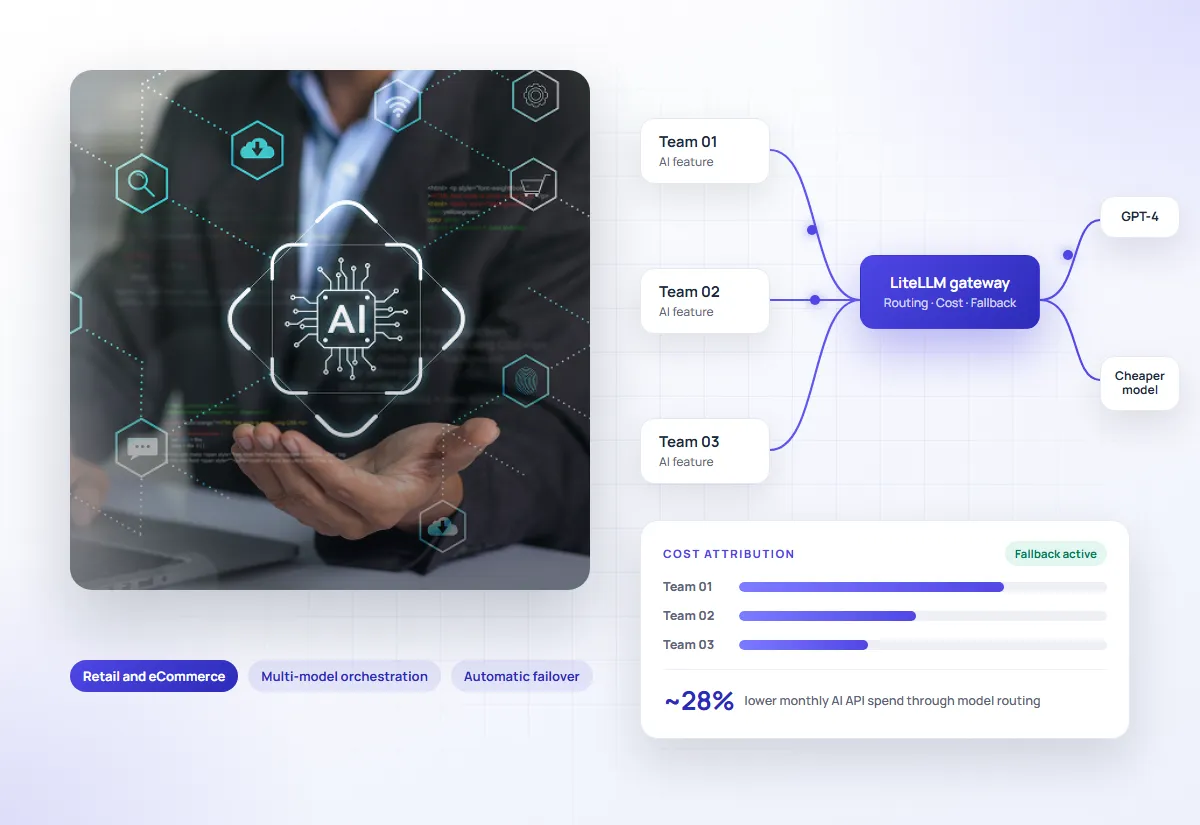
Our AI API Integration Services build a unified gateway layer that manages model routing, API key management, cost tracking, and fallback logic. A single gateway lets your application call any model through one interface rather than managing provider-specific code in every feature.
-
Our AI Model Integration Services cover both hosted API models and self-hosted open-source models running on your own infrastructure. Third-Party AI Model Integration includes the authentication, data formatting, and output handling each model or provider requires.
-
Our SaaS AI Integration work embeds generative AI capabilities into existing SaaS products without rebuilding the platform. AI features connect through the SaaS platform APIs, adding intelligent summarization, generation, classification, or retrieval to existing user workflows.
-
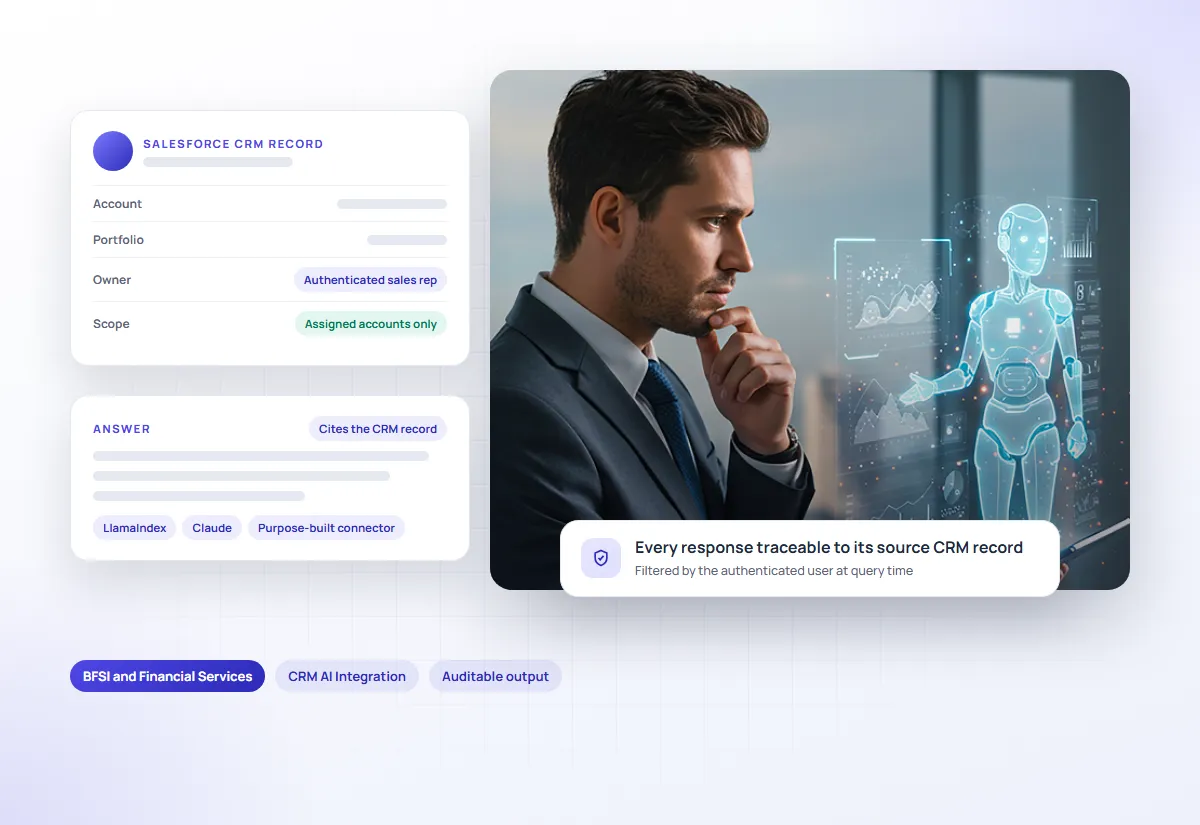
Our CRM AI Integration connects AI models to Salesforce, HubSpot, and other CRMs so the model can retrieve customer history, update records, and generate context-aware responses. Sales, support, and marketing AI features require this CRM layer to produce output that reflects the actual customer relationship.
-
Our ERP AI Integration connects AI models to SAP, Oracle, and Microsoft Dynamics, so inventory, finance, and supply chain data inform AI output. Enterprise users asking AI questions about their business need the model to see current ERP data rather than stale training knowledge.


Share which systems your AI feature needs to connect with.
We will map the API dependencies and data flows before recommending an integration approach.
Map My Integration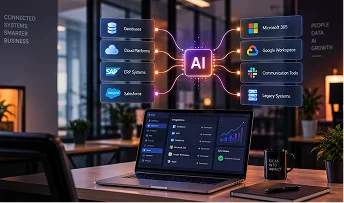
Connecting AI to Your Workflows, Data, and Business Systems
Generative AI API Integration is the starting point, but most production applications need three more layers to work reliably. These capabilities sit between the model and the business systems it needs to act on.
-
01
RAG and Knowledge Base Integration
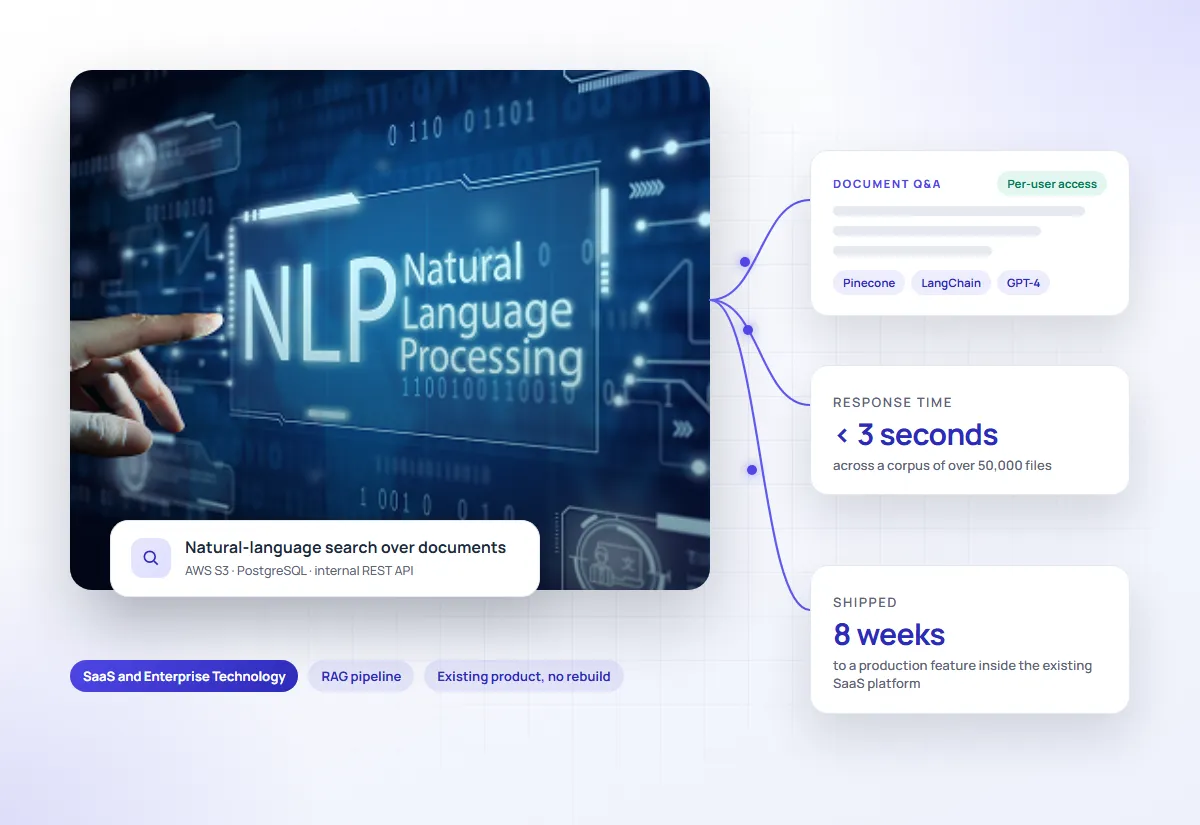
Retrieval-augmented generation connects the model to your internal documents, databases, and knowledge bases at query time. The model retrieves relevant context before generating a response, grounding its output in your actual data rather than general training knowledge.
-
02
AI Workflow and Process Integration
Our AI Workflow Integration connects AI output to downstream business actions: updating a record, triggering an approval, sending a notification, or writing to a database. AI that can only respond in a chat window adds limited business value. AI that can act on its response changes how the workflow runs.
-
03
ERP and Structured Data Integration
Our AI Data Integration layer handles structured business data from ERP, analytics, and operational databases that the model needs to access at query time. Data formatting, authentication, query optimization, and result caching are all part of this layer.
-
04
Multi-Model Routing and Orchestration
Our AI Orchestration Services build the routing layer that directs queries to the right model based on task type, cost threshold, and latency requirements. One orchestration layer manages GPT-4 for complex reasoning, a smaller model for classification, and a self-hosted model for sensitive data in a single application.
-
05
Agentic AI and Tool Use Integration
AI agents that use tools need an integration layer that exposes your business APIs as callable functions the model can invoke during a reasoning chain. We design the tool definitions, permission boundaries, input validation, and output handling that agentic workflows require to be safe and reliable in production.

Generative AI Integration Services in Practice: Three Production Builds.
Each engagement below started with a clear integration problem, not a technology preference. The outcomes reflect what Generative AI Integration Services deliver when the architecture is designed around the business needs.
How We Scope and Deliver a Generative AI Integration Engagement.
Every integration starts by mapping what the AI needs to know and do before writing any code. The system connections, data flows, and API contracts define the integration scope and prevent reworking mid-build.
-
01
System and Data Audit
We document every system the AI feature needs to read from or write to, including the APIs, authentication methods, and data formats involved.
An integration map covering all data sources, endpoints, authentication requirements, and output destinations.
-
02
Architecture Design
We design the integration architecture covering model selection, retrieval strategy, API gateway design, data pipeline, and orchestration approach.
An architecture document you approve before building begins, with the LLM API Integration and AI Data Integration layers explicitly defined.
-
03
Build and Connect
We build the integration layer connecting the model to each system, starting with the highest-priority data and workflow connections.
ERP AI Integration and CRM connections are validated against real data in a staging environment before production deployment.
-
04
Evaluation and Testing
We test the integrated system against real user queries, edge cases, and high-volume conditions before release.
A test report covering output quality, latency, cost per query, and error handling behavior across all integration points.
-
05
Production Deployment
We deploy the integration with monitoring, logging, and cost tracking in place from day one.
A live integration with observability instrumented so your team can see how the AI feature is performing across every connected system.
-
06
Optimization and Support
Post-launch we monitor retrieval quality, API cost, latency trends, and output accuracy on an ongoing basis.
A monthly review covering integration performance, cost trajectory, and recommended optimizations for the next cycle.
Have an AI integration challenge?
Share the systems involved, and we will scope the architecture.
Request an Integration Scoping CallTools and Platforms Behind Our AI Integration Engagements.
Our Enterprise AI Integration Services use a stack selected for the specific integration layer, not for brand visibility. Each tool is chosen for what it does reliably in production, not for what looks impressive in a pitch deck.
OpenAI (GPT-4, GPT-4o)
Foundation model API for reasoning, generation, and function calling
Anthropic Claude
Long-context model API suited to document analysis and structured output tasks
Google Gemini
Multimodal model API for text, image, and structured data tasks
Meta Llama / Mistral
Open-source models for self-hosted deployments where data residency is required
LangChain
Orchestration framework for chaining LLM calls, tool use, and retrieval pipelines
LlamaIndex
Data framework for RAG pipelines connecting models to structured and unstructured data sources
LiteLLM
Unified API gateway for routing across 100+ LLM providers with cost tracking and fallback
CrewAI
Multi-agent orchestration for complex workflows requiring coordinated AI agent behavior

Pinecone
Managed vector database for semantic search and RAG retrieval at production scale

Weaviate
Open-source vector database with hybrid search and GraphQL query support
Apache Kafka
Event streaming for real-time data pipelines feeding live context to AI integrations
Airbyte
Open-source data connector platform for syncing structured data into the AI integration layer
Salesforce API
CRM data connectivity for customer context, record updates, and workflow triggers
SAP and Oracle APIs
ERP data connectivity for inventory, finance, and supply chain context
REST and GraphQL
Standard API protocols for connecting custom and third-party SaaS platforms
Zapier / Make
No-code connectors for lightweight workflow integration between AI output and business apps
FAQs
Your generative AI model is ready. The integration is what makes it useful for your business.
Start with a scoping session.
Book an Integration Scoping Call