LLMOps Services for Production Generative AI
Majorly all AI applications perform perfectly in demos but break down in production. Our Generative AI Optimization Services cover the monitoring, evaluation, cost control, and lifecycle management that keep LLM applications reliable once real users and real data arrive.
- LLM Monitoring and Observability
- Evaluation and Quality Testing
- Cost and Token Optimization
- Production Lifecycle Management

What LLMOps Is, and Why Production AI Needs It
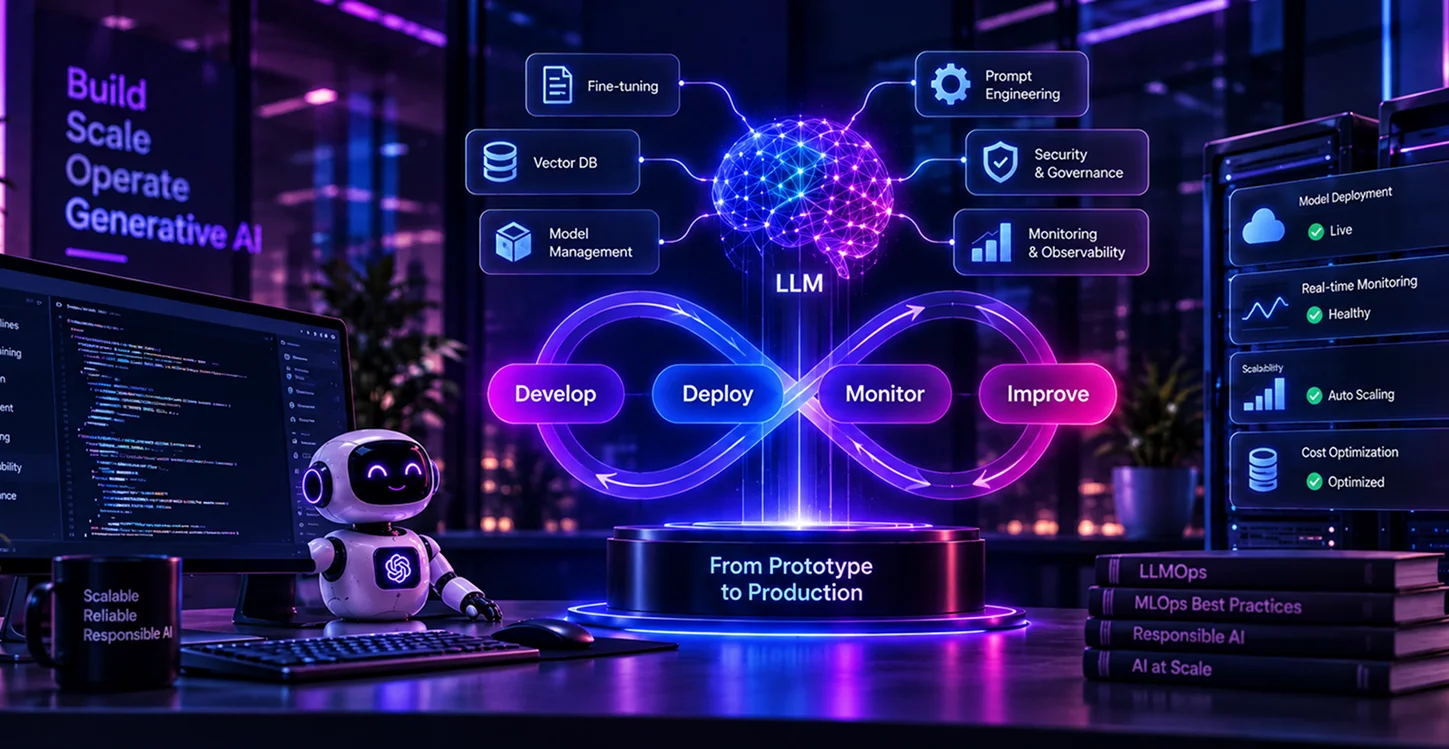
LLMOps is the operational discipline for developing, deploying, and maintaining LLM-based applications in production. It extends MLOps with LLM-specific requirements: prompt management, output evaluation, token cost tracking, and hallucination monitoring.
LLMOps vs MLOps
Traditional MLOps handles model training pipelines, versioning, and inference serving structured ML models. LLMOps addresses the additional complexity of prompt engineering, foundation model integration, RAG pipelines, and output quality evaluation at scale.
Where Production LLMs Break
LLM applications in production encounter latency spikes, token cost overruns, output drift, and context window failures. These are not model failures. They are operational failures that the application layer and monitoring infrastructure need to catch and address.
What LLMOps Covers
Deployment pipelines, prompt version control, A/B evaluation, guardrails, cost tracking, observability, and model updates all sit within LLMOps scope. Each layer needs specific tooling and processes that standard software operations practices do not cover by default.
When LLMOps Becomes Necessary
For a single LLM prototype, manual review is manageable. At production scale, manual oversight fails within days. Any application serving real users at consistent volume needs automated evaluation, monitoring, and cost controls to remain reliable.
The LLM is Deployed. Now the Operational Gaps Start Showing
Shipping a generative AI application is not the end of the engineering problem. It is where operational problems begin. Without proper Generative AI Optimization Services running in production, degradation is invisible until a user reports it.

Outputs Drift Without Alerts
LLM output quality changes as prompts age, models update, or input distributions shift. Without LLM Monitoring Services and automated evaluation gates, quality drift is discovered by a user's complaint rather than a monitoring alert.
Observability Is Missing
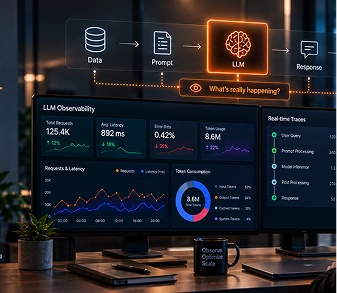
Standard application monitoring tools do not track prompt tokens, completion tokens, latency by query type, or output faithfulness. Proper LLM Observability Services require instrumentation built specifically for how LLM applications produce and serve responses.
Token Costs Scale Unexpectedly
LLM API costs grow non-linearly with usage volume, prompt length, and suboptimal model selection for each task. Without token-level tracking and routing controls, production costs can exceed budget within days of a traffic spike.
Evaluations Run Once, Not Continuously
Most teams evaluate LLM output quality once during development and assume it holds in production. Model updates, prompt changes, and new input patterns all break that assumption without continuous evaluation in place.
No Deployment Governance
Prompt changes and model switches get deployed directly to production without testing or rollback capability. A single bad prompt version reaching production can degrade every user's interaction until someone manually identifies and reverts to the change.
AI Model Monitoring Gaps
Without AI Model Monitoring Services covering both the model layer and the application layer, failures are diagnosed after damage is done. Incomplete monitoring means the team learns about production incidents from users rather than from instrumentation.
What Our LLMOps Services Cover Across the Full Production Lifecycle.
Our LLMOps Implementation Services address each layer of production of LLM operations, from initial deployment through to ongoing model management. Each capability below maps to a specific failure point that unmanaged LLM applications encounter at scale.
-
We build CI/CD pipelines for LLM applications covering prompt versioning, model selection, staging gates, and production release controls. Every prompt change and model update moves through a tested pipeline rather than direct deployment to production.
-
Our LLM Evaluation Services run automated quality checks on output faithfulness, relevance, tone, and task completion against defined criteria. Evaluation gates run before every release and on a continuous sample of live traffic to catch quality drift between releases.
-
Our LLM Cost Optimization program covers token usage auditing, model routing by task complexity, prompt compression, and caching strategy. The goal is to reduce inference spending without degrading output quality for the tasks that matter most to users.
-
We instrument LLM applications for latency, token usage, error rate, output quality scores, and user feedback signals. Dashboards and alerting give the engineering team visibility into production behavior before users report problems.
-
Retrieval-augmented generation pipelines need separate monitoring for retrieval of quality, chunk relevance, and context of faithfulness. We add evaluation and monitoring layers to RAG systems, so retrieval failures are caught and addressed at the pipeline level.
-
Our AI Model Lifecycle Management covers model version tracking, foundation model updates, fine-tuned model registry, and deprecation planning.Each model in production has a documented owner, evaluation baseline, and update policy rather than undocumented dependencies.

Tell us which layers of your LLM application currently have no monitoring or evaluation coverage.
We will prioritize the program accordingly.
Map My LLMOps Gaps
Three Production Builds Where LLMOps Services Changed the Outcome
Each engagement below started with a production LLM application that had specific operational failures. The outcomes reflect what LLM Production Optimization delivers when the right monitoring and evaluation infrastructure is in place.



How We Build an LLMOps Program Around Your Production Application
Getting LLM Production Optimization right requires understanding your current stack, failure modes, and business constraints before prescribing a toolchain. Our engagement follows a structured sequence with a clear deliverable at each stage.
- 01
Production Audit
We review your current LLM application architecture, deployment process, monitoring coverage, and cost structure.
An audit report identifying the highest-risk operational gaps and the order in which they should be addressed.
- 02
Observability Build
We instrument the application with LLM-specific tracing, token tracking, latency measurement, and output logging.
A working observability layer with dashboards and alerting configured for your production environment.
- 03
Evaluation Framework
We define evaluation criteria, build automated evaluation pipelines, and establish quality baselines for each use case.
An automated evaluation suite running on a sample of live traffic and gating every staged release.
- 04
Cost and Routing Controls
We implement token tracking, model routing rules, prompt caching, and spending alerts based on audit findings.
Documented cost controls with a projected monthly savings estimate against the pre-program baseline.
- 05
Deployment Governance
We build CI/CD pipelines for prompt and model changes, including staging environments and rollback capability.
Deployment pipeline where every change is tested and reversible before reaching production users.
- 06
Ongoing Operations
We run monthly evaluation reviews, model update assessments, and cost optimization cycles as managed services.
A monthly LLMOps operations report covering quality trends, cost trajectory, and recommended actions.

Have a production LLM application with gaps in monitoring, evaluation, or cost control?
Start with a production audit.
Request an LLMOps AuditTools and Platforms Behind Our Generative AI Monitoring Services
Our AI model monitoring services use LLMOps tooling rather than adapting general-purpose monitoring stacks. Each tool is selected for the specific production challenge it addresses, not for brand recognition.

LangSmith
End-to-end LLM tracing, run tracking, and evaluation for LangChain-based applications

Arize AI
LLM performance monitoring, hallucination detection, and drift alerting for production deployments

Langfuse
Open-source LLM observability with trace logging, cost tracking, and prompt versioning

Helicone
LLM API request logging, latency profiling, and cost attribution at the request level

RAGAS
RAG pipeline evaluation covering context recall, faithfulness, and answer relevance metrics

DeepEval
Unit testing framework for LLM outputs with customizable evaluation criteria and CI integration

PromptFoo
Prompt evaluation and regression testing with multi-model comparison and output scoring
Braintrust
LLM evaluation platform with scoring functions, human review workflows, and dataset management
MLflow
Experiment tracking, model registry, and deployment management for LLM versioning and lineage.
BentoML
Model serving framework with containerized deployment, batching, and adaptive scaling.

LiteLLM
Unified LLM routing layer supporting 100+ providers with fallback, load balancing, and cost controls.
Weights and Biases
Training and fine-tuning experiment tracking with artifact management and model comparison.

OpenMeter
Usage metering and cost attribution for LLM API consumption across users and features
GPTCache
Semantic caching layer that reduces redundant LLM API calls for repeated or similar queries

LlamaIndex
Data framework for RAG pipelines with chunking, retrieval, and context optimization controls

Portkey
LLM gateway with model routing, cost tracking, semantic caching, and fallback management
What Changes in Production After LLMOps Is Running
Our Generative AI Performance Optimization program changes how the team understands and manages the application in production. These are measurable operational improvements, not projected benefits from a vendor's pitch.

Faster Issue Detection
With LLM Observability Services running, production failures surface through alerts rather than through user reports. Mean time to detection drops because the monitoring infrastructure flags anomalies before they affect a significant share of traffic.
Controlled Output Quality
Automated AI Model Performance Optimization evaluation runs continuously rather than only during development sprints. Quality regressions are caught before deployment rather than discovered post-release through user feedback.
Predictable Inference Cost
LLM Application Performance Optimization includes token cost tracking that makes spending visible and controllable at the query, user, and feature level. Teams can make informed decisions about model selection and prompt design based on actual cost data rather than estimates.
Safe, Reversible Deployments
Prompt and model changes deploy through a tested pipeline with staging validation and one-step rollback. The risk of a single bad deployment affecting all production users drops significantly once the release of governance is in place.
FAQs
Your LLM application is in production. The question is whether you can see what is happening inside it.
Start with an LLMOps audit.
Book a Production Audit