Gen AI India

Your Partner in Generative AI Transformation

AI is no longer a future advantage. It is the present difference between businesses that grow and businesses that stall. Gen AI India serves as the delivery engine for enterprises and startups that want to move from AI exploration to AI execution.

We build production-ready generative AI solutions that connect to your data, integrate with your systems, and operate inside your real business workflows. Not demos. Not pilots that go nowhere. Systems that work.

  • 50+ AI Projects Delivered
  • India's Leading Gen AI Team
  • Trusted by Enterprises and Startups

AI is Separating Market Leaders from the Rest

The organizations that deploy AI today are not experimenting. They are reducing operational costs, compressing decision cycles, and building capabilities that are structurally difficult for competitors to replicate. The gap between leaders and laggards is widening every quarter.

Generative AI is behind the shift. Models that understand language, retrieve business knowledge, generate content, and execute tasks are now available for enterprise deployment. The question is no longer whether to use them. It is how to deploy them in a way that creates real, measurable value for your business.

Gen AI India helps organizations answer that question with clarity. We identify the right use cases, select the right architecture, build the right system, and take it to production.

Helping Enterprises Compete in an AI-Driven World

There is no shortage of information about generative AI. There is, however, a shortage of teams who can turn that information into working software inside a real business environment.

Most AI projects fail not because the technology is wrong but because the implementation is disconnected from the actual workflow, data environment, and operational requirements of the business. A model that works in a demo frequently does not work at production scale, with real users, on real data, under real performance and security constraints.

That is the gap Gen AI India closes. We work with your team to understand the business problem first, define what success looks like in measurable terms, and build a system that meets those terms.

Our role is to separate what is genuinely useful from what is unnecessary noise, and to deliver practical AI that makes your operations faster, smarter, and more efficient.

See What Generative AI Can Actually Do for Your Business

Here is what we build, and how each service connects to a real business outcome.

Generative AI Consulting

Most organizations know they want to use AI. Few know exactly where to start, which use cases to prioritize, or how to evaluate the risks involved. Our consulting service answers those questions before any development begins.

Read More Read Less

We map your workflows, assess your data, evaluate technical and commercial feasibility, and define a roadmap that is grounded in your actual business objectives. You leave with a clear, prioritized plan instead of an abstract strategy.

  • Use case identification and ROI assessment
  • AI strategy and implementation roadmap
  • Data readiness and governance planning
  • Feasibility evaluation across builds options

Generative AI Model Development

When an off-the-shelf model does not meet your requirements, we build one that does. Our custom model development service produces AI models trained on your data, designed for your domain, and optimized for your specific use case.

Read More Read Less

This is appropriate for organizations with proprietary data, specialized terminology, or performance requirements that general-purpose models cannot satisfy.

  • Custom LLM development and domain-specific training
  • Multi-modal AI model creation
  • Secure and scalable model architecture
  • Model evaluation and performance benchmarking

AI Model Fine-Tuning

Foundation models are powerful general tools. Fine-tuning makes them precise instruments for your business. We take existing models and customize them using your data, improving accuracy, domain relevance, and consistency for your specific workflows.

Read More Read Less

This is typically faster and more cost-effective than building a model from scratch, while still producing results that a generic model cannot match.

  • Custom LLM fine-tuning on domain-specific data
  • Instruction tuning and prompt alignment
  • Reinforcement learning from human feedback (RLHF)
  • Ongoing fine-tuning as requirements evolve

RAG Systems and Enterprise Knowledge AI

Retrieval-Augmented Generation connects an AI model to your business knowledge so it can retrieve accurate information before generating a response. The result is an AI system that answers questions using your actual documents, not general training data.

Read More Read Less

RAG is particularly effective for internal knowledge assistants, document Q&A systems, and any use case where the AI needs to work with information that changes frequently or is private to your organization.

  • Retrieval-Augmented Generation system development
  • Enterprise knowledge base AI development
  • Document search and Q&A system implementation
  • Context-aware information retrieval pipelines

AI Agent Development

An AI agent goes further than a chatbot. Where a chatbot answers questions, an agent acts. It retrieves information, interacts with your systems, applies defined rules, and completes multi-step tasks without requiring a human to manage each stage.

Read More Read Less

We design and build agents with the right level of autonomy for your use case, including human-in-the-loop controls where critical decisions require review before execution.

  • Single and multi-agent system design and development
  • Tool integration and system interaction
  • Workflow automation and task orchestration
  • Human-in-the-loop approval and oversight controls

Generative AI Chatbot Development

Customer expectations for support quality have shifted. AI chatbots that understand context, retrieve accurate answers, and handle real conversations without constant escalation are now table stakes for customer-facing operations.

Read More Read Less

We build chatbots connected to your CRM, knowledge base, and support systems so they can handle genuine customer queries at scale without sacrificing accuracy or experience.

  • Enterprise AI chatbot development
  • Conversational AI and virtual assistant deployment
  • Multi-channel chatbot integration
  • CRM and helpdesk system connectivity

Generative AI Integration Services

The most valuable AI is the AI that works inside the tools your team already uses. We connect generative AI capabilities to your existing software stack, whether that is your ERP, your CRM, your databases, or the custom applications your business depends on.

Read More Read Less

Integration means your team gains AI capabilities without changing how they work. The AI fits into existing workflows instead of creating new ones.

  • LLM integration with enterprise software
  • CRM, ERP, and database connectivity
  • Generative AI API development and management
  • Third-party AI platform integration

See What AI Can Do for Your Industry

Different industries carry different data environments, regulatory requirements, workflow complexity, and risk profiles. We do not use a single template across verticals. We build AI solutions that fit the specific operational reality of your sector.

Healthcare

Patient-facing assistants, clinical knowledge systems, document processing, and administrative automation that reduces paperwork without compromising care quality.

Banking and Fintech

Document intelligence, customer support AI, financial research systems, compliance workflow automation, and fraud detection tools built for regulated environments.

Manufacturing

Technical knowledge assistants, predictive maintenance support, document processing, and operational workflow AI that keeps production moving and reduces unplanned downtime.

Logistics and Supply Chain

Shipment tracking intelligence, document processing, demand forecasting support, and operational assistants that reduce delays and improve coordination across supply chains.

SaaS and Technology

AI copilots embedded in your product, support automation, enterprise search, and AI-powered features that improve your product's core value proposition.

Retail and E-commerce

Product discovery engines, catalog intelligence, customer service agents, and personalization systems that improve conversion and retention.

Legal

Contract review and analysis, document intelligence, legal research support, and compliance workflow automation built with appropriate access controls and audit trails.

Education and EdTech

Learning assistants, content generation systems, assessment automation, and knowledge platforms that reduce administrative burden and improve learning outcomes.

Empowering the Next Wave of Market Leaders with AI

Outcomes are easier to evaluate when you can see them in a real business context. Here are examples of what we have built and what it delivered.

Analytics dashboard displaying data extracted from unstructured documents

Automated NLP Data Extraction Platform

A growing enterprise was processing large volumes of unstructured documents manually. Analyst time was being consumed by extraction and formatting tasks rather than the analysis those documents were supposed to support.

We developed an AI-powered NLP solution that automated the entire data extraction and analysis pipeline. The result was faster processing, greater accuracy, real-time insight delivery, and a material improvement in operational efficiency. The team that had been working through documents was freed to focus on the work they could do.

Modern smart office interior connected to building management systems

Smart Office AI Application

A facilities and workspace management company needed to connect employees with building systems in a way that felt intelligent and responsive rather than manual.

We built an AI-powered mobile application that connects users with smart office infrastructure, enabling automated climate and lighting control, predictive maintenance scheduling, and intelligent workspace navigation.

The deployment improved employee experience, reduced energy consumption, and gave facilities to teams actionable operational data.

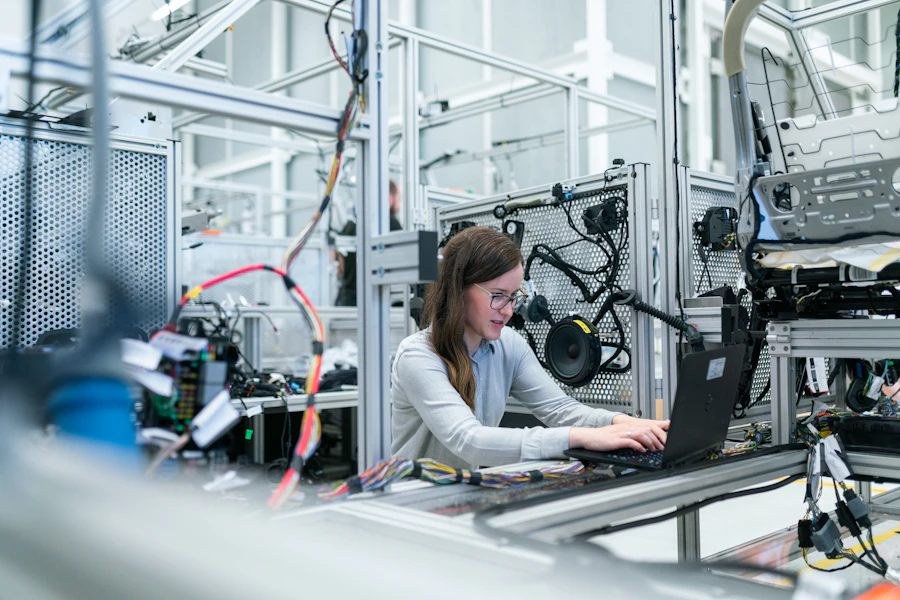
Engineer monitoring industrial equipment and IoT sensors on a laptop

IoT Gateway with Predictive Intelligence

An operations team was managing equipment across multiple sites and was consistently reacting to failures rather than anticipating them. Downtime was costing the business more than the maintenance itself.

We built a scalable IoT gateway solution with intelligent monitoring and predictive capabilities across the equipment fleet. The system automated routine operations, flagged potential issues before they became failures, and maintained the environmental conditions required for reliable performance. Downtime reduced. Operational reliability improved.

How We Take GenAI From Idea to Production

A working demo and a production system are not the same thing. Getting from one to the other requires validation at every stage: the business case, the data, the architecture, the security model, the integration design, and the deployment environment. We work through each stage systematically, so the final system is reliable and ready for real users.

  1. Step 1: Understand the Business Problem

    We define the workflow, the users, the business objective, the constraints, and the expected outcome. We evaluate whether generative AI is actually the right approach before any technical work begins.

  2. Step 2: Assess Data and Feasibility

    We evaluate data quality, accessibility, structure, governance, and readiness for AI use. We assess technical and commercial feasibility based on what exists in your environment today.

  3. Step 3: Choose Architecture

    We determine whether the solution requires an API-based model, a RAG system, fine-tuning, an agent architecture, a private deployment, or a combination of these approaches, and we explain why.

  4. Step 4: Design the Solution

    We produce technical design: architecture diagrams, data flows, integration specifications, a security model, a monitoring framework, and a clear implementation roadmap.

  5. Step 5: Build and Integrate

    We develop the application, connect the required systems, implement retrieval or tool-use where needed, and establish security and access controls throughout the build.

  6. Step 6: Deploy, Monitor, and Optimize

    We move the solution into your environment and remain engaged after launch. Model behavior, data quality, costs, and business requirements change over time. We continue to monitor and improve the system.

What We Believe About Building AI That Works

Technology alone has never transformed a business. What transforms a business is technology that is built around actual workflows, operated by real people, and held to a measurable standard. AI is no different.

We evaluate the business requirement before selecting any technology. We design systems for production, not for presentations. Security, performance, monitoring, cost, and scalability are part of the initial design, not additions made after the fact.

We work with your existing stack because the best AI is the AI that fits your operations, not the AI that requires you to rebuild them.

And we continued after lunch. Model behavior changes. Data changes. Business requirements change. The systems we build are designed to be monitored, maintained, and improved over time, not handed over and forgotten.

What Our Clients Say

Sonia Bisht CTO, LogicAI

The team understood our business requirements before recommending the right Gen AI approach. Their thinking around model selection, integration, performance, and ongoing optimization gave us a clearer path for expanding our AI capabilities than anything we had seen from other vendors.

Roshan Singh Chief Digital Officer, GenAI Boost

The team helped us build a Gen AI foundation that could support multiple business applications. They did not just deliver a solution. They helped us think through the architecture for long-term scale, which is what we actually needed.

Frequently Asked Questions

Generative AI development is the process of building software that uses models such as large language models and multimodal AI models to generate, retrieve, analyze, or transform information for a specific business use case. It includes everything from consulting and architecture design to model development, integration, deployment, and ongoing optimization.

ChatGPT is a general-purpose consumer product. Generative AI development for your business means building AI applications that are grounded in your own data, connected to your own systems, governed by your own rules, and deployed in your own environment. The output is not a general chatbot. It is a purpose-built system designed for your specific workflows.

RAG, or Retrieval-Augmented Generation, connects an AI model to external knowledge sources so it can retrieve relevant information before generating a response. It is the right approach when your AI needs to work with information that is private to your organization, changes frequently, or is too large to include in a model's training data.

A chatbot answers questions. An AI agent acts. An agent can retrieve information from your systems, apply defined business rules, interact with external tools, and complete multi-step tasks without requiring a human to manage each step. The right choice depends on your use case and how much autonomous action is appropriate for the decisions involved.

Yes. Generative AI can connect with CRM, ERP, databases, and other business applications through APIs, secure connectors, and workflow integrations. We assess your existing stack during the architecture phase and design the integration to fit what you already have, not to replace it.

The decision depends on performance requirements, privacy considerations, cost, latency, available infrastructure, and the specific task the model needs to handle. We evaluate the business requirement before selecting any technology. That includes assessing whether a commercial API, an open-source model, a fine-tuned model, or a private deployment is the right fit.

A focused proof of concept typically takes four to eight weeks. A production-ready enterprise system generally takes three to six months, depending on the complexity of the use case, data readiness, integration requirements, and the number of stakeholders involved in review and approval.

We provide ongoing monitoring, optimization, and maintenance after deployment. Model behavior, data quality, costs, and business requirements all change over time. We remain engaged to ensure the system continues to perform at the standard it was built to meet.

Ready to Put AI to Work in Your Business?

No commitment required. No sales pitch. A direct conversation with an AI team that has built production systems and can give you an honest assessment of your use case.

Discuss Your AI Use Case!