
Generative AI vs Predictive AI: Which One Should You Be Using
This guide breaks down the key differences between generative AI and predictive AI, helping businesses understand when to use each and why mixing them up can lead to poor decisions.
- How generative AI creates content while predictive AI forecasts outcomes
- The core differences in data, output, cost, and real-world applications
- Where each type of AI delivers the most value across industries
- How to decide the right approach based on your business problem
- Why combining both can create more powerful, outcome-driven AI systems
This overview helps you move beyond confusion and choose the right AI strategy with clarity and purpose.
Most people who ask “should we use AI?” are actually asking two different questions without realizing it.
One is: can AI help us create things faster? The other is: can AI help us make smarter decisions? Those are both valid questions, but they point to completely different types of AI. Mixing them up is one of the more common (and expensive) mistakes businesses make right now.
This guide breaks down generative AI vs predictive AI in plain terms, shows you where each one actually works, and helps you figure out which makes sense for your situation. If you want a quick opinion before reading further, our generative AI development company has helped businesses across sectors answer this same question, often in a single conversation.
Table of Contents
What is Generative AI?
Generative AI produces new things. Give it a starting point such as a topic, a brief, an image, a set of instructions, and it builds something from scratch. That could be a blog post, a line of code, a product image, a customer response, or a full sales proposal.
It doesn’t pull from a database of pre-written answers. It creates output by drawing on patterns it learned during training on very large datasets. That’s why two people asking the same question can get two slightly different answers.
Common generative AI models include:
- Large Language Models (LLMs): ChatGPT, Claude, Gemini (for text and conversation)
- Diffusion Models: Midjourney, DALL-E (for image generation)
- Generative Adversarial Networks (GANs): for video, voice synthesis, and realistic image creation
- Variational Autoencoders (VAEs): for generating synthetic training data
What makes generative AI genuinely impressive is that it doesn’t just retrieve, it creates. And that’s the key distinction worth holding onto as we move forward.
What is Predictive AI?
Predictive AI has been running quietly in the background of many businesses for years. Your bank uses it when it flags an unusual transaction. Spotify uses it when it suggests what to play next. A hospital uses it when it identifies which patients might need more attention before they deteriorate.
It doesn’t create anything. It analyses what has already happened to calculate what is likely to happen next. The output is always some form of a number, a score, or a category.
Common predictive AI techniques include:
- Regression models: predict a continuous value (like sales revenue next quarter)
- Classification algorithms: categorize outcomes (like “will this customer churn: yes or no?”)
- Clustering: group customers by behavior without a predefined label
- Time series forecasting: predict demand, pricing, or resource needs over time
- Decision trees and random forests: for complex, multi-variable business decisions
Predictive AI is the backbone of industries like finance, healthcare, retail, and logistics. It’s mature, well-understood, and extraordinarily useful when you need answers grounded in what has already happened.
Generative AI vs Predictive AI: Where They Actually Differ
Before having a deep analysis between, predictive AI vs generative AI, let us have a brief view of the same, also serving as a base of the upcoming details.
| Feature | Generative AI | Predictive AI |
| Primary Goal | Create new content or data | Forecast outcomes or classify events |
| Input Type | Unstructured (text, images, audio) | Structured (historical datasets, numbers) |
| Output Type | New content such as text, images, code, audio | Predictions such as scores, probabilities, decisions |
| Training Data Size | Massive (billions of data points) | Smaller, targeted datasets |
| Core Technology | LLMs, GANs, Diffusion Models, VAEs | Regression, classification, clustering, time series |
| Best Use Cases | Content creation, code generation, chatbots, synthetic data | Fraud detection, demand forecasting, churn prediction |
| Decision Style | Open-ended, creative, context-aware | Calculated, probabilistic, data-anchored |
| Maturity Level | Newer but rapidly growing | More established and widely adopted |
| Key Examples | ChatGPT, Claude, Midjourney, GitHub Copilot | Fraud detection engines, recommendation systems, supply chain tools |
Neither one is universally better. Read that twice, because a lot of vendors won’t tell you that. Start with generative ai consulting services, if not sure about either rather than living on an assumption and losing on your investments. On that note let us now move towards a detailed view of differences between predictive vs generative AI.
Fundamental Working of Both
Both are forms of machine learning. Both learn from data. But the type of question each one answers is completely different.
Generative AI asks: “Based on what I’ve learned, what should I create?” And on the other hand, Predictive AI asks: “Based on what happened before, what is likely to happen next?” That difference in orientation changes everything, the data you need, the infrastructure you use, how you measure success, and what kind of business problems each one actually solves.
Training Data: Unstructured vs Structured
Generative AI models are trained on massive volumes of unstructured data, books, websites, images, and code repositories. The breadth of data is what gives them general-purpose abilities.
Predictive AI models typically train on structured, labeled datasets specific to the task at hand. A fraud detection model trains past transactions labeled as fraudulent or legitimate. A churn model trains customer records with known outcomes. The data is narrower but more precise.
Output Type: Open vs Closed
When you ask a generative AI to write a product description, the output could take a hundred different valid forms and that’s by design. The openness is the feature.
When you ask a predictive AI “will this customer churn in the next 30 days,” the answer is essentially yes or no, plus a confidence score. That closed-form precision is what makes it useful for automated decision-making at scale.
Compute and Infrastructure Costs
Generative AI inference, running large language models in particular is computationally intensive. It requires GPUs and often significant cloud spending. Predictive models, once trained, tend to run much faster and cheaper at inference time, which is why they’re commonly embedded in real-time systems.
Data Orientation
Generative AI Works with unstructured data (text, images, audio) and generates novel outputs. Output is open-ended and creative. Success is often measured by quality, relevance, and human judgment.
Predictive AI Works with structured data (numbers, categories, time series) and produces a specific answer. Output is a score, class, or probability. Success is measured by accuracy and precision.
Real-World Use Cases: Where Each Type Wins
This section breaks down where each types of AI generative vs predictive actually delivers results across industries, workflows, and business scenarios, so you can move beyond theory and start thinking in terms of application.
Where Generative AI Delivers the Most Value
Marketing & Content: Generative AI can produce blog posts, ad copy, email sequences, and social media content at a pace no human team can match. Gartner estimates that by 2025, large organizations could use generative AI for at least 30% of their outbound marketing messages.
Customer Support: AI-powered chatbots built on LLMs handle complex queries, understand context, and carry conversations that feel far more natural than scripted bots of the past.
Software Development: Tools like GitHub Copilot allow developers to write, review, and optimize code faster, turning hours of work into minutes.
Drug Discovery & Research: Generative models are being used to predict molecular structures that could lead to new medicines, dramatically shortening research cycles.
Synthetic Data Generation: When real data is scarce or sensitive, generative AI can produce synthetic datasets that preserve the statistical properties of real data, useful for training other AI models without privacy concerns.
Where Predictive AI Delivers the Most Value
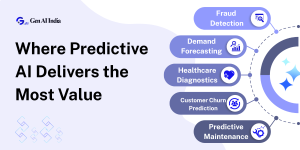
Fraud Detection: Banks and financial institutions use predictive AI to scan transaction data in real time and flag anomalies before they become losses. About 51% of business owners already use AI for fraud prevention, and 63% of financial institutions rank this as their top AI investment.
Demand Forecasting: Retailers use predictive models to anticipate what products customers will want, in what quantities, and allow smarter inventory management and fewer stockouts.
Healthcare Diagnostics: Predictive AI analyzes patient records, lab results, and medical history to flag risk factors and support clinical decision-making reducing time-to-diagnosis by up to 40% in many early implementations.
Customer Churn Prediction: SaaS companies and subscription services use predictive models to identify which customers are most likely to cancel allowing retention teams to act before it’s too late.
Predictive Maintenance: Manufacturing plants use sensor data and predictive models to catch equipment issues before they cause downtime, saving significant time and resources.
Generative AI vs Predictive AI Differences Based on Industries
The difference between generative AI and predictive AI becomes even clearer when you look at how they are applied across industries.
| Industry | Predictive AI Use Case | Generative AI Use Case |
| Finance | Credit scoring, fraud detection, risk modeling | Automated report generation, client communications |
| Healthcare | Disease risk prediction, patient triage | Medical record summarization, drug discovery |
| Retail & eCommerce | Demand forecasting, product recommendations | Product descriptions, personalized emails |
| Manufacturing | Equipment failure prediction, quality control | Technical documentation, design prototyping |
| Marketing | Lead scoring, campaign performance forecasting | Ad copy, content creation, A/B test variations |
| Legal | Contract risk analysis, litigation outcome prediction | Contract drafting, legal research summaries |
Key Risks of Generative vs Predictive AI
No honest comparison leaves the downside. Both approaches come with real consideration.
Predictive AI Risks
- Data dependency: if your historical data is biased or incomplete, predictions will be too
- Static models: predictive models can become outdated as markets change
- Overconfidence: businesses sometimes treat probability scores as certainties
Generative AI Risks
- Hallucinations: models can generate confident sounding but incorrect information
- Output quality: generated content often needs human review before it’s used
- Data privacy: sending sensitive business data to third-party models carries risk
- Cost and compute: running large models at scale requires significant infrastructure
Managing these risks effectively is one of the biggest challenges today. Work with an experienced generative AI development partner for meaningful differences.
How to Decide Between Predictive AI vs Generative AI
There’s no universal right answer in the predictive vs. generative AI debate. The right choice depends entirely on what problem you’re trying to solve. Here are the questions worth working through before making any decision.
Start With the Output You Need
If what you want is a piece of content, a document, an image, a response, a code snippet that’s a generative AI use case. If what you want is a number, a category, or a yes/no signal, that’s a predictive AI use case.
Take a Quick Test
Describe your ideal output in one sentence. If the sentence includes words like “write,” “create,” “generate,” or “draft”, lean toward generative AI. If it includes “predict,” “score,” “classify,” “flag,” or “forecast” lean toward predictive AI.
Look at Your Existing Data
Do you have years of clean, labeled historical records, transaction logs, customer churn data, equipment sensor readings? That’s the raw material for predictive AI. Do you have a large body of unstructured text, documents, or content that needs to be processed or generated from? That’s where generative AI typically fits.
Think About How You’ll Measure Success
Predictive AI success is usually easier to quantify; you can measure accuracy, false positive rates, and lift over a baseline. Generative AI success is often more qualitative, at least initially. If your leadership team needs a clear metric to justify the investment quickly, predictive AI often has an advantage here.
Consider Your Regulatory Context
In heavily regulated industries, banking, insurance, and healthcare decisions made by AI often need to be explained. Predictive models can show which factors drove a particular score. Many generative AI outputs are harder to audit, which can create compliance challenges that need to be planned up front.
If you’re automating creative work, communication, or knowledge management, generative AI is likely the right path. If you’re trying to reduce risk, anticipate customer behaviour, or sharpen operational decisions with data, predictive AI is probably the better starting point.
Can You Use Both Generative AI and Predictive AI Together?
The framing of generative AI vs. predictive AI as a binary choice misses something important: these two types of AI work extremely well together. Some of the most effective enterprise AI systems in use today combine both in the same workflow.
Think about the retail business. Predictive AI analyses customer purchase history and flags for which users are most likely to respond to a particular type of offer. Generative AI then creates a personalized message specifically for that segment. The two systems work in sequence — one anticipates, one creates.
Three Combined Patterns Worth Knowing
Predict → Generate: Use predictive AI to identify which customers, risks, or opportunities matter most, then use generative AI to create the right content or response for each one. This is the most common combined pattern.
Generate → Predict: Use generative AI to create synthetic training data when real labeled data is scarce, then train a predictive model on that expanded dataset. This approach is growing in healthcare and manufacturing.
Generate to explain: Use generative AI to translate the outputs of a predictive model into plain-language explanations that non-technical users can understand and act on.
The companies seeing the best returns from AI right now are not those that picked one type and went all-in. They’re the ones building workflows where generative and predictive AI hand off to each other at the right moments.
The Short Version of Everything You Need to Remember
If you strip away the technical complexity, the choice between predictive vs generative AI often comes down to one simple question: what are you trying to achieve?
Whether you’re creating content, forecasting outcomes, or building intelligent systems, each type of AI serves a very specific purpose. And in many modern use cases, the real value comes from using both together.
If you are still not getting things right, hire generative AI developers who can lead you to the right path based on your business situations. The quick guide below distills everything into practical scenarios, so you can instantly map your goal to the right AI approach without overthinking the details.
| If your goal is… | Use This |
| Creating content, drafts, images, or code automatically | Generative AI |
| Forecasting demand, sales, or customer behaviour | Predictive AI |
| Building a customer-facing chatbot or AI assistant | Generative AI |
| Detecting fraud or flagging anomalies in real time | Predictive AI |
| Summarizing internal documents or knowledge bases | Generative AI |
| Predicting which patients, customers, or assets are at risk | Predictive AI |
| Personalized outreach after identifying the right audience | Gen AI + Predictive AI |
| Improving an ML model with richer contextual data | Gen AI + Predictive AI |
Conclusion
The generative AI vs predictive AI differences come down to a simple idea: one builds things, the other anticipates things. Both are genuinely useful. Both are becoming more accessible every month. And for most businesses past a certain size, the question is less “which one” and more “how do we bring both in strategically.”
The companies that will gain ground with AI over the next few years are the ones treating these as complementary tools, not competing bets. Whether you’re starting with a single use case or planning a broader AI strategy, begin with a real business problem and work backwards to the right tool.
Frequently Asked Questions
1. Is ChatGPT generative AI or predictive AI?
ChatGPT is generative AI. It’s built on a large language model trained to generate text responses. Technically, language models predict the next most likely token but in terms of how it functions and is used in the real world, ChatGPT is firmly in the generative category.
2. What is Predictive AI vs Generative AI?
Predictive AI focuses on analyzing historical data to forecast future outcomes, such as demand, risk, or customer behavior. Generative AI, on the other hand, creates new content—like text, images, code, or audio based on patterns it has learned from existing data. In simple terms, predictive AI tells you what is likely to happen, while generative AI helps you create something new.
3. Is predictive AI the same as machine learning?
Not exactly, but they overlap significantly. Traditional machine learning is the most common approach to building predictive models. Generative AI is also a form of machine learning, just a different kind. When people say, “predictive AI,” they usually mean ML models focused on forecasting specific, structured outcomes.
4. Which is more expensive to implement among predictive AI vs generative AI?
Generative AI tends to carry higher infrastructure costs, especially at inference times, because the models are much larger. Predictive models are generally lighter and cheaper to run in production. That said, the cost of collecting, cleaning, and labelling data for predictive models can be substantial, so the true cost depends heavily on your specific use case.
5. Can a small business use predictive AI?
Yes. Many SaaS platforms already embed predictive AI features, your CRM, email marketing tool, or analytics dashboard may be using it without labelling it as such. Custom predictive model development requires data and technical expertise, but using platforms with built-in predictive capabilities is very accessible at any company’s size.