What is Generative AI and How Does It Work: A Complete Guide for Business Leaders
This guide explains what Generative AI is, how it works, and why it matters for business leaders in 2026. You’ll understand the core technologies behind it, some real world use cases across departments, leading tools and models, implementation costs, and practical ROI timelines. Whether you’re evaluating off-the-shelf solutions or considering custom development, this guide will help you make informed, strategic decisions about adopting Generative AI in your organization.
The business landscape is experiencing a fundamental shift. Generative AI has moved from research labs to boardrooms. It has transformed how companies operate and compete.
For business leaders, it is very important to understand this technology. It’s the way they can identify opportunities that could define your organization’s next decade.
This comprehensive guide breaks down generative AI in practical terms. We will explore how it works, what it costs, and how leading organizations are already leveraging Generative AI development to gain competitive advantages.
Table of Contents
What is Generative AI?
Generative AI refers to artificial intelligence systems that can create new and original content. This content can be of any form. Be it text, images, code, music, video, and more.
Gen AI creates this content based on patterns learned from existing data. Where traditional AI systems classify or analyze existing information, generative AI produces novel outputs that didn’t exist before.
Let us take a simple example of this. Traditional AI might recognize a cat in a photo or predict customer churn. But Generative AI can create an entirely new image of a cat that never existed. It can write a marketing campaign from scratch or generate functional code for a new software feature.
The technology achieved mainstream awareness in late 2022 with ChatGPT’s public launch. But its foundations span decades of research in machine learning, neural networks, and natural language processing.
What changed wasn’t the core concept but the scale and accessibility of these systems.
The Key Characteristics of Generative AI
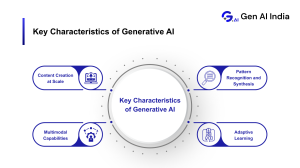
Content Creation at Scale:
Generative AI can produce thousands of variations in minutes. Yes, most of the content you read online is the output of Gen AI LLMs.
It can be product descriptions, design mockups, code functions, or data analysis. All these tasks that would take human teams days or weeks.
Pattern Recognition and Synthesis:
These systems learn underlying patterns from vast datasets. Then apply those patterns to generate new content that maintains coherent structure and context.
Multimodal Capabilities:
Modern generative AI can work across different content types. It can translate text to images. It can create videos from descriptions or turn sketches into professional designs.
Adaptive Learning:
The base models are pre-trained. But they can be fine-tuned for specific industries or use cases. This makes them increasingly relevant to specialized business needs.
What is the Main Goal of Generative AI?
The fundamental goal of generative AI is to augment human creativity, productivity, and decision-making by automating the creation of high-quality content and solutions. However, this broad objective manifests differently across business contexts.
Primary Objectives in Business Settings
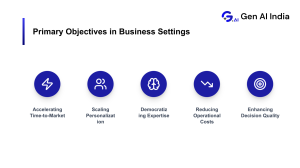
Accelerating Time-to-Market:
In competitive industries, speed to deliver matters. Generative AI enables rapid prototyping and product development cycles.
What once took weeks can now happen in hours. With the help of Gen AI businesses can test more ideas. They can iterate faster and respond to market changes with agility.
Scaling Personalization:
Modern consumers expect personalized experiences. But delivering customization at scale has traditionally been cost-prohibitive.
Generative AI makes it economically viable to create unique customer experiences, personalized marketing content, and tailored product recommendations for millions of users simultaneously.
Democratizing Expertise:
Not every organization can hire top-tier designers, writers, or data scientists. Generative AI puts sophisticated capabilities into the hands of generalist teams.
Which means smaller companies can compete with larger enterprises and use subject matter experts to focus on strategy while AI handles execution.
Reducing Operational Costs:
By automating repetitive creative and analytical tasks, generative AI allows organizations to reallocate human talent to higher-value strategic work.
The ROI comes not just from cost reduction but from redirecting human creativity toward innovation.
Enhancing Decision Quality:
Generative AI can simulate scenarios. It can generate alternative strategies and provide data-driven insights that help executives make more informed decisions under uncertainty.
How Does Generative AI Work?
If you are able to understand the mechanics of generative AI, you will be able to make informed decisions about implementation, realistic expectations about capabilities, and strategic choices about where to invest.
The Foundation: Neural Networks and Deep Learning
Generative AI relies on artificial neural networks when you look at its core. Its computing systems are inspired by biological brains. These networks consist of layers of interconnected nodes (neurons) that process information and identify patterns.
Deep learning refers to neural networks with many layers (hence “deep”). This allows them to learn increasingly abstract representations of data. The first layers might recognize basic features (edges in an image, common word combinations in text), while deeper layers identify complex patterns (faces, sentiment, contextual meaning).
The Training Process
Generative AI models undergo intensive training on massive datasets:
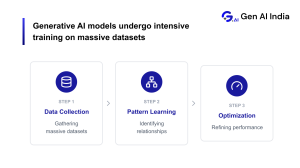
Data Collection: Models are trained on billions of data points. This data can be anything like text from books and websites, millions of images, code repositories, or domain-specific datasets. The quality and diversity of this training data fundamentally determine the model’s capabilities.
Pattern Learning: During training, the model adjusts billions of internal parameters to minimize the difference between its predictions and actual outputs. It’s learning the statistical relationships that make language coherent, images realistic, or code functional.
Optimization: Through countless iterations, the model refines its understanding. For language models, this means learning grammar, context, facts, reasoning patterns, and even nuances like tone and style.
The training phase is computationally intensive. This requires week or months on specialized hardware and costing millions of dollars for state-of-the-art models. However, once trained, these models can be deployed at relatively low cost.
Generation Mechanisms
Different types of generative AI use different approaches:
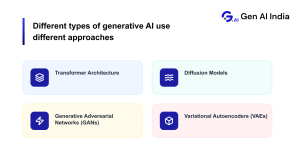
Transformer Architecture (GPT, BERT, etc.): These models are dominant in language AI. They use attention mechanisms to understand context. They predict the most likely next word (or token) based on everything that came before.
This builds coherent text one piece at a time. This same architecture now powers multimodal models that work with images, code, and other content types.
Diffusion Models (DALL-E, Stable Diffusion, Midjourney): For image generation, diffusion models start with random noise and gradually refine it into a coherent image based on text descriptions. They learn to reverse a “noise-adding” process, step by step creating increasingly detailed and accurate images.
Generative Adversarial Networks (GANs): These systems use two neural networks in competition. One generates content while the other evaluates it.
Through this adversarial process, both improve until the generator creates highly realistic outputs. GANs excel at creating photorealistic images and synthetic data.
Variational Autoencoders (VAEs): These compress data into a compact representation (encoding) and then reconstruct it (decoding). By manipulating the encoded space, they can generate variations and new examples similar to the training data.
The Inference Process
When you use a generative AI tool, the model isn’t “thinking” in the human sense. Instead, it performs probabilistic calculations. For a language model generating a response:
- Your prompt is converted into numerical tokens the model understands
- The model processes these tokens through its neural network layers
- It calculates probability distributions for what should come next
- It samples from these probabilities to select the next token
- This process repeats, with each new token influencing subsequent predictions
- Generation continues until a stopping condition is met
The entire process happens in milliseconds where it creates the illusion of real-time conversation or instant content creation.
Fine-Tuning and Customization
There is no doubt that base models are powerful. But still they become exponentially more valuable when customized for specific use cases:
Fine-Tuning: Training the model further on domain-specific data (legal documents, medical records, your company’s historical data) to specialize its knowledge and output style.
Prompt Engineering: Crafting instructions in ways that reliably produce desired outputs. It is a skill that’s become crucial for effective AI implementation.
Retrieval-Augmented Generation (RAG): Combining generative models with company databases or knowledge bases. This allows them to reference current, proprietary information not in their training data.
Reinforcement Learning from Human Feedback (RLHF): Using human evaluations to further refine model behaviour. We can say it helps to make outputs more helpful, accurate, and aligned with business objectives.
15+ Top Generative AI Tools in 2026
The generative AI ecosystem has exploded with hundreds of tools. But understanding the landscape helps executives identify which solutions align with their business needs.
Text and Language Models
1. ChatGPT (OpenAI):
The most recognized generative AI tool, ChatGPT excels at conversational AI, content generation, analysis, and problem-solving. To be honest, it does not need any introduction from our end.
Business applications include customer service, content creation, data analysis, and coding assistance. The enterprise version offers high level security, data privacy controls, and administrative features.
2. Claude (Anthropic):
Known for nuanced understanding, longer context windows (ability to process more information at once), and strong reasoning capabilities. This tool is particularly valuable for complex analysis, document processing, and applications requiring careful judgment.
3. Gemini (Google):
Google’s multimodal offering integrates with Google Workspace. This is a natural choice for organizations already in that ecosystem. Gemini is strong at research, analysis, and productivity enhancement.
4. Microsoft Copilot:
Embedded across Microsoft 365, this brings generative AI directly into familiar tools like Word, Excel, PowerPoint, and Teams.
Image and Design Generation
5. Midjourney:
Produces highly artistic, creative images particularly suited for marketing materials and brand visualization. The quality is exceptional, though it requires learning prompt crafting techniques.
6. DALL-E (OpenAI):
Offers precise control over image generation with strong instruction-following capabilities. Integrated into various platforms. This makes it accessible for rapid prototyping and content creation.
7. Stable Diffusion:
Open-source and highly customizable that allows organizations to run models on their own infrastructure. Ideal for companies with specific privacy requirements or those wanting to fine-tune for particular visual styles.
8. Adobe Firefly:
Designed for commercial use with commercially-safe training data, integrated into Adobe’s creative suite. Perfect for marketing teams already using Adobe tools.
Code Generation
9. GitHub Copilot:
Autocompletes code, suggests entire functions, and assists with debugging. Developer productivity tool that’s becoming standard in software teams, reportedly increasing coding speed by 30-50% for many developers.
10. Tabnine:
Offers AI code completion with strong privacy controls and the ability to train on private codebases. This makes it suitable for security-conscious enterprises.
11. Amazon Code Whisperer:
Integrated with AWS services, particularly valuable for organizations already in the Amazon cloud ecosystem.
Specialized Business Tools
12. Jasper:
Marketing-focused platform for creating brand-consistent content at scalelike blog posts, social media, ad copy, and more.
13. Copy.ai:
Sales and marketing copy generation with templates optimized for conversion and engagement.
14. Synthesia:
Creates AI-generated video content with digital avatars, useful for training materials, product demonstrations, and multilingual content without video production teams.
15. Runway:
Video editing and generation platform that can create, edit, and enhance video content using AI.
Industry-Specific Solutions
The most value comes from vertical-specific tools:
- Legal: Harvey AI for legal research and document drafting
- Healthcare: Nuance DAX for clinical documentation
- Financial Services: Bloomberg GPT for financial analysis
- Customer Service: Intercom Fin, Ada, or Zendesk AI for automated support
Build vs Buy Considerations
Executives face a crucial decision: use off-the-shelf tools or develop custom solutions.
Off-the-shelf tools offer rapid deployment, lower upfront costs, and continuous updates. They’re ideal for standardized use cases and getting quick wins.
Custom development makes sense when you need proprietary capabilities, have unique data that provides competitive advantage, require full control over data and models, or need deep integration with existing systems.
Many organizations adopt a hybrid approach. They use commercial tools for general needs while developing custom solutions for core differentiators.
Generative AI Development Cost
The understanding of the cost structure of generative AI helps executives budget appropriately and evaluate ROI realistically.
Commercial Tool Subscription Costs
1. Individual Plans:
Entry-level subscriptions typically range from $20-30 per user per month for tools like ChatGPT Plus, Midjourney, or GitHub Copilot. These work for small teams or individual power users.
2. Team Plans:
Mid-tier plans for teams of 5-50 users generally cost $25-60 per user monthly, adding collaboration features, increased usage limits, and basic administrative controls.
3. Enterprise Plans:
Large-scale deployments with enhanced security, compliance features, dedicated support, and custom integrations typically start at $500-5,000+ monthly, with pricing often negotiated based on usage volume and specific requirements.
Custom Development Costs
Building proprietary generative AI solutions involves several cost components:
Initial Development (3-6 months):
- Small-scale proof of concept: $50,000-150,000
- Production-ready MVP: $150,000-500,000
- Enterprise-grade solution: $500,000-2,000,000+
These ranges reflect consultant/agency rates, team composition, complexity, and whether you’re fine-tuning existing models or building from scratch.
Infrastructure Costs:
- Cloud computing for training: $10,000-100,000+ for one-time model training
- Inference (ongoing usage): $0.001-0.10 per API call depending on model size
- Storage and data processing: $500-5,000+ monthly
- GPU/specialized hardware: $1,000-10,000+ monthly for dedicated resources
Ongoing Operational Costs:
- Model maintenance and updates: $50,000-200,000 annually
- Data scientists/ML engineers: $50,000-250,000 per engineer annually
- Infrastructure scaling as usage grows: highly variable
- Quality assurance and monitoring: $30,000-100,000 annually
Hidden and Indirect Costs
Change Management:
Training employees, updating processes, and managing organizational adaptation often equals or exceeds technology costs. Budget $20,000-200,000+ depending on organization size.
Data Preparation:
Generative AI is only as good as its data. Cleaning, structuring, and labeling data can cost $50,000-500,000+ for enterprise datasets.
Compliance and Legal:
Ensuring AI usage meets regulatory requirements, protecting IP, and managing liability may require legal consultation and specialized compliance tools.
Integration Complexity:
Connecting generative AI with existing systems (CRM, ERP, databases) often requires substantial development effort.
Cost-Benefit Analysis Framework
To evaluate whether generative AI investments make sense:
Calculate Current Costs: Measure the fully-loaded cost of activities you’re considering automating or augmenting (salaries, time, opportunity costs).
Estimate Efficiency Gains: Conservative estimates suggest 20-40% productivity improvements for knowledge workers using generative AI. For content creation tasks, gains can exceed 60-80%.
Consider Quality Improvements: Faster iteration, more personalization, and enhanced creativity can deliver revenue impacts beyond cost savings.
Factor in Strategic Value: Some capabilities enable entirely new business models or competitive moats that don’t fit traditional ROI calculations.
Plan for Scaling: Initial costs may seem high. But generative AI scales more economically than hiring proportionally. Costs may increase sub-linearly as usage grows.
Typical ROI Timelines
- Quick wins (chatbots, content assistance): 3-6 months to positive ROI
- Moderate complexity (custom fine-tuning, workflow integration): 6-12 months
- Transformative implementations (new product features, business model changes): 12-24+ months
The key is starting with focused use cases that demonstrate value before expanding to more ambitious applications.
Best Generative AI Use Cases Across Departments
Generative AI delivers value across virtually every business function. So, it is important for you to have an idea of proven use cases to identify where to start their AI journey.
Gen AI in Marketing and Content Creation
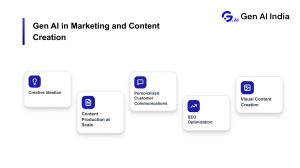
Content Production at Scale: Generate blog posts, social media content, email campaigns, and product descriptions in a fraction of the time. Marketing teams report producing 5-10x more content variations for A/B testing.
Personalized Customer Communications: Create individualized email sequences, product recommendations, and messaging that adapt to customer behavior, demographics, and preferences automatically.
Creative Ideation: Generate campaign concepts, taglines, visual mockups, and creative variations that human teams can refine, accelerating the creative process from weeks to days.
SEO Optimization: Produce keyword-optimized content, meta descriptions, and structured data while maintaining quality and brand voice.
Visual Content Creation: Design social media graphics, advertising imagery, product visualizations, and marketing materials without extensive design resources.
Gen AI in Customer Service and Support
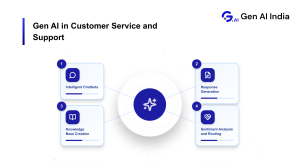
Intelligent Chatbots: Deploy conversational AI that handles routine inquiries, troubleshoots problems, and escalates complex issues to humans, operating 24/7 across multiple languages.
Response Generation: Assist support agents with suggested responses, reducing handle time by 30-50% while maintaining quality and consistency.
Knowledge Base Creation: Automatically generate and update help documentation, FAQs, and training materials based on customer interactions and product changes.
Sentiment Analysis and Routing: Analyze customer communications to detect emotion, urgency, and intent, routing conversations appropriately and alerting managers to developing issues.
Gen AI in Software Development
Code Generation: Accelerate development by generating boilerplate code. Also create test cases and implement standard functions. This lets developers to focus on complex logic and architecture.
Code Documentation: Automatically generate comments, API documentation, and technical specifications from existing code, improving maintainability.
Bug Detection and Fixing: Identify potential issues, suggest fixes, and even implement solutions for common bugs and security vulnerabilities.
Legacy Code Modernization: Assist in translating old codebases to modern languages or frameworks. It lowers technical debt.
Gen AI in Data Analysis and Business Intelligence
Report Generation: Transform raw data into narrative reports, executive summaries, and data-driven insights without manual analysis.
Data Visualization: Generate appropriate charts, graphs, and dashboards based on datasets and business questions.
Predictive Modeling: Create forecasts, scenario analyses, and trend predictions from historical data.
SQL and Query Generation: Convert natural language questions into database queries, democratizing data access for non-technical users.
Gen AI in Product Development
Rapid Prototyping: Generate product concepts, user interface mockups, and feature specifications quickly for faster iteration.
User Research Synthesis: Analyze customer feedback, reviews, and research data to identify patterns and opportunities.
Requirements Documentation: Create user stories, technical specifications, and acceptance criteria from high-level product ideas.
Design Variations: Generate multiple design alternatives for products, packaging, or user experiences for testing.
Gen AI in Human Resources
Job Description Creation: Generate compelling, inclusive job postings optimized for different platforms and candidate pools.
Candidate Screening: Analyze resumes, create screening questions, and generate interview guides tailored to specific roles.
Onboarding Materials: Produce personalized training content, documentation, and welcome materials for new employees.
Performance Review Assistance: Help managers structure feedback, identify development opportunities, and document performance conversations.
Gen AI in Sales and Revenue Operations
Proposal Generation: Create customized proposals and pitch decks tailored to specific prospects.
Lead Qualification: Analyze prospect data to score leads and personalize outreach.
Sales Email Sequences: Generate personalized cold outreach, follow-ups, and nurture campaigns at scale.
Competitive Analysis: Synthesize competitor intelligence from multiple sources into actionable insights.
Gen AI in Legal and Compliance
Contract Review: Analyze agreements for risks, unusual terms, and compliance issues at a fraction of traditional review costs.
Document Drafting: Generate standard contracts, NDAs, employment agreements, and other legal documents from templates and specific requirements.
Regulatory Research: Quickly find relevant regulations, precedents, and compliance requirements across jurisdictions.
Discovery Assistance: Analyze large document sets for eDiscovery, identifying relevant materials faster than manual review.
Gen AI in Finance and Accounting
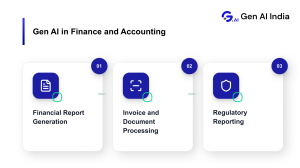
Financial Report Generation: Create management reports, variance analyses, and financial summaries from raw accounting data.
Invoice and Document Processing: Extract data from receipts, invoices, and financial documents automatically.
Risk Analysis: Generate risk assessments, scenario planning, and financial projections.
Regulatory Reporting: Assist in creating compliance reports and filings with required formats and disclosures.
The common thread across successful use cases: generative AI handles time-consuming, repetitive, or scalable tasks while humans provide strategy, judgment, and final oversight.
11 Generative AI Applications and Examples
Real-world examples bring abstract capabilities into focus. Here’s how leading organizations are deploying generative AI for tangible business outcomes. Plus, if you also want to make the best of this tech, generative AI consulting is a perfect start.
1. Enterprise Productivity: Microsoft and GitHub
Microsoft embedded generative AI across its product suite with Copilot. This move has fundamentally changed how millions work daily.
In Outlook, it drafts emails and summarizes long threads. In Teams, it captures meeting notes and action items. In Excel, it analyzes data and creates formulas from natural language.
GitHub Copilot, deployed to over a million developers, demonstrates measurable impact: developers complete tasks 55% faster according to GitHub’s research.
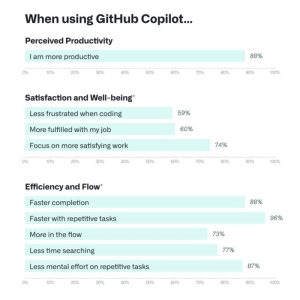
The tool suggests entire functions, catches potential bugs, and assists with documentation.
2. Content Personalization: Spotify
Spotify uses generative AI to create personalized playlist descriptions, podcast recommendations, and user-specific marketing content at a scale impossible manually. With hundreds of millions of users, traditional personalization would require an army of content creators.
Their AI-powered DJ feature goes further. It generates personalized audio introductions and explanations for song selections, creating a customized radio experience for each listener.
Business Impact: Increased user engagement, longer listening sessions, and improved retention through ultra-personalized experiences.
3. Customer Service: Klarna
Financial technology company Klarna deployed generative AI for customer service, handling two-thirds of customer conversations. The AI assistant manages 2.3 million conversations monthly. This is equivalent to 700 full-time agents.
The implementation reduced average resolution time from 11 minutes to under 2 minutes while operating in 23 markets and 35 languages simultaneously.
Business Impact: $40 million in annual savings, faster customer resolution, 24/7 availability, and freed human agents for complex, high-value interactions.
4. Creative Production: Coca-Cola
Coca-Cola partnered with OpenAI to create personalized marketing campaigns and product innovation. They used DALL-E and ChatGPT to generate advertising creative, product concepts, and consumer-facing content.
Their “Create Real Magic” campaign invited consumers to create Coca-Cola artwork using generative AI. They produced over 120,000 unique pieces.

Business Impact: Reduced creative production costs, faster campaign iteration, and novel consumer engagement opportunities.
5. Drug Discovery:Insilico Medicine
Pharmaceutical company Insilico Medicine uses generative AI to design new drug candidates, drastically compressing timelines for drug discovery. Their AI generated a novel drug for idiopathic pulmonary fibrosis in under 18 months. This process traditionally takes 4-5 years.
The AI proposes molecular structures with desired properties, predicts their effectiveness, and optimizes for manufacturability and safety.
6. Legal Services: Allen & Overy and Harvey AI
Global law firm Allen & Overy deployed Harvey AI across 3,500 lawyers to assist with contract analysis, legal research, and document drafting. The tool helps lawyers find relevant case law, identify risks in agreements, and draft standard legal documents.
Associates report saving 4-6 hours weekly on routine research and document review, redirecting that time to complex legal strategy and client relationships.
7. E-commerce: Amazon and Product Listings
Amazon uses generative AI to create and optimize product listings, generating descriptions, titles, and bullet points that improve discoverability and conversion. Sellers provide basic product information, and AI generates compelling, SEO-optimized content.
For sellers managing hundreds or thousands of products, this transforms a week-long process into minutes, while improving consistency and quality.
Business Impact: Increased seller productivity, better customer experience through clearer product information, and improved search relevance.
8. Education: Khan Academy and Khanmigo
Khan Academy developed Khanmigo, an AI-powered tutor that provides personalized instruction, answers questions, and guides students through problems without simply giving answers. The AI adapts to each student’s learning pace and style.
For teachers, it generates lesson plans, creates quiz questions, and provides administrative assistance, addressing the time constraints that limit personalized attention in classrooms.
Business Impact: Scalable personalized learning, teacher productivity gains, and improved educational outcomes through adaptive instruction.
9. Design and Architecture: Autodesk
Autodesk integrated generative design into its architecture and engineering software. This help designers to input constraints (space requirements, materials, costs, structural loads) and receive optimized design alternatives.
The AI generates hundreds of options that human designers might never consider. It explores design spaces beyond human intuition while respecting engineering and budget constraints.
10. Financial Services: Bloomberg GPT
Bloomberg trained a large language model specifically on financial data – news, analyst reports, market data, and regulatory filings. Bloomberg GPT assists financial professionals with research, analysis, and decision support.
It can analyze market sentiment, summarize earnings calls, identify emerging trends, and answer complex financial questions drawing from Bloomberg’s vast proprietary datasets.
Business Impact: Faster investment research, improved analyst productivity, and enhanced decision-making through rapid synthesis of complex financial information.
11. Internal Knowledge Management: Notion AI
Notion AI helps organizations manage institutional knowledge by summarizing meeting notes, extracting action items, answering questions from company wikis, and generating status updates from project databases.
For distributed teams, it acts as an always-available knowledge assistant, reducing the time spent searching for information and keeping everyone aligned.
Top Generative AI Models as Per 2026
This is another important section of our blog. The right knowledge of generative AI models helps you choose the right foundation for their applications.
Large Language Models (LLMs)
GPT-5(OpenAI): The most capable publicly available language model, GPT-5.x demonstrates strong reasoning, creativity, and knowledge across domains.
The Turbo variant offers faster response times at lower cost, while GPT-4o (optimized) provides multimodal capabilities processing text, images, and audio.
Claude (Anthropic): Known for nuanced understanding and reduced hallucination rates, Claude excels at complex analysis and instruction-following.
Claude 4.x represents the high-capability tier, while Sonnet balances performance and cost, and Haiku offers fast, economical processing for simpler tasks.
Gemini (Google): Google’s latest generation model features massive context windows (processing up to a million tokens), strong multimodal capabilities, and deep integration with Google’s ecosystem.
Gemini 3 pro represents maximum capability, Pro balances performance and efficiency, and Nano runs on-device for mobile applications.
LLaMA (Meta): An open-source model family that organizations can run on their own infrastructure, offering customization and data privacy. While requiring more technical expertise, it provides full control and cost predictability.
Mistral AI: European open-source models offering strong performance with lower computational requirements, appealing to organizations with infrastructure constraints or regulatory considerations around data sovereignty.
Image Generation Models
DALL-E 3 (OpenAI): Integrated with ChatGPT, DALL-E 3 creates detailed images from text descriptions with improved instruction-following and fewer artifacts than previous versions.
Midjourney: Particularly strong at artistic and stylized imagery, Midjourney v6 produces photorealistic results and handles complex prompts effectively, though it operates primarily through Discord rather than standard APIs.
Stable Diffusion: Open-source with versions optimized for different use cases (speed, quality, specific content types). Organizations can fine-tune it on proprietary image datasets for brand-specific generation.
Adobe Firefly: Trained on Adobe Stock and public domain content, ensuring commercial safety. Deeply integrated with Adobe Creative Cloud, making it practical for professional creative workflows.
Code Generation Models
Codex (OpenAI): Powers GitHub Copilot, specialized for code completion and generation across dozens of programming languages.
CodeLlama (Meta): Open-source code generation model built on LLaMA, offering capabilities for code completion, debugging, and explanation without commercial licensing restrictions.
StarCoder: Open-source code model trained on permissively licensed code from GitHub, designed for transparency and avoiding license complications.
Multimodal Models
GPT-4V (Vision): Extends GPT-4 with image understanding, enabling applications that combine visual and textual analysis from medical image interpretation to retail product analysis.
Gemini Pro Vision: Google’s multimodal offering processes images, video, and audio alongside text, enabling comprehensive content understanding and generation.
Claude 3 Models: All Claude 3 variants (Opus, Sonnet, Haiku) include vision capabilities, processing images alongside text for integrated analysis.
Specialized and Domain-Specific Models
Med-PaLM (Google): Medical domain-specific model achieving expert-level performance on medical licensing exam questions, designed for healthcare applications with appropriate guardrails.
BloombergGPT: Financial domain model trained on extensive financial data, optimized for market analysis, financial document understanding, and industry-specific tasks.
LegalBERT: Legal domain model fine-tuned on legal texts, contracts, and case law for specialized legal applications.
BioGPT: Trained on biomedical literature for pharmaceutical research, drug discovery, and medical research applications.
Embedding and Retrieval Models
While not generative in the traditional sense, embedding models are crucial for retrieval-augmented generation (RAG):
OpenAI Embeddings: Convert text into numerical representations for semantic search and retrieval, enabling systems to find relevant information from company knowledge bases.
Cohere Embed: High-quality embeddings optimized for enterprise search and retrieval applications.
Sentence Transformers: Open-source embedding models offering flexibility and cost control for organizations building proprietary search systems.
Model Selection Considerations
Performance vs. Cost: Larger models (GPT-4, Claude Opus, Gemini Ultra) deliver superior quality but cost 10-50x more than smaller alternatives. Many applications work well with mid-tier models (GPT-3.5, Claude Haiku, Gemini Pro).
Latency Requirements: Real-time applications need fast response times. Smaller models or optimized variants respond in milliseconds versus seconds for larger models.
Context Window Size: Tasks involving long documents require models with large context windows (Claude 3 handles 200,000 tokens, Gemini 1.5 reaches 1 million tokens, while GPT-4 manages 128,000 tokens).
Privacy and Data Residency: Regulations may require data to stay in specific geographic regions or prevent cloud processing entirely, favoring open-source models you can host locally.
Customization Needs: Fine-tuning capabilities vary. Open models (LLaMA, Stable Diffusion) offer maximum flexibility, while commercial APIs limit customization to prompt engineering and retrieval augmentation.
Multimodal Requirements: If your application processes images, audio, or video alongside text, multimodal models are essential rather than chaining separate specialized models.
Licensing and Commercial Use: Open-source licenses vary. Some allow unrestricted commercial use while others impose restrictions. Commercial APIs include licensing in their pricing but may have usage restrictions.
The Evolution of Model Capabilities
Generative AI models improve rapidly. GPT-4 was considered cutting-edge in March 2023; by late 2024, multiple comparable or superior models existed. This pace of advancement has important implications:
Avoid Over-Customization: Today’s custom fine-tuning may become obsolete when next-generation base models exceed your specialized model’s capabilities.
Build Flexible Architectures: Design systems that can swap underlying models as better options emerge without rebuilding entire applications.
Focus on Data and Process: Your proprietary data, processes, and domain expertise create more durable competitive advantages than model selection alone.
Plan for Capability Growth: Applications that seem impossible today may become trivial next year. Design roadmaps with this acceleration in mind.
Moving Forward with Generative AI
Generative AI represents a fundamental shift in how businesses operate. The question isn’t whether to adopt generative AI, but how to do so strategically and effectively.
Key Takeaways for Business Leaders
Start with Business Problems:
The most successful implementations begin with clear business challenges. Then apply generative AI as a solution.
Embrace Experimentation:
Unlike traditional IT projects requiring extensive upfront planning, generative AI favors rapid experimentation. Start small, measure results, iterate quickly, and scale what works.
Invest in Data and Infrastructure:
Model capabilities improve constantly. But your data and systems provide enduring competitive advantage. Quality data pipelines, robust evaluation frameworks, and integration architecture matter more than choosing the perfect model today.
Build AI Literacy Organization-Wide:
The companies seeing the greatest returns don’t limit AI to technical teams. They educate employees across functions, encouraging responsible exploration and frontline innovation.
Establish Governance Early:
Implement guidelines around data privacy, quality standards, human oversight, and ethical use before problems emerge. Strong governance enables faster, more confident scaling.
Measure Rigorously:
Track both quantitative metrics (time saved, costs reduced, revenue increased) and qualitative outcomes (employee satisfaction, customer experience, innovation quality). Generative AI’s impact often extends beyond traditional ROI calculations.
Prepare for Change Management:
Technology implementation is straightforward compared to organizational adaptation. Allocate resources for training, process redesign, and cultural transformation.
The organizations that thrive in the generative AI era won’t necessarily be those with the largest AI budgets or the most sophisticated models. They’ll be the ones that thoughtfully do generative AI integration into their strategic vision, empower their teams to leverage these capabilities, and maintain focus on creating genuine value for customers and stakeholders.
FAQs
1. What’s the difference between generative AI and traditional AI?
Traditional AI analyzes, classifies, or predicts based on existing data. It can recognize a face in a photo, forecast sales, or detect fraud. Generative AI creates entirely new content in form of text, images, code, designs.
2. How do I know if my company’s data is safe when using generative AI tools?
Data security depends entirely on which tools you choose and how you configure them. Consumer tools like free ChatGPT may use your inputs for model training unless you opt out. Enterprise versions offer stronger guarantees and compliance with regulations like GDPR and SOC 2. For highly sensitive data, you have options: use enterprise agreements with strict data handling provisions, deploy open-source models on your own infrastructure, or implement on-premises solutions where data never leaves your servers.
3. How quickly is generative AI technology changing, and will my investment become obsolete?
Generative AI is evolving at an unprecedented pace. Models that seemed cutting-edge six months ago are now considered standard. This creates both opportunity and risk. The good news: capabilities improve constantly, often at no additional cost if you’re using API-based services. New models frequently offer better performance at lower prices. Our recommendation is to build flexible architectures that can swap underlying models as technology improves.