
Generative AI in FinTech: How Intelligent Innovation Is Transforming Financial Services?
Generative AI is reshaping FinTech by enabling smarter decision-making, hyper-personalized customer experiences, advanced fraud prevention, and faster product innovation. From intelligent lending and portfolio management to compliance automation and predictive analytics, Gen AI has become a strategic imperative for modern financial services. Enables real-time, data-driven decisions across investment operations Delivers hyper-personalized customer journeys with intelligent insights Accelerates innovation while strengthening compliance and operational efficiency
The FinTech industry is undergoing one of its most significant transformations in decades, driven by the rapid rise of Gen AI. What began as experimental automation has now evolved into a strategic capability reshaping how financial institutions design products, engage customers, manage risk, and scale operations. Generative AI in FinTech is a competitive necessity.
As financial ecosystems grow complex and user expectations continue to rise. You can get a Generative AI development company for AI integration services to help you overcome any challenges. Gen AI offers FinTech leaders a powerful way to unlock productivity, personalization, and profitability. Let’s explore what all this smart technology offers to enterprises and users.
Table of Contents
Generative AI in the FinTech Market: Scope and Outlook
Generative AI is finding widespread adoption across nearly every FinTech sub-sector. It includes digital banking, payments, lending, wealth management, insurance, and regulatory technology. Plus, it helps to simulate outcomes, identify patterns, and automate decision-making.
The market trajectory clearly reflects this momentum. The Generative AI in the FinTech market is projected to reach USD 9.87 billion by 2030, growing at a CAGR of 36.1%.
These organizations are not adopting Generative AI in fintech for experimentation. Instead, they invest to improve productivity, strengthen compliance, and deliver user experiences.
Why Is Generative AI a Strategic Imperative for FinTech?
The FinTech industry has undergone a rapid transformation to digital-first personalized experiences. AI is helping FinTech firms modernize operations, enhance customer engagement, and improve financial accuracy.
Generative AI in fintech empowers firms to process massive volumes of behavioral data in real time. It enables automated workflows, predictive insights, and intelligent decision-making. It is across lending, payments, wealth management, insurance, and compliance. So, financial services become more efficient, responsive, and customer-centric.
Generative AI builds on this foundation with creativity and adaptability to financial systems. FinTech platforms can generate insights that align with individual user needs and dynamic markets.
Core Applications of Generative AI Across FinTech Operations
Here are the real-time applications of Gen AI in the fintech industry.
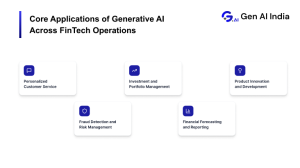
Personalized Customer Service
Traditional rule-based chatbots are being replaced by GenAI-powered virtual assistants, as per sentiments. These systems engage users through conversational interactions that feel intuitive and human-like.
Generative AI enables proactive financial engagement, alerting users about payments, suggesting optimizations, or offering tailored financial advice. With 24/7 availability, these intelligent assistants provide uninterrupted support while reducing customer service costs.
Fraud Detection and Risk Management
As financial fraud becomes sophisticated, Generative AI offers a powerful defense mechanism. By generating realistic financial data, firms can train fraud detection models on a broader range of scenarios. Or hire Generative AI engineers for easy fraud detection and risk management.
Gen AI systems evolve, learning from new transaction behaviors to identify anomalies. They also support advanced scenario modeling to simulate economic stress events to enable proactive risk mitigation.
Investment and Portfolio Management
Generative AI in fintech plays a growing role in investment strategy and wealth management. GenAI can refine algorithmic trading strategies and identify opportunities faster than traditional systems.
For investors, AI-driven robo-advisors use Gen AI to build and manage personalized portfolios. These systems rebalance assets as per market fluctuations, helping maximize returns while controlling risk exposure.
Financial Forecasting and Reporting
Financial forecasting becomes more accurate and actionable with Generative AI. Advanced models uncover hidden correlations within historical and real-time data. It helps to deliver deeper insights into revenue trends, liquidity risks, and growth opportunities.
Generative AI also automates financial reporting by converting structured data into clear narratives using NLP. It reduces manual effort, minimizes errors, and ensures stakeholders receive data-backed insights.
Product Innovation and Development
Generative AI in FinTech firms to innovate faster and with greater confidence. Organizations can test product ideas in virtual environments before investing in full-scale development.
AI-assisted ideation tools help teams explore new features, services, and business models via traditional brainstorming. Additionally, GenAI supports the creation of hyper-personalized financial products.
Key Business Benefits of Generative AI in FinTech Enterprises
Here are the key benefits of using Generative AI integration services in FinTech firms.
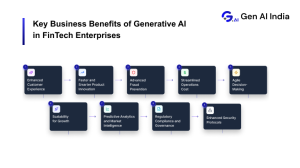
Enhanced Customer Experience
Generative AI enables hyper-personalized financial interactions by analyzing user behavior. From tailored advice to intelligent chatbots, Gen AI improves accessibility and customer satisfaction.
Faster and Smarter Product Innovation
By simulating scenarios and generating prototypes in controlled environments. Gen AI accelerates product development cycles. FinTech firms can test ideas, predict customer responses, and refine offerings. Also, it allows them to stay ahead of market shifts and regulatory changes.
Advanced Fraud Prevention
Generative AI excels at analyzing massive datasets, suspicious transactions, and emerging risks. This proactive approach strengthens fraud prevention, minimizes financial losses, and protects institutional reputation.
Streamlined Operations Cost
Automating repetitive tasks like data entry, compliance checks, and reporting reduces operational overheads. Generative AI in fintech drives efficiency, allowing FinTech firms to scale operations to maintain cost and service quality.
Agile Decision-Making
With deep insights into market trends, customer behavior, and financial forecasts. Generative AI empowers leadership teams to make data-driven decisions with strategic objectives.
Scalability for Growth
Gen AI solutions are inherently scalable for FinTech firms to handle increasing transaction volumes. Without compromising performance, the essential capability for fast-growing digital platforms.
Predictive Analytics and Market Intelligence
With real-time data, Gen AI forecasts user behavior, market movements, and demand patterns. It helps FinTech companies optimize resource allocation and personalize engagement strategies.
Regulatory Compliance and Governance
Generative AI in fintech simplifies compliance by automating reporting, monitoring policy changes, and audit-ready documentation. So, it reduces regulatory risk and ensures ongoing adherence.
Enhanced Security Protocols
Gen AI strengthens cybersecurity through anomaly detection, real-time threat monitoring, and adaptive learning. These capabilities ensure the continuous protection of sensitive financial data and reinforce customer confidence.
Top Use Cases of Generative AI in FinTech
Below are the most impactful ways Generative AI is transforming FinTech today.
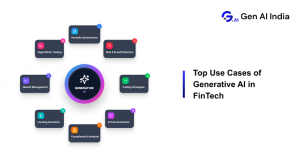
Portfolio Optimization and Asset Management
Investment performance depends on balancing risk, diversification, and timing. Generative AI enhances portfolio management by learning from historical data, real-time market signals, and macroeconomic indicators.
It enables smarter diversification by evaluating thousands of asset combinations. And recommending optimal allocations aligned with risk appetite and financial goals.
Risk Assessment and Fraud Detection
Financial crime is evolving rapidly, and static rule-based systems are no longer sufficient. Generative AI introduces adaptive risk intelligence capable of identifying threats.
By analyzing massive transaction datasets, it detects subtle behavioral anomalies that signal fraud. These models evolve, learning from new attack patterns to improve detection accuracy.
GenAI in fintech enables advanced modeling of credit, market, and operational risks. Institutions can also automate compliance workflows and monitor transactions in real time.
Trading Strategies and Prediction
Speed and insight are decisive advantages in modern trading environments. Generative AI in fintech empowers traders with deeper market intelligence and faster execution.
By combining structured market data with unstructured sources like news feeds and social sentiment. GenAI identifies trends and generates predictive trading signals. Pattern recognition capabilities uncover opportunities that traditional analytics often miss.
Intelligent Virtual Assistants
Customer expectations in FinTech demand instant, personalized, and always-available support. Generative AI is redefining customer service through intelligent chatbots and virtual assistants.
These AI-powered systems engage users in natural conversations, assist transactions, and provide contextual guidance. By learning from user interactions, they improve response accuracy.
Regulatory Compliance and Data Analysis
Navigating regulatory complexity is one of the biggest challenges for financial institutions. Generative AI simplifies compliance by automating monitoring, reporting, and documentation.
AI systems can scan transactions for suspicious behavior and compliance risks, and generate audit-ready reports. This reduces manual workloads while minimizing compliance gaps.
Intelligent Lending Decisions
Traditional credit scoring models rely on limited data, often excluding deserving borrowers. Generative AI introduces a more inclusive and accurate approach to credit evaluation.
By analyzing alternative data sources. Such as transaction history, behavioral signals, and real-time financial activity. It leads to fairer lending decisions, reduced default rates, and expanded access to credit.
Personalized Wealth Management
Personalization has become a defining factor in financial services. Generative AI in fintech enables institutions to deliver highly customized financial guidance.
AI-driven systems analyze individual goals, risk tolerance, and market conditions for tailored investment strategies. Wealth managers enhance advisory quality while strengthening long-term client relationships.
Algorithmic Trading
Automation supports financial operations, and Generative AI elevates it through intelligent decision-making.
AI-powered trading systems execute strategies with speed and precision, processing vast datasets. These systems adapt continuously, learning from outcomes to refine future decisions.
Key Challenges in Adopting Generative AI in FinTech
Here are the loopholes faced in Gen AI & fintech integration.
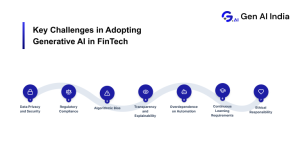
Data Privacy and Security
Financial data is highly sensitive. Robust encryption, secure architectures, and strict data governance. So, these are essential to prevent breaches and maintain customer trust.
Regulatory Compliance
FinTech organizations must ensure AI systems align with evolving regulations. Compliance is built into AI workflows from the outset to avoid legal and reputational risks.
Algorithmic Bias
AI models can inherit biases from historical data. Continuous monitoring, training datasets, and ethical AI frameworks ensure customer interactions.
Transparency and Explainability
Complex AI models often function as black boxes. Financial institutions must invest in explainable AI to satisfy regulators and build confidence in AI-driven decisions.
Overdependence on Automation
While AI enhances efficiency, human oversight remains critical. Strategic decisions should balance machine intelligence with expert judgment.
Continuous Learning Requirements
Markets evolve rapidly. Generative AI in fintech is regularly updated to remain accurate.
Ethical Responsibility
Fairness, accountability, and transparency are non-negotiable in finance. Ethical AI practices are essential to sustain long-term adoption and public trust.
Best Practices for Implementing Generative AI in FinTech Successfully
To maximize value while maintaining compliance, FinTech firms should follow a structured approach:
- Data Quality Assurance – Train Gen AI models on clean and relevant data to ensure reliable outputs.
- Ethical AI Governance – Address bias, privacy, and transparency to promote fairness and user trust.
- Continuous Upskilling – Invest in training teams to keep pace with evolving AI capabilities.
- Regulatory Compliance – Align Gen AI initiatives with financial regulations to avoid legal and reputational risks.
The Future of Generative AI in FinTech: What Lies Ahead?
Generative AI is shaping a future where financial services become more adaptive and personalized.
- Hyper-Personalized Financial Services will dynamically adjust offerings based on life events and behavior.
- Productivity Gains could add trillions of dollars to the global economy. According to McKinsey, up to 75% of value is concentrated in customer operations, sales, engineering, and R&D.
- Smarter Risk and Compliance systems will detect threats more accurately than traditional models. With 80% of credit risk organizations are expected to adopt Gen AI cwithin a year.
Want customized Generative AI journey in FinTech operations?
Conclusion:
Generative AI in FinTech represents a decisive shift toward intelligent and user-centric financial services. Organizations that align technology with business strategy will define the future of finance. Those delays risk being left behind in an industry where intelligence, speed, and personalization are the new benchmarks of success.
FAQs
1. How does Generative AI create measurable business value for FinTech companies?
Generative AI drives business value by reducing operational costs, improving decision accuracy, and accelerating time-to-market. It automates high-volume processes like onboarding, compliance checks, fraud monitoring, and reporting while enabling personalized customer experiences that improve retention and lifetime value.
2. Is Generative AI secure and compliant enough for financial services?
Yes, when implemented correctly. Enterprise-grade Generative AI solutions are designed with encrypted data pipelines, access controls, audit logs, and compliance-ready architectures.
3. Which FinTech functions benefit the most from Generative AI adoption?
Generative AI delivers the highest impact in customer support, fraud detection, credit risk assessment, financial reporting, portfolio management, and regulatory compliance.
4. How does Generative AI improve customer experience in FinTech platforms?
Generative AI enables hyper-personalized interactions by analyzing customer behavior, financial history, and preferences in real time. It powers intelligent chatbots, personalized financial advice, proactive alerts, and tailored product recommendations.
5. What should FinTech leaders consider before investing in Generative AI?
Business leaders should evaluate data readiness, regulatory impact, security frameworks, and ROI alignment. A successful GenAI strategy requires high-quality data, ethical AI practices, continuous monitoring, and integration with existing systems to ensure scalability, compliance, and long-term business growth.