Should Your Business Fine-Tune an LLM or Use RAG With Enterprise Data?
- RAG connects your LLM to live or frequently updated enterprise data without retraining, making it the faster and less expensive path to production.
- LLM fine-tuning embeds behavioral and stylistic changes directly into model weights, producing consistency that retrieval alone cannot replicate.
- Data volatility, output consistency requirements, compliance needs, and total cost of ownership are the four variables that determine which approach your use case requires.
- Fine-tuning requires substantial labeled training data; RAG requires a clean, well-structured, and continuously maintained document or knowledge store.
- Enterprises that start with RAG and layer fine-tuning onto high-volume workflows typically achieve better cost efficiency than implementing both approaches simultaneously from day one.
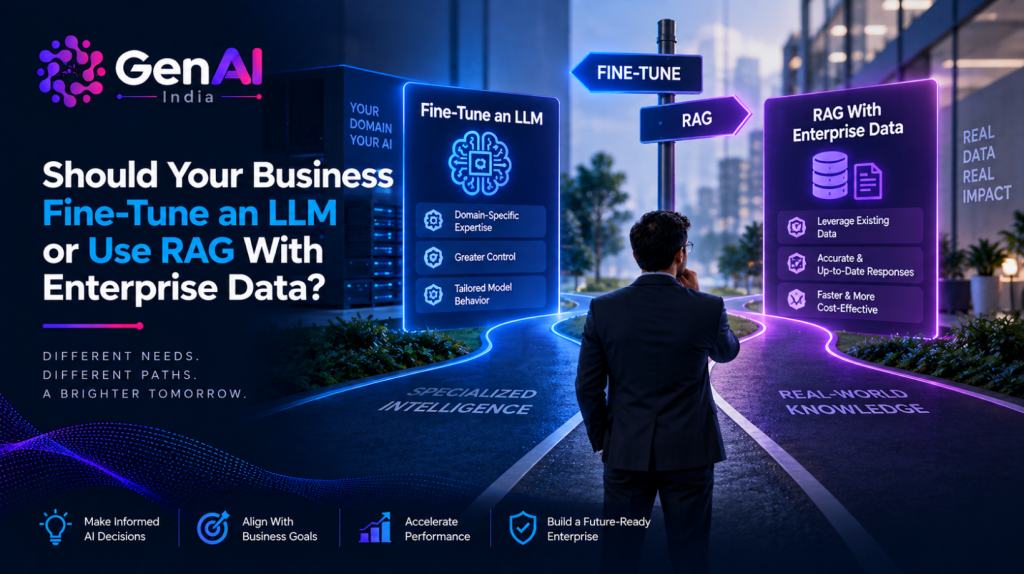
RAG (retrieval-augmented generation) is the right starting point for most enterprises: it connects your LLM to existing internal data without retraining, keeps responses grounded in current information, and costs significantly less upfront. Fine-tuning an LLM makes sense when you need durable behavioral change, such as enforcing domain-specific terminology, a consistent output format that retrieval alone cannot produce.
Most enterprise AI systems that perform at scale use both in a layered architecture, starting with RAG for fast deployment and adding fine-tuning where output consistency justifies the training investment.
Table of Contents
Is fine-tuning overkill when you can just connect your documents to a model with RAG?
RAG retrieves relevant content from a vector database or document to store at query time and injects it into the model’s context window before generating a response. The base model weights remain unchanged; output quality depends on retrieval of quality.
Fine-tuning LLM models, by contrast, modifies the weights themselves through supervised training on a domain-specific dataset, embedding new terminology, format conventions, and reasoning patterns that apply uniformly to every subsequent output regardless of what is retrieved.
How Should You Decide Which Approach Your Enterprise Needs?
“What is better for enterprise AI: RAG or fine-tuning an LLM?”
According to MarketsandMarkets, the global retrieval-augmented generation market is estimated at $1.94 billion in 2025 and is projected to reach $9.86 billion by 2030, growing at a CAGR of 38.4%. That growth rate reflects how quickly enterprises are adopting RAG as a primary AI data strategy, but investment in fine-tuning LLM capabilities for specialized domains is accelerating alongside it.
The most reliable decision framework evaluates four variables in sequence: how often your data changes, how consistent your output needs to be, what your compliance requirements are for source attribution, and what your available budget is for implementation and ongoing operation. Most enterprises that approach RAG vs fine-tuning as a one-time technical decision, rather than an ongoing architectural question, end up rebuilding their AI infrastructure within 18 months as data volumes and use case complexity grow.
- If your enterprise data changes weekly or more frequently, RAG is the correct primary approach since it retrieves from an updated source without any retraining cost.
- If AI outputs must consistently follow a specific format, domain vocabulary, or regulatory tone, fine-tuning is the most reliable mechanism for achieving that consistency.
- If your use case requires regulators or auditors to trace every AI-generated answer to a specific source document, RAG provides natural citation support that fine-tuned models alone cannot.
What Are the Cost Differences Between RAG and Fine-Tuning an LLM?
Upfront investment for fine-tuning a mid-sized LLM typically ranges from $30,000 to $150,000 depending on dataset size, compute requirements, and training iterations needed to reach acceptable performance.
A detailed breakdown of the cost of building a RAG-based enterprise AI application shows that basic RAG production systems start in the $40,000 to $100,000 range and scale with data complexity, but their primary ongoing costs are vector database maintenance, embedding refresh cycles, and retrieval infrastructure rather than retraining.
Which Business Scenarios Call for RAG vs Fine-Tuning?
The practical decision usually comes down to whether your enterprise needs dynamic, data-grounded responses or consistent, behaviorally stable outputs. Both are legitimate requirements in enterprise AI, and understanding your generative AI development cost before committing to either architecture prevents the most common budget overruns in enterprise AI projects.
Enterprises deploying AI for regulated industries such as healthcare, legal, or financial services typically benefit most from professional AI model fine-tuning services where domain-specific training data, compliance requirements, and output validation are managed as part of the engagement.
Should You Combine RAG and Fine-Tuning in One Architecture?
Yes, in most mature enterprise AI deployments. The hybrid approach uses fine-tuning to embed stable behavioral changes into the model and RAG to supply current, retrievable data at inference time. A generative AI model development engagement that designs both from the start is more cost-effective than retrofitting one onto the other after deployment.
- Fine-tuning for output format, domain vocabulary, and reasoning style; layer RAG to handle dynamic data that changes between model updates.
- A fine-tuned model running over a RAG pipeline reduces hallucinations while maintaining the style and format consistency that retrieval alone cannot provide.
- The hybrid architecture works best when query volume is high enough to justify the fine-tuning investment and data changes frequently enough to require live retrieval.
- Enterprises in regulated industries often find that a fine-tuned model over a RAG pipeline satisfies both the consistency demands of internal stakeholders and the auditability demands of compliance teams.
The Bottom Line
RAG and fine-tuning LLM models solve different problems, and treating the choice as binary causes most enterprises to underperform both. The practical path is to start with RAG for rapid deployment and data-grounded responses, then add fine-tuning where output consistency, domain specialization, or inference cost reduction justifies the training investment.
Whether you manage RAG vs fine-tuning decisions in-house or through a specialist team, the enterprises that extract the most value from their AI infrastructure are those that treat these two approaches as complementary layers in a deliberate architecture rather than competing alternatives to evaluate once and implement in isolation.
FAQs
1. What is the main difference between RAG and LLM fine-tuning for enterprise use cases?
RAG retrieves relevant content from external data at query time without modifying the model; fine-tuning LLM models modifies the model weights through additional training. RAG keeps responses current and citable; fine-tuning produces consistent behavioral changes that persist across every output regardless of the data retrieved.
2. When does fine-tuning an LLM make more sense than using RAG?
Fine-tuning makes sense when your enterprise requires outputs that consistently follow a specific format, domain vocabulary, or regulatory tone that cannot be reliably enforced through prompting or retrieval. It is also appropriate when inference latency or cost at high query volumes makes a smaller, specialized model more practical than a large general-purpose model with a long context window.
3. How much does LLM fine-tuning cost compared to a RAG implementation?
AI model fine-tuning for a mid-sized LLM typically costs $30,000 to $150,000 upfront including dataset preparation and training compute, with lower ongoing inference costs. A basic RAG system typically costs $40,000 to $100,000 to build but carries higher ongoing infrastructure costs for vector database maintenance and embedding refresh. Total cost over two years often favors fine-tuning for high-volume, stable use cases and RAG for lower-volume or frequently changing data.
4. Can RAG and fine-tuning be used together in the same enterprise AI system?
Yes, and this is the recommended architecture for most production enterprise deployments. Fine-tuning handles behavioral consistency, domain adaptation, and output formatting, while RAG handles dynamic data retrieval and source attribution. The two approaches are complementary rather than competing, and the strongest enterprise AI systems typically use both.