How Much Does It Cost to Build a RAG-Based Enterprise AI Application?
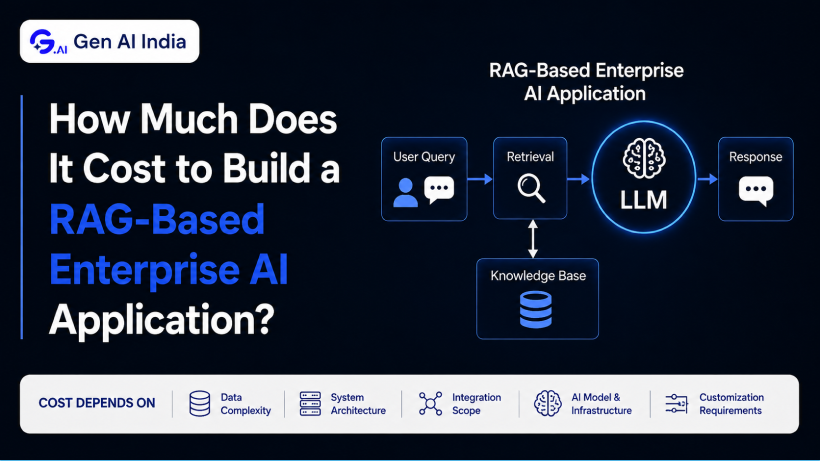
- Enterprise RAG development can cost $40,000 to $500,000+, depending on the application’s complexity, data, integrations, and security requirements.
- Data quality matters as much as the AI model. Clean, structured, and accessible enterprise data can reduce development complexity.
- Enterprise integrations increase costs. Connecting RAG with CRMs, ERPs, databases, and document systems requires additional development.
- Security cannot be an afterthought. Permission-aware retrieval, authentication, encryption, and data isolation are essential for enterprise AI applications.
- RAG does not always require a custom AI model. Existing LLMs can often deliver strong results when combined with the right retrieval architecture.
Building a RAG-based enterprise AI application can cost roughly $40,000 to $500,000+, while highly customized or agentic enterprise implementations can cross $1 million. The final budget depends on the size and quality of your enterprise data, number of data sources, retrieval architecture, AI model, integrations, security requirements, user volume, and ongoing infrastructure.
A simple internal knowledge assistant may sit toward the lower end of the range. A production-grade enterprise AI platform connected to CRM, ERP, document repositories, databases, identity systems, and business workflows can require a much larger investment. And future-ready Gen AI development services can help you integrate it smoothly.
A RAG application makes this possible by allowing an AI model to retrieve relevant information from a company’s private knowledge base before generating a response. Instead of expecting the model to know everything, the application gives it access to the information it needs at the moment a user asks a question.
Table of Contents
What Is a RAG-Based Enterprise AI Application?
Retrieval-Augmented Generation (RAG) is an AI architecture that combines information retrieval with generative AI. Instead of asking a large language model to answer a question entirely from what it learned during training, a RAG system first searches relevant business information and then provides that context to the model.
| RAG Application Level | Estimated Development Cost | Typical Timeline | Best Suited For |
| Basic RAG application | $40,000–$100,000 | 2–4 months | Small internal knowledge bases |
| Mid-level enterprise RAG | $100,000–$250,000 | 4–7 months | Multiple enterprise data sources |
| Advanced enterprise RAG | $250,000–$500,000+ | 6–12 months | Complex business workflows |
| Agentic/custom RAG | $500,000–$1M+ | 9–18+ months | Large-scale AI automation |
The basic process looks like this:
Enterprise Data → Data Processing → Embeddings → Search → Relevant Context → LLM → Grounded Response
Imagine an employee asks, “What is our refund policy for enterprise customers?”
A standard AI model may generate a general answer based on its training. A RAG application can search the company’s latest policy documents, retrieve the relevant section, provide it to the model, and generate an answer based on that information.
This is particularly useful for enterprises because their most valuable information is usually private.
Why Are Enterprises Investing in RAG?
Enterprise users rarely need another generic chatbot. They need AI that understands their products, processes, policies, customers, documents, and workflows.
That is where RAG becomes commercially useful.
A customer service organization can use RAG to help agents find accurate answers across thousands of product documents. A sales team can use it to summarize customer information before meetings. Employees can ask questions about internal policies without searching through multiple systems. A legal team can retrieve relevant clauses from large document collections. A Gen AI fine-tuning service can give customers an AI assistant that understands its product documentation.
The value comes from connecting AI to information that already exists inside the organization.
Enterprise RAG platforms are also increasingly being positioned as part of broader enterprise search and AI infrastructure rather than standalone chatbots.
How Much Does Each Part of a RAG Application Cost?
The overall cost becomes easier to understand when you break the application into its individual components.
Data Collection and Preparation
Data preparation is often one of the most underestimated parts of a RAG project.
An enterprise may have thousands or millions of documents, but those documents are rarely ready to be consumed by an AI application. Information may contain duplicate files, outdated policies, inconsistent formatting, scanned PDFs, missing metadata, irrelevant content, or conflicting versions.
Developers and data engineers may therefore need to collect the information, remove duplicates, clean the content, classify documents, extract text, add metadata, divide content into meaningful chunks, and prepare it for indexing.
Document Ingestion and Processing
Once data has been prepared, it needs to enter the RAG pipeline.
The ingestion process can include PDFs, Word documents, spreadsheets, web pages, databases, emails, support tickets, product catalogs, or other enterprise sources. Each source may require a different connector or processing method.
If the business continuously creates new information, the system also needs an automated process to detect changes and update the knowledge base.
Embedding Generation
RAG systems commonly convert documents and user queries into numerical representations called embeddings.
These representations allow the system to identify information that is conceptually related to a question, even when the exact words do not match.
The cost depends on the amount of content being indexed, the embedding model selected, how frequently documents change, and whether information needs to be re-indexed.
Vector Database and Storage
The resulting embeddings need to be stored somewhere so they can be searched efficiently.
Businesses can use dedicated vector databases or databases that support vector search. The right choice depends on data volume, query frequency, existing infrastructure, latency requirements, and the organization’s technical preferences.
A small internal knowledge assistant may need relatively modest infrastructure. A customer-facing enterprise platform with high query volumes and large datasets requires more robust architecture.
Retrieval and Search Layer
Retrieval is at the heart of a RAG system. The application needs to determine which pieces of information are relevant to a user’s question before sending them to the language model.
A basic implementation may use semantic vector search. More sophisticated enterprise systems can combine semantic search with keyword matching, metadata filtering, reranking, and other retrieval strategies.
This matters because even the best LLM cannot provide a reliable answer if the retrieval layer sends it irrelevant or incomplete information.
Enterprise RAG systems may therefore use hybrid search and additional ranking techniques to improve retrieval quality.
LLM Integration
The next layer connects the retrieved information to a large language model.
Gen AI consulting services can use commercial APIs, open-source models, or self-hosted models depending on their requirements.
Using an existing model API is generally faster because the business does not need to build and train a foundation model. However, the application still needs to manage prompts, context windows, token usage, model selection, error handling, and response validation.
Application and Backend Development
A production RAG system needs more than a search box and an API connection.
Developers may need to build the chat interface, backend services, APIs, conversation history, user management, feedback mechanisms, analytics, administrative controls, and business workflows.
If the RAG assistant is embedded into existing enterprise software, developers also need to make sure the new AI layer works naturally with the current application architecture.
This is where general AI experimentation becomes real product engineering.
Security and Access Control
Security becomes especially important when an AI application can access confidential enterprise information.
Consider an organization where sales representatives can access customer information but contractors cannot. If the RAG application ignores those permissions, it could retrieve information that the user should never see.
Enterprise RAG therefore needs appropriate authentication and authorization controls. Depending on the use case, the system may require role-based access, tenant isolation, encryption, audit trails, secure APIs, data governance, and permission-aware retrieval.
These requirements increase development effort but are essential when AI interacts with sensitive business data.
RAG Development Cost by Enterprise Complexity
Not every business needs the same RAG architecture, and here are some types.
| RAG Development Level | Estimated Cost | Typical Timeline | Key Capabilities | Best Suited For |
| Basic RAG Application | $40,000–$100,000 | 2–4 months | Document search, semantic retrieval, LLM integration, basic authentication, conversational interface | Internal knowledge assistants, product documentation, basic support bots |
| Mid-Level Enterprise RAG | $100,000–$250,000 | 4–7 months | Multiple data sources, hybrid search, metadata filtering, CRM/ERP integrations, permission-aware retrieval, analytics | Growing enterprises with complex knowledge bases and workflows |
| Advanced Enterprise RAG | $250,000–$500,000+ | 6–12 months | Large-scale data processing, advanced retrieval, enterprise security, multi-system integrations, monitoring, high availability | Large organizations with complex AI and data requirements |
| Agentic/Custom RAG | $500,000–$1M+ | 9–18+ months | AI agents, tool calling, multi-step reasoning, automated workflows, custom orchestration, advanced security | Enterprises seeking AI-driven automation and intelligent decision-making |
Basic RAG Application: $40,000–$100,000
A basic RAG application generally has a limited knowledge base and a relatively simple user experience.
It may connect to a few document repositories, provide a conversational interface, perform semantic search, and generate answers using an existing LLM.
This approach works well for an internal knowledge assistant, product documentation chatbot, or small customer-support application.
The development focus is usually on data ingestion, retrieval, model integration, user authentication, interface development, and testing.
Mid-Level Enterprise RAG: $100,000–$250,000
A mid-level system becomes more sophisticated when AI needs to work with multiple enterprise data sources.
The application may connect to a CRM, ERP, document management system, databases, internal websites, and support platforms.
At this level, businesses often require hybrid retrieval, metadata filtering, permission-aware search, analytics, better evaluation, monitoring, and more robust security.
The system is no longer simply answering questions. It is becoming part of the organization’s information infrastructure.
Advanced Enterprise RAG: $250,000–$500,000+
Advanced RAG applications are designed for large organizations with complex requirements.
They may involve huge knowledge bases, multiple departments, several data sources, advanced retrieval techniques, enterprise authentication, tenant-level data isolation, high availability, extensive monitoring, and complex integrations.
The application may also support multiple models and sophisticated routing strategies to balance accuracy, speed, and cost.
At this stage, the project can involve AI engineers, data engineers, backend developers, cloud specialists, DevOps professionals, security experts, and QA engineers.
Agentic or Highly Customized RAG: $500,000–$1M+
RAG becomes significantly more complex when it is combined with AI agents.
Instead of simply retrieving information and answering a question, an agentic system may interpret the request, retrieve information, use external tools, query multiple systems, perform calculations, make decisions, and execute approved actions.
For example, an enterprise sales assistant could retrieve a customer’s purchase history, check CRM activity, analyze account information, prepare a report, and create a follow-up task.
The additional reasoning, tool usage, security controls, orchestration, and monitoring can push development costs considerably higher.
What Factors Affect the Cost of Building Enterprise RAG?
Here are some factors that directly impact the RAG cost.
Size of the Enterprise Knowledge Base
The size of the knowledge base directly affects processing, storage, indexing, and retrieval requirements.
A company with a few thousand documents has very different requirements from an organization with millions of documents and years of historical data.
More data also creates additional challenges around relevance. The system must find the right information instead of simply finding more information.
Number of Data Sources
Every new data source adds integration requirements.
Connecting a document repository may be straightforward. Connecting that repository along with a CRM, ERP, customer database, ticketing platform, and internal APIs requires more development and testing.
The more systems RAG can access, the more important data permissions and synchronization become.
Data Quality
Clean data makes RAG development easier. Poor-quality data creates the opposite effect. Outdated documents, duplicate records, conflicting information, missing metadata, and inconsistent formatting can reduce retrieval accuracy and increase development time.
This is why businesses should audit their data before asking how much the AI model will cost.
RAG Architecture
A basic vector-search architecture may be sufficient for a small use case.
Enterprise applications may need hybrid search, reranking, metadata filtering, query rewriting, multi-step retrieval, or graph-based approaches.
Each additional layer can improve the system, but it also introduces development, testing, and operational requirements.
AI Model Selection
Model choice affects both development and operating costs.
Commercial APIs are generally convenient and fast to implement. Open-source models can provide greater control, but businesses may need to manage hosting, optimization, updates, and infrastructure.
The best model is not necessarily the most powerful one. It should be selected based on the actual task, response quality, latency, privacy requirements, and cost per request.
Security and Compliance
Enterprise RAG systems often deal with sensitive information.
Security requirements can include identity management, encryption, access controls, audit logs, data retention policies, tenant isolation, and compliance reviews.
Regulated industries may require additional controls and documentation, increasing the overall project budget.
Number of Users and Query Volume
A RAG application designed for 100 employees has different infrastructure requirements from one serving 100,000 customers.
As traffic grows, businesses need to think about concurrency, caching, load balancing, model costs, database performance, monitoring, and availability.
Integration Requirements
Integrations can become one of the biggest cost drivers.
If users only need answers from a document repository, the architecture can remain relatively simple. If the AI must access CRM records, ERP information, inventory, support tickets, and customer-specific data, the project becomes considerably more involved.
RAG Infrastructure and Monthly Operating Costs
Once the application goes live, businesses need to budget for ongoing AI and infrastructure costs.
LLM API Usage
Every request sent to an external model can generate usage costs.
The monthly bill depends on the number of users, number of requests, prompt size, retrieved context, output length, and model selected.
A business may therefore spend relatively little during an MVP phase but see usage increase substantially as more customers adopt the feature.
Embedding Costs
New or updated documents may need to be embedded again.
Businesses with frequently changing information need an ingestion process that detects updates and keeps the knowledge base current.
Vector Database Costs
Vector storage and search generate recurring infrastructure expenses.
The cost depends on the database provider, storage requirements, query volume, availability requirements, and scale.
Cloud Infrastructure
The RAG application may require compute, storage, networking, caching, databases, monitoring, and other cloud services.
Advanced deployments may also require GPU infrastructure when models are hosted internally.
Monitoring and Evaluation
AI performance needs to be monitored after launch. In LLMs vs. Gen AI, track response quality, retrieval performance, latency, token usage, failures, user feedback, and cost per interaction.
This helps identify problems before they become expensive operational issues.
Hidden Costs of Enterprise RAG Development
The initial development quotation rarely tells the whole story.
Data Re-Indexing
Enterprise information changes constantly. New documents are added, policies are updated, products change, and old information becomes irrelevant. The system needs to keep its knowledge base synchronized.
Model Upgrades
AI models evolve quickly. Hire Gen AI developers to test new models to improve quality, reduce latency, or control costs.
Model changes can require prompt updates, regression testing, and evaluation.
Retrieval Optimization
A RAG application rarely performs perfectly on the first release.
Teams may need to adjust chunking, metadata, retrieval strategies, reranking, prompts, and evaluation datasets to improve response quality.
Security Audits
As AI becomes more deeply integrated with enterprise information, businesses may need recurring security reviews and penetration testing.
Human Evaluation
Some use cases require people to review AI responses, particularly when mistakes could have significant business consequences.
Scaling
A successful AI feature creates its own infrastructure challenge.
More users mean more requests, larger databases, greater monitoring requirements, and potentially higher model consumption.
How Much Does It Cost to Build RAG for Different Business Use Cases?
Here are the RAG chatbot costs for your business.
Enterprise Knowledge Assistant
An enterprise knowledge assistant helps employees find information across internal documents and systems.
A basic version can remain relatively straightforward. However, costs increase when the assistant needs department-level permissions, multiple repositories, advanced search, citations, analytics, and enterprise authentication.
Cost impact: A basic enterprise knowledge assistant may cost around $40,000–$80,000, while complex implementations can exceed $100,000.
Customer Support RAG Chatbot
A support chatbot can retrieve product documentation, FAQs, troubleshooting guides, and support information before generating answers.
The complexity increases when it needs customer-specific information or must integrate with CRM and ticketing systems.
An India-focused 2026 estimate places basic RAG chatbot development around ₹1.5 lakh–₹4 lakh, with more complex systems reaching ₹10 lakh or more when deeper integrations are involved.
Cost impact: A basic RAG chatbot may start at around ₹1.5 lakh–₹4 lakh, while enterprise-grade versions with CRM, ticketing, and customer-data integrations can cost ₹10 lakh+.
Internal Employee Copilot
An employee copilot can help staff summarize information, find policies, prepare reports, and answer questions.
Because it may access confidential internal information, permission-aware retrieval and identity management become particularly important.
Cost impact: An internal employee copilot can cost approximately $50,000–$150,000+, depending on the number of systems, users, workflows, and security requirements.
Legal Document Assistant
A legal RAG application can search contracts, agreements, policies, and other documents.
The focus here is not simply answering questions. The system needs to retrieve the correct source and ideally show supporting evidence so users can verify the response.
Cost impact: A legal document assistant may cost around $50,000–$150,000+, with additional costs for advanced document processing, citations, compliance, and security.
Financial Knowledge Assistant
Financial organizations may use RAG to search internal policies, financial documentation, research, compliance information, or customer records.
Security, auditability, data access controls, and response accuracy can make these projects more demanding than a standard knowledge chatbot.
Cost impact: Financial RAG applications can start around $75,000–$150,000 and increase significantly for regulated, high-volume, or customer-facing deployments.
B2B Sales and CRM Assistant
A sales assistant can retrieve account information, customer history, product information, previous interactions, and sales documents.
The main cost driver is often integration. The AI needs controlled access to several systems while ensuring each sales representative sees only the information they are authorized to access.
Cost impact: A B2B sales and CRM assistant may cost approximately $50,000–$150,000+, depending largely on CRM/ERP integrations, access controls, automation, and the number of users.
Build vs. Buy vs. Customize a RAG Solution
There is no single right approach for every organization.
Buy an Existing AI Platform
Buying an existing platform can be the quickest route when the business has standard requirements.
The trade-off is customization. Businesses may have to adapt their workflows to the platform instead of building the AI around their existing processes.
Integrate RAG Into Existing Software
This is often a practical choice for businesses that already have a stable SaaS or enterprise application.
The company can add AI capabilities while keeping its existing application, customer data, workflows, and user experience.
Build a Custom Enterprise RAG Application
Custom development makes sense when AI is strategically important or when existing platforms cannot support the company’s data, security, or workflow requirements.
It costs more, but it provides greater control over the architecture and user experience.
Use Open-Source RAG Components
Open-source tools can reduce licensing restrictions and provide architectural flexibility.
However, the organization still needs the technical expertise to deploy, secure, maintain, scale, and upgrade those components.
How to Reduce Enterprise RAG Development Costs Without Sacrificing Quality
Start With One High-Value Use Case
Don’t start by trying to build an AI system for the entire organization.
Choose one workflow where RAG can create measurable value. For example, a business could begin with customer support knowledge retrieval before expanding into sales intelligence and internal automation.
This reduces the initial investment and provides real-world data before the next development phase.
Use Existing LLMs First
Most businesses do not need to train a foundation model.
Using an established model allows teams to validate the business case before investing in more complex model customization.
Build an MVP
The first version should solve one clearly defined problem.
Once users adopt it and the business can measure the results, additional retrieval methods, integrations, and automation can be introduced.
Reuse Existing APIs
If your application already has reliable APIs, use them.
Rebuilding existing data infrastructure simply to introduce AI can increase development costs without adding business value.
Prioritize ROI
AI should solve a business problem, not simply demonstrate that the company uses AI.
Reducing support workload, improving employee productivity, accelerating document processing, or helping sales teams access customer information can provide a much clearer return on investment.
How to Choose the Right RAG Development Partner
Choosing a RAG development partner should involve more than checking whether the company has built an AI chatbot.
The team should understand AI engineering and enterprise software architecture. Look for experience with LLMs, RAG pipelines, data engineering, vector databases, APIs, cloud infrastructure, security, enterprise integrations, and AI evaluation.
It is also important to understand how the partner approaches architecture.
A strong development team should be able to explain why a particular retrieval strategy is appropriate, whether you actually need a custom model, how the system will handle permissions, and how costs will change as usage grows.
Conclusion
A RAG-based enterprise AI application can cost approximately $40,000 to $500,000+, while highly customized or agentic systems can exceed $1 million. The actual cost depends on the data volume, data quality, retrieval architecture, AI models, enterprise integrations, security requirements, user scale, and ongoing infrastructure.
The most important thing to remember is that RAG development is not simply about connecting an LLM to a chatbot. A production-ready enterprise system needs a reliable data pipeline, accurate retrieval, secure access controls, application integration, evaluation, monitoring, and continuous optimization.
Frequently Asked Questions
1. How much does it cost to build a RAG-based enterprise AI application?
A RAG-based enterprise AI application can cost approximately $40,000 to $500,000+. Highly customized or agentic systems can exceed $1 million. The final cost depends on data volume, integrations, security, retrieval architecture, AI models, and user scale.
2. How much does a RAG chatbot cost?
A simple RAG chatbot can cost significantly less than a full enterprise platform. One 2026 India-focused estimate places basic RAG chatbot development at approximately ₹1.5 lakh–₹4 lakh, medium-complexity projects at ₹4 lakh–₹10 lakh, and customized systems at ₹10 lakh or more.
3. What factors affect RAG development cost?
The major factors include data preparation, number of data sources, knowledge-base size, retrieval architecture, LLM selection, integrations, security, user volume, infrastructure, testing, and ongoing maintenance.
4. Is RAG cheaper than fine-tuning an LLM?
RAG can be more practical than fine-tuning when the main requirement is giving an existing model access to frequently changing private information. It allows businesses to retrieve current knowledge without retraining the model whenever their documents change.
5. How long does it take to build an enterprise RAG application?
A basic RAG application may take a few months, while a complex enterprise implementation can take six months or longer. Data preparation, integrations, security, evaluation, and enterprise deployment often have a greater effect on the timeline than the initial LLM integration.