How Much Does Generative AI Development Cost in 2026?
- Generative AI development can range from tens of thousands to more than $1 million, depending on the application’s scope, integrations, data, and scale.
- A focused AI MVP costs considerably less than a multi-workflow enterprise platform with advanced security and governance.
- AI model selection directly affects both development and recurring operating costs, especially when usage grows.
- Data preparation and system integration can become major cost drivers when AI needs access to proprietary business information.
- RAG, AI copilots, multimodal capabilities, and autonomous workflows require more engineering than a basic AI chatbot.
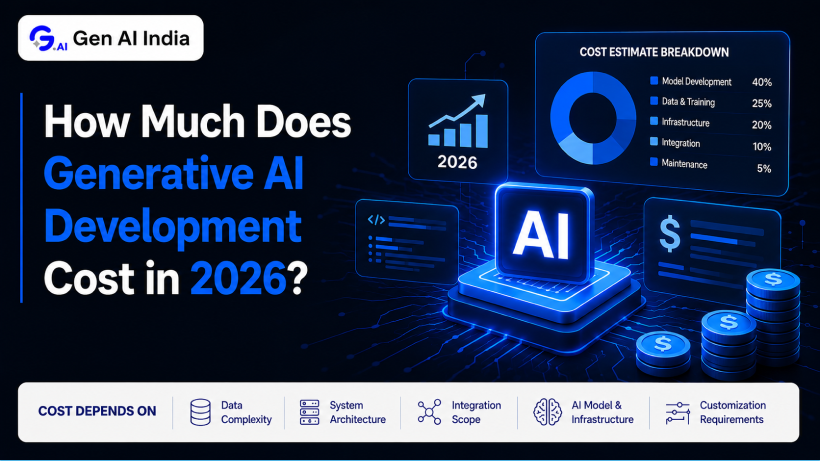
Generative AI development typically costs $20,000–$60,000 for a focused solution, $60,000–$250,000+ for a mid-level application, and $400,000–$1 million+ for a large enterprise program. However, these are planning ranges rather than fixed prices. The Gen AI development cost depends on the complexity of the use case, AI model, data requirements, integrations, security, infrastructure, development team, and expected user scale.
For a business planning to invest in Generative AI in 2026, the better question is not simply “How much does Generative AI cost?” It is “What level of AI capability do we need, and what will it take to make that capability reliable, secure, and useful for our customers or employees?”
This guide breaks down the major cost drivers, development models, application types, hidden expenses, and practical ways businesses can control their Gen AI development services cost without compromising the quality of the final product.
Table of Contents
What Is Included in the Cost of Generative AI Development?
A production-ready solution usually combines several technical and business layers.
| Generative AI Project Type | Estimated Cost in 2026 | Typical Timeline | Examples |
| Focused AI Solution | $20,000–$60,000 | 1–3 months | Internal assistant, content generator, basic chatbot |
| Mid-Level GenAI Application | $60,000–$250,000+ | 3–6 months | RAG assistant, AI SaaS feature, document intelligence |
| Advanced Enterprise AI | $250,000–$500,000+ | 6–12 months | AI copilot, multi-workflow automation, enterprise assistant |
| Large-Scale AI Program | $400,000–$1M+ | 9–18+ months | Multi-model enterprise AI ecosystem, large-scale automation |
AI Strategy and Use-Case Discovery
Before developers write code, the business needs to determine what the AI should actually accomplish.
This sounds simple, but it is often where projects either become focused or unnecessarily expensive. A company may initially say that it wants to “add Generative AI to its platform,” but that statement does not define a development project. The team needs to identify the specific problem, target users, expected workflow, required data, success metrics, and acceptable level of AI autonomy.
AI Model Integration
The next cost component is connecting the application with an appropriate Generative AI model.
Gen AI integration services can choose from commercial foundation models, open-source models, specialized models, or customized approaches. The right choice depends on the application’s accuracy requirements, data sensitivity, latency expectations, expected traffic, customization needs, and budget.
However, the model still needs to be integrated properly.
Data Engineering and Preparation
Data can have a major impact on the overall Gen AI development cost.
A business may already possess thousands of documents, customer records, product descriptions, support conversations, contracts, reports, and knowledge-base articles. However, that does not mean the information is immediately ready for AI.
Data may contain duplicate records, outdated documents, inconsistent formats, missing metadata, irrelevant information, or access restrictions. Developers and data engineers may therefore need to clean, transform, classify, structure, and index the information before the AI can use it reliably.
Application and Backend Development
Generative AI still needs to live inside a software application.
The development team may need to build dashboards, chat interfaces, AI suggestion panels, approval workflows, content editors, reporting screens, authentication systems, and backend services that allow users to interact with the AI.
The backend also acts as the bridge between the AI model and the rest of the business application. It may control which information the AI can access, which actions it can perform, and what happens when the model produces an invalid or incomplete response.
API and Enterprise Integrations
Generative AI becomes significantly more valuable when it can work with existing business systems. Total enterprise investment in generative AI surged dramatically, scaling past $644 billion with nearly 80% concentrated in underlying hardware and server infrastructure.
Each integration introduces its own authentication methods, APIs, data structures, permissions, error conditions, and testing requirements. As the number of integrations increases, so does the engineering effort and therefore the overall development cost.
Security and Compliance
Security should not be added after the AI feature has already been developed.
Generative AI applications can potentially process customer information, internal documents, financial records, employee information, intellectual property, and other sensitive business data. The architecture therefore needs to control what information is available to the model and which users can access it.
Testing and AI Evaluation
Testing a Generative AI application is different from testing a traditional software feature.
A conventional function may be expected to return the same result every time. Generative AI can produce different responses to similar inputs, which means teams need to evaluate whether the output is accurate, relevant, safe, consistent, and aligned with the business requirements.
Deployment and Monitoring
The final development cost also includes getting the AI system into production and keeping it reliable.
A production AI application should also provide visibility into important metrics such as response latency, request volume, token usage, failure rates, user feedback, and AI quality.
This is important because an AI application is not truly finished when it goes live. It needs to be monitored and optimized as users, data, models, and business requirements change.
What Factors Affect Gen AI Development Cost?
The cost of Generative AI development is shaped by several interconnected factors.
Complexity of the AI Use Case
The first factor is what the AI actually needs to do. A simple AI writing assistant may only require a model API, prompt engineering, and an interface. A sophisticated AI system may need retrieval, reasoning, tool use, workflow automation, human approval, and integration with multiple enterprise systems.
As the number of AI capabilities increases, the architecture becomes more complex and requires more development and testing.
The latter requires considerably more backend logic, permissions, validation, and failure handling.
AI Model Selection
Model selection has a direct impact on both development and operational costs.
Using a commercial foundation model can reduce the initial development effort. Open-source models can offer greater control but may introduce additional infrastructure, hosting, optimization, and maintenance requirements.
Data Quality and Availability
If the Gen AI consulting services already have structured data, developers can move more quickly. If information is scattered across spreadsheets, PDFs, databases, emails, legacy applications, and disconnected systems, additional data engineering becomes necessary.
The business therefore needs to evaluate not just how much data it has, but also:
- Where the data is stored
- Who owns it
- How accurate it is
- How frequently it changes
- Whether it contains sensitive information
- Whether users have different access permissions
- How easily it can be connected to the AI system
Number and Complexity of Integrations
An AI application with no external integrations is relatively straightforward compared with one that needs to interact with multiple business platforms.
Every integration requires development and testing, and enterprise systems often have complex authentication, permissions, APIs, and legacy constraints.
A company that wants an AI copilot connected to its CRM, ERP, support platform, data warehouse, and identity provider should therefore expect a larger budget.
Security and Compliance Requirements
Security requirements increase the development effort because AI needs to operate within the organization’s existing access and governance structure.
A customer-facing AI chatbot may require basic authentication and data protection. An internal enterprise copilot may need employee-level permissions so that one user can’t retrieve information belonging to another department.
User Volume and Scalability
The number of users also influences Gen AI development cost.
An internal AI assistant serving 200 employees has different infrastructure requirements from a consumer application serving millions of users.
Higher traffic can increase model consumption, cloud infrastructure requirements, database load, monitoring needs, and engineering work around performance and reliability.
This is why scalability should be considered during architecture planning rather than after the application begins receiving high traffic.
Multimodal Requirements
Text-based applications are generally simpler than applications that process multiple types of content.
If the AI needs to understand or generate images, audio, video, documents, or combinations of these formats, the development architecture becomes more sophisticated.
Each additional modality introduces new models, APIs, infrastructure, testing requirements, and operating costs.
Gen AI Development Cost by Application Type
The following estimates can help businesses create an initial budget.
| AI Application | Estimated Development Cost | Typical Development Time | Common Business Use |
| AI Chatbot | $15,000–$50,000 | 1–3 months | Customer support and FAQs |
| RAG-Based Assistant | $30,000–$100,000+ | 2–5 months | Enterprise knowledge search |
| AI Copilot | $50,000–$150,000+ | 3–6 months | Sales, support, and productivity |
| Document Intelligence | $30,000–$100,000+ | 2–5 months | Contracts, invoices, reports |
| Recommendation Engine | $40,000–$120,000+ | 3–6 months | Product and content recommendations |
| Multimodal AI Application | $75,000–$250,000+ | 4–9 months | Text, image, audio, and video processing |
| Enterprise AI Platform | $250,000–$1M+ | 6–18+ months | Large-scale AI automation |
AI Chatbot Development Cost
AI chatbots remain one of the most common entry points for businesses adopting Generative AI.
A basic chatbot can connect an existing LLM with a website or application and answer customer questions using predefined prompts or general model knowledge. The development cost is relatively low because the architecture does not necessarily require complex data pipelines or custom machine learning.
This increases the Gen AI development cost because developers need to build authentication, API integrations, conversation history, and fallback mechanisms.
A basic chatbot may therefore cost around $15,000–$50,000, while a sophisticated enterprise chatbot can cost considerably more.
RAG-Based AI Assistant Development Cost
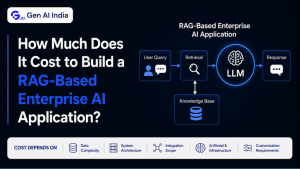
Retrieval-Augmented Generation, or RAG, is useful when an AI application needs to work with company-specific information.
Instead of relying only on the knowledge contained within an LLM, a RAG system retrieves relevant information from a company’s documents, databases, knowledge bases, or other sources before generating a response.
A RAG application may therefore cost approximately $30,000–$100,000+, depending on the size of the knowledge base and the number of systems involved.
AI Copilot Development Cost
An AI copilot is more deeply integrated into the user’s existing workflow.
Instead of opening a separate AI tool, users interact with AI directly inside the software they already use. A sales representative, for example, could ask the copilot to summarize a customer account, identify open opportunities, draft a follow-up email, or suggest the next sales action.
This requires to hire Gen AI developers to understand the application’s context and interact with business data.
Because of this deeper integration, an AI copilot can cost approximately $50,000–$150,000+.
Intelligent Document Processing Cost
Businesses deal with a large volume of documents every day. These can include invoices, purchase orders, contracts, financial statements, insurance documents, applications, and reports.
Generative AI can help extract information from these documents, summarize them, classify them, identify missing details, and move information into existing business workflows.
The development cost can range from $30,000 to $100,000+, depending on document complexity, accuracy requirements, processing volume, and integrations.
AI Recommendation Engine Cost
Generative AI can also be combined with recommendation systems to personalize customer experiences.
A B2B eCommerce platform could recommend products based on previous purchases, customer industry, order frequency, product compatibility, and current inventory.
A recommendation engine can cost around $40,000–$120,000+, although the range can increase for high-volume platforms with real-time personalization.
Multimodal Generative AI Development Cost
Multimodal AI works with more than one type of content. Depending on the application, it may understand or generate text, images, audio, video, or documents.
For example, an eCommerce application could allow a customer to upload an image of a product and ask the AI to identify similar products. A healthcare application could combine text and medical images, while a media platform could generate text descriptions, images, and audio content from the same input.
As a result, development can cost approximately $75,000–$250,000+.
The infrastructure cost can also become significant because images, audio, and video generally require more processing and storage than text.
Enterprise Generative AI Platform Cost
Large enterprises may eventually move beyond individual AI features and build an internal Generative AI tools & platform.
Such a platform can provide multiple AI capabilities across departments. Employees might use it for customer support, sales intelligence, document analysis, knowledge retrieval, reporting, content generation, and workflow automation.
Development costs can reach $250,000 to $1 million or more, particularly when the platform supports thousands of users and multiple business-critical workflows.
Generative AI Development Cost by Development Approach
Here are the different development approaches of Generative AI.
Using Existing AI APIs
For most businesses, an existing AI API is the most practical starting point. The development team connects the application to a foundation model and builds the required business functionality around it. This reduces the need for expensive model training and allows the business to launch sooner.
It works particularly well for applications such as content generation, summarization, customer support, translation, conversational interfaces, and general-purpose assistants.
Customizing an Existing Model
Some businesses need the AI to perform better within a specific domain.
Instead of building a model from scratch, developers can customize an existing model using techniques such as RAG, fine-tuning, structured prompting, or domain-specific workflows.
RAG is often a practical choice when the main requirement is giving the AI access to proprietary business information. Fine-tuning may be considered when the business needs more consistent behavior, formatting, or specialized task performance.
Building a Custom AI Model
A custom AI model is the most expensive approach and should generally be considered only when there is a strong business reason.
The company may need proprietary training data, machine learning engineers, data scientists, GPU infrastructure, model evaluation, deployment infrastructure, and ongoing optimization.
Training a foundation model from scratch is an entirely different investment from integrating Generative AI into an existing application.
Hidden Costs That Can Increase Gen AI Development Cost
Here are the hidden costs that can increase Gen AI development costs.
AI Model and API Usage
Many AI models use usage-based pricing. The more requests users make, the more the business spends.
A small MVP may generate only a few thousand requests each month. Once the product becomes successful and thousands of customers use the AI feature regularly, API consumption can become a significant recurring expense.
Businesses should therefore estimate expected usage before selecting a model.
Cloud Infrastructure
AI applications may require cloud servers, databases, object storage, vector databases, caching, monitoring, and other infrastructure.
If the application uses self-hosted or open-source models, compute requirements can become even more important.
GPU infrastructure, in particular, can increase operational expenses when models need to be hosted or processed at scale.
AI Monitoring
Traditional software monitoring is not enough for Generative AI.
Businesses need to track whether AI responses remain useful and accurate. They may also need to monitor hallucinations, response latency, failed requests, token consumption, user feedback, and changes in model performance.
These monitoring systems create additional development and operational costs but are essential for production reliability.
Data Maintenance
AI systems that rely on business data need that information to remain accurate.
If a company updates its policies, product catalog, pricing, documentation, or internal procedures, the AI’s knowledge source also needs to be updated.
This is particularly important for RAG applications. A system that retrieves outdated information can produce an answer that is technically well-written but operationally incorrect.
Human Oversight
Not every AI decision should be completely automated.
For financial, legal, healthcare, compliance, or other sensitive workflows, businesses may require employees to review AI-generated recommendations before action is taken.
Human-in-the-loop workflows add development and operational costs, but they can significantly reduce business risk.
How to Reduce Generative AI Development Cost
Here is how to reduce Generative AI development cost.
Start With One Business Problem
Do not begin by trying to build an AI platform for every department.
Choose one problem where AI can create measurable value. It could be reducing support workload, improving document processing, helping sales teams prepare faster, or making internal knowledge easier to access.
Build an AI MVP
An MVP allows the business to validate the idea before making a larger investment.
For example, instead of building an enterprise-wide AI support system immediately, a company could launch a small RAG assistant for one product line or support team.
Use Existing Foundation Models
Training a custom model is expensive. Existing foundation models can handle many common Generative AI tasks without the need for extensive model development.
Businesses can then invest their budget in the areas that create differentiation, such as proprietary data, integrations, workflow automation, user experience, and security.
Use RAG Before Fine-Tuning When Appropriate
Businesses sometimes assume that they need to fine-tune an AI model whenever they want it to work with company information.
That is not always the case.
If the requirement is primarily for the model to answer questions using frequently changing company documents, RAG may be a more practical solution than fine-tuning.
Design for Model Flexibility
Avoid building the entire application around one model provider.
A model-agnostic architecture can allow businesses to switch models based on cost, performance, availability, or business requirements.
This flexibility becomes increasingly valuable as AI models continue to evolve.
Prioritize Features With Measurable ROI
The best AI investment is not necessarily the most technically advanced one.
A simple AI feature that saves employees 10 hours per week may provide more business value than an expensive autonomous AI system that few employees use.
Before development begins, define how success will be measured. This could include reduced support tickets, faster document processing, higher conversion rates, improved employee productivity, or lower operational costs.
Build vs. Buy vs. Integrate: Which Option Makes Sense?
Businesses typically have three major choices when adopting Generative AI.
Buy an Existing AI Solution
Buying an existing AI product is usually the fastest option when the required capability is already available.
It can reduce development time and upfront costs. However, businesses may have limited control over customization, workflows, integrations, and data.
This approach works well for standardized business requirements.
Integrate Generative AI Into Your Existing Product
Integration is often the best option when the company already has a strong software product and wants to add AI capabilities.
The business keeps its existing application while adding AI functionality around it.
This can be especially useful for SaaS companies that want to introduce AI features without rebuilding their entire platform.
Build a Custom Generative AI Product
A custom solution provides the highest level of control. It is appropriate when the business has a unique AI use case, proprietary data, complex workflows, or specific security and compliance requirements that cannot be addressed by an off-the-shelf product.
However, customization also increases the initial investment and ongoing maintenance requirements.
How to Choose a Generative AI Development Partner?
The right development partner can have a significant impact on both project cost and outcome.
Businesses should look beyond a vendor’s ability to connect an application to an LLM API. A strong Generative AI development team should understand AI architecture, backend development, data engineering, RAG, APIs, cloud infrastructure, security, testing, and business workflows.
The team should also be able to explain why a particular AI approach is suitable for the use case.
A good partner should also provide a clear breakdown of development costs, infrastructure costs, API usage, maintenance requirements, and future scalability.
Want a Generative AI expert for your business application cost calculation?
Conclusion
The Gen AI development cost in 2026 can range from approximately $20,000 for a focused AI solution to $1 million or more for a large-scale enterprise AI program. The final investment depends on the AI use case, model selection, data quality, integrations, security, infrastructure, user volume, and level of customization.
The most practical approach for most businesses is not to build everything from scratch. Start with an existing foundation model, connect it to valuable business data, build one high-impact use case, and validate the results through an MVP.
Once the solution proves its value, the business can expand it into RAG, AI copilots, intelligent automation, multimodal experiences, or agentic workflows.
FAQs
-
How much does Gen AI development cost in 2026?
Generative AI development can cost anywhere from $10,000 to $150,000+, depending on the use case, model, integrations, data requirements, security, and level of customization.
-
What factors affect Gen AI development cost?
The main factors include AI model selection, application complexity, data preparation, integrations, development team size, security, cloud infrastructure, testing, and ongoing maintenance.
-
How much does it cost to build a Gen AI chatbot?
A basic Gen AI chatbot may cost around $10,000–$25,000, while an enterprise chatbot with RAG, custom workflows, APIs, authentication, and advanced security can cost significantly more.
-
Is Generative AI development expensive for startups?
Not necessarily. Startups can reduce costs by using existing AI APIs, open-source models, cloud services, and an MVP-first development approach instead of building a custom AI model from scratch.
-
How much does a RAG-based Gen AI application cost?
A RAG-based application can cost approximately $20,000–$80,000+, depending on the volume of data, retrieval architecture, integrations, security requirements, vector database, and response accuracy needed.