Should Your Enterprise Build an AI Copilot or Buy an Existing AI Tool?
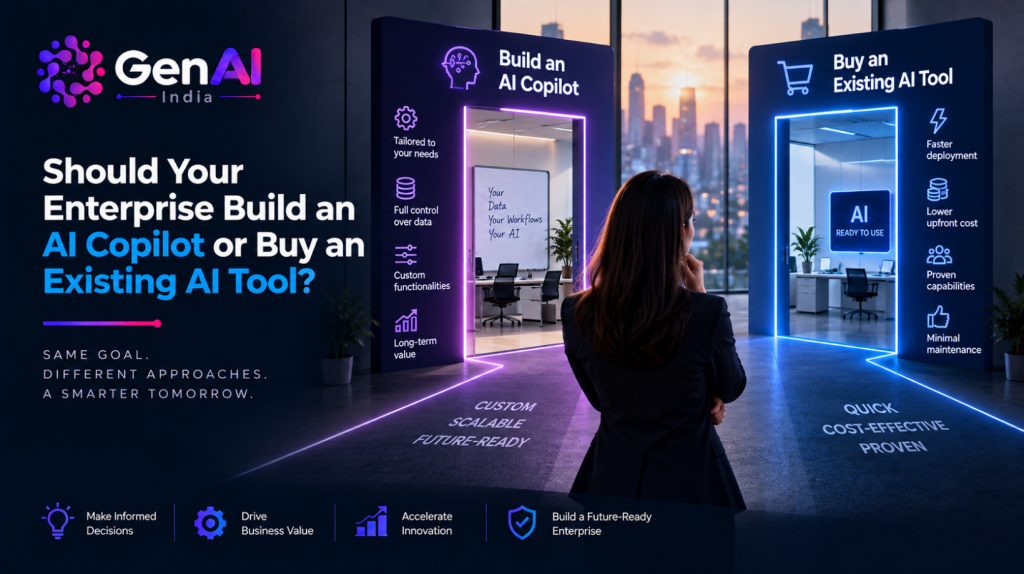
- Buy when an existing AI tool already solves your use case and speed to value matters.
- Build when your AI copilot needs proprietary data, specialized workflows, or unique capabilities.
- Consider hybrid when you need a proven AI foundation with custom workflows or integrations.
- Compare options based on cost, customization, data, security, integrations, scalability, and time to value.
- A custom build also means owning maintenance, monitoring, governance, security, and ongoing AI operations.
The question keeps surfacing in boardrooms across every industry. Should your organization build a custom AI copilot tailored to your data and workflows, or license a market-ready AI tool and deploy it in weeks? Both paths carry real merit and meaningful risk. Choosing the wrong one can cost an enterprise significantly in time, budget, and competitive ground.
The right choice depends on what you are trying to solve. A team that buys a general-purpose AI tool for a specialized workflow will hit a ceiling fast. A team that builds custom for a use case a purchased product already handles well is spending resources it did not need to spend. This guide gives you the framework to make the right call.
Table of Contents
What Is the Difference Between Building an AI Copilot and Buying an Existing AI Tool?
A custom AI copilot is purpose-built on your proprietary data, integrated into your internal tools, and designed around your specific workflows and decision logic. An off-the-shelf AI tool is a pre-built product such as Microsoft Copilot or Salesforce Einstein, licensed and deployed with minimal configuration.
Building gives you full control over data, model behavior, and intellectual property. Buying gives you speed and vendor-managed reliability. The right answer lives at the intersection of your use case specificity, your data sensitivity, and your timeline.
What Do Enterprises Say About Custom AI Development?
Enterprise communities consistently point to the same pattern: build when your use case is specialized, your data is sensitive, or the AI behavior itself is the competitive product. A procurement AI copilot built on your vendor contracts cannot be replicated by a generic tool. A customer service AI trained on your product knowledge base will outperform an off-the-shelf solution on every metric that matters.
The scenarios that consistently favor a custom build are:
- Your workflows involve regulated or proprietary data that cannot be processed by a third-party vendor. Healthcare, legal, and financial services organizations frequently fall here.
- The AI behavior needs to reflect business logic unique to your organization, such as custom pricing rules, approval hierarchies, or proprietary product catalogs.
- You are building a differentiating product capability. If the AI feature is your competitive moat, owning it outright is the only defensible position.
- Your usage volume will be large enough that SaaS licensing fees will exceed the cost of a custom build within two to three years.
Structured generative AI consulting at the scoping stage is what separates enterprise teams that build exactly what they need from those that are over-engineer or under-scope, both of which destroy the return on the initial investment.
What Are Business Leaders Saying About Off-the-Shelf AI Tools?
Business leaders on Quora highlight a consistent pattern: enterprises that build before understanding their AI maturity tend to over-invest in capabilities, they are not ready to use. For most organizations, buying a proven product accelerates learning and delivers measurable value without requiring internal ML engineering capacity.
When the use case is clear and the data is ready, the build decision benefits from professional generative AI integration services that handle architecture, API connectivity, and deployment without pulling internal teams off their core work.
Off-the-shelf tools are the right call in these situations:
- You need a working solution within a few weeks. Sales and support teams deploy AI tools in days and see productivity gains immediately.
- The use case is standard enough that a mature product already handles it well. Email drafting, meeting summarization, and document search are solved problems with proven vendors.
- Your internal team does not have the ML engineering depth to build and maintain a production AI system reliably.
- Budget constraints make a large upfront build investment impractical in the current planning cycle.
For industries evaluating first AI deployments, including firms exploring generative AI for fintech workflows, buying a proven tool to build baseline competency before investing in a custom build is a practical strategy that many mature enterprises now follow.
What Are the Real Costs of Building a Custom AI Copilot for Enterprise?
Cost is the most common reason enterprises pause on a custom build. The investment is real, and so is the long-term return when the use case justifies it.
Understanding the full generative AI development cost before committing to a build path gives leadership a realistic baseline for budget planning and helps avoid the scope creep that derails most overrun projects.
How Do You Decide? Key Factors to Evaluate Before Choosing
The build versus buy decision comes down to five variables that every enterprise leadership team should audit before committing resources.
- Data sensitivity: If your AI needs to process confidential or regulated information, a custom build with private cloud or on-premise deployment eliminates the data governance risk that comes with third-party vendor access.
- Workflow specificity: Generic tools perform well on generic tasks. If the AI use case requires fluency with your internal product logic or business processes, a purpose-built solution will outperform a licensed product by a measurable margin.
- Integration complexity: Off-the-shelf tools have standard connectors. When your systems are custom-built or your integration requirements are non-standard, the configuration effort on a purchased tool can exceed what a custom build would cost.
- Internal AI capability: If you do not have AI or ML engineers on staff, the maintenance burden of a custom system is a real cost. Organizations that plan to hire generative AI developers or work with a dedicated development agency should factor the total cost of that partnership into the build option.
- Timeline and business priority: A major event six weeks away is not a timeline for a custom build. An 18-month product roadmap with AI at its core often is. Timeline is one of the most commonly overlooked factors in the build versus buy decision.
Reviewing a generative AI guide for business leaders before entering vendor selection or build scoping is one of the highest-leverage preparation steps available to enterprise leadership teams. According to the latest reports of Fortune Business Insights, the global generative AI market will grow from $43.87 billion in 2023 to $667.96 billion by 2030.
Concluding Thoughts
Build a custom AI copilot when data privacy, workflow specificity, or competitive differentiation is the priority. Buy an existing AI tool when speed to deployment, standard use cases, and limited internal AI engineering capacity are the constraints. A custom build ranges from $80,000 to over $500,000, however delivers lower long-term cost per unit at a volume. And most enterprises get the maximum benefit from deploying a purchased tool where the value justifies the investment.
FAQs
1. Is it cheaper to buy an AI tool or build one for enterprise use?
Buying has lower upfront costs and faster deployment. Building requires higher initial investment but delivers lower per-unit cost at scale and eliminates recurring licensing fees. The crossover point typically occurs between two and four years of active deployment.
2. Can an enterprise run both a purchased AI tool and a custom-built AI copilot at the same time?
Yes, and many enterprises do exactly this. A common pattern is deploying an off-the-shelf tool for standard productivity use cases while building a custom copilot for high-value, proprietary workflows. This hybrid approach balances speed with long-term strategic capability.
3. What are the main risks of buying an AI tool for enterprise?
The main risks are data governance exposure if vendor policies do not meet compliance requirements, limited ability to customize model behavior for specialized workflows, and vendor lock-in as the tool embeds across internal processes.