How Much Does It Cost to Add AI Features to an Existing B2B Software Product?
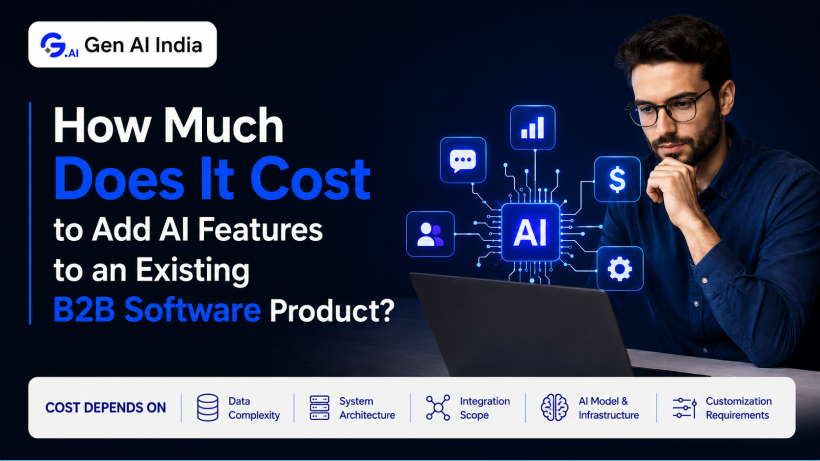
- AI integration costs can range from $5,000 to $150,000+, depending on the AI feature, data readiness, integrations, security, and development complexity.
- The type of AI feature directly affects the budget, with basic chatbots and content generation costing less than RAG assistants, recommendation engines, and custom AI solutions.
- Existing software architecture plays an important role in integration costs, as modern applications with well-defined APIs are easier to extend.
- Data preparation can become a major part of the AI integration cost, especially when business data is scattered, outdated, unstructured, or stored across multiple systems.
- Businesses can often reduce initial AI development costs by using existing AI APIs, while custom models make more sense when specialized requirements, greater control, justify the additional investment.
Adding AI to an existing B2B software product can cost anywhere from $5,000 to $150,000+, depending on what you want the AI to do, how complex your existing software is, how much usable data you have, and whether you use an existing AI model or build a custom solution. A simple AI chatbot may fall toward the lower end, while RAG-based enterprise assistants, custom ML models, and multi-agent automation can require a significantly larger investment.
For a Gen AI development company trying to estimate the AI feature integration cost for a B2B website, there is no single fixed price. The actual investment depends on the AI feature, security requirements, cloud infrastructure, and ongoing maintenance. A practical way to estimate the budget is to separate the project into AI development, data preparation, testing, and recurring operational costs.
The good news is that adding AI doesn’t mean rebuilding your entire B2B software product. If your existing application has a stable architecture, AI can often be introduced as an additional layer. This allows businesses to start with one high-value use case, measure its impact, and expand AI capabilities. Let’s dive in to learn about AI integration into a B2B website.
Table of Contents
How Much Does AI Feature Integration Cost Into a B2B Website?
The cost of adding AI varies significantly based on the feature and its technical complexity. A small AI enhancement using an existing API can be developed within a few weeks, while a custom enterprise AI system may require several months of optimization.
A business may spend less when integrating a simple AI API into a modern application. A heavily regulated enterprise with complex legacy infrastructure could spend considerably more. The AI market is projected to reach a staggering $1,339 billion by 2030, experiencing substantial growth from its estimated $214 billion revenue in 2024.
| AI Feature | Estimated Cost | Complexity | Typical Business Use |
| AI chatbot | $5,000–$15,000 | Low–Medium | Customer support and FAQs |
| AI content generation | $5,000–$15,000 | Low–Medium | Product descriptions, emails, reports |
| AI summarization | $5,000–$15,000 | Low–Medium | Meetings, documents, conversations |
| AI document processing | $10,000–$30,000 | Medium | Invoices, contracts, reports |
| AI-powered search | $10,000–$30,000 | Medium | Enterprise knowledge discovery |
| RAG-based assistant | $15,000–$50,000+ | Medium–High | Internal knowledge and support |
| Recommendation engine | $15,000–$40,000 | Medium–High | Personalization and product discovery |
| Predictive analytics | $20,000–$50,000+ | High | Forecasting and risk analysis |
| Custom AI/ML model | $30,000–$100,000+ | High | Specialized business predictions |
| Advanced AI agents | $40,000–$150,000+ | Very High | Multi-step workflow automation |
The most important point is that businesses should not evaluate AI cost based only on the model being used. An inexpensive AI API can still require significant engineering work when it has to interact with enterprise databases, CRMs, ERPs, and document repositories.
What Determines the Cost of AI Integration?
In reality, several technical and business factors influence the final budget.
Type of AI Feature
The first and most obvious factor is the type of AI capability you want to add. A basic content-generation feature may require an API connection, prompt design, a user interface, and some testing. An enterprise AI assistant, however, may need document ingestion, access control, retrieval pipelines, response validation, and continuous evaluation.
Similarly, predictive analytics requires historical business data and machine learning workflows. A computer vision feature may require image processing, model selection, training data, and specialized infrastructure.
Cost impact: Simple AI features may cost around $5,000–$15,000, while advanced AI capabilities can require $50,000–$150,000+.
Existing Software Architecture
Your current software architecture has a direct impact on integration cost.
A modern application built with modular services and well-documented APIs provides developers with clear integration points. AI can be introduced without making major changes to the core product.
A legacy application may tell a different story. If business logic is tightly coupled or important data is stored across disconnected systems. Hiring Gen AI developers may first need to build APIs or middleware to make that information available to the AI layer.
Cost impact:A modern architecture can keep integration costs lower, while legacy systems may add $10,000–$30,000+ in API, middleware, and modernization work.
Data Quality and Availability
A B2B company may have years of customer records, product information, contracts, support conversations, sales data, and internal documents. However, having a lot of data does not automatically mean the data is ready for AI.
Information may be duplicated, outdated, poorly structured, incomplete, or stored in incompatible systems. Before using it for AI, developers may need to clean, organize, transform, classify, or enrich it.
Cost impact: Data preparation can add roughly $5,000–$30,000+, depending on the volume, quality, and number of data sources involved.
AI Model Selection
Businesses also need to decide whether to use a commercial AI API, an open-source model, a fine-tuned model, or a custom machine learning model.
Using an established API from a major AI provider is often the fastest way to launch a feature. It reduces the need to train and maintain a model internally.
Open-source models provide greater control and can be useful when data privacy, customization, or infrastructure requirements justify them. However, hosting, optimization, scaling, and maintenance can increase the total cost.
Cost impact: API-based integration is usually more affordable initially, while fine-tuned, self-hosted, or custom models can increase development costs by $20,000–$100,000+.
Integration Complexity
AI becomes significantly more valuable when it can access the right business context.
Payment systems, identity providers, enterprise databases, third-party APIs, and legacy applications may also have different authentication mechanisms and data formats.
The number and complexity of these connections can have a substantial effect on the final project cost.
Cost impact: Each additional integration can add approximately $2,000–$10,000+, depending on the system, API complexity, authentication, and testing requirements.
Security and Compliance
B2B applications frequently handle sensitive business information. Gen AI integration services therefore need to be designed around security from the beginning.
Depending on the industry and application, businesses may need encryption, role-based access, audit logs, data isolation, secure API communication, authentication controls, and compliance processes.
Cost impact: Security and compliance requirements can add $5,000–$30,000+, with highly regulated enterprise applications potentially requiring significantly more.
UI and User Experience
AI functionality also needs to fit naturally into the existing product.
A business might integrate a powerful AI model, but if users cannot understand when to use it or how to validate its output, the feature may deliver little value.
Developers may need to create conversational interfaces, AI suggestion panels, dashboards, approval workflows, feedback mechanisms, or explanation features. The AI experience should feel like part of the existing product rather than a separate tool attached to it.
Cost impact: AI-focused UI/UX work can add around $3,000–$15,000+, depending on the number of screens, workflows, and user interactions.
Testing and AI Evaluation
Traditional software testing checks whether a feature behaves according to predefined rules. AI systems introduce another challenge: the output may vary.
An AI feature needs to be evaluated for accuracy, relevance, consistency, hallucinations, security, response time, and failure handling.
For business-critical applications, teams may also need human evaluation processes and monitoring systems to identify when AI performance starts declining.
Cost impact: AI testing and evaluation can add approximately $5,000–$25,000+, particularly when the feature requires extensive testing, human review, monitoring, and performance evaluation.
AI Feature Integration Cost by Complexity Level
A useful way to understand the investment is to divide AI integration into three broad complexity levels.
| Complexity Level | Estimated Cost | Typical AI Features | Development Requirements | Best For |
| Basic AI Integration | $5,000–$15,000 | AI content generation, summarization, email drafting, simple chatbots | AI API integration, prompt engineering, UI development, authentication, basic testing | Businesses testing their first AI feature or launching an MVP |
| Intermediate AI Integration | $15,000–$50,000 | RAG assistants, AI search, document intelligence, CRM copilots, recommendation engines | Data pipelines, backend integration, vector databases, access controls, evaluation, security testing | B2B businesses connecting AI with internal data and workflows |
| Advanced AI Integration | $50,000–$150,000+ | Custom ML models, predictive analytics, computer vision, multi-agent systems, real-time AI automation | Custom model development, data engineering, cloud infrastructure, AI/ML expertise, advanced testing and monitoring | Enterprises with complex, specialized, or large-scale AI requirements |
Level 1: Basic AI Integration — $5,000–$15,000
Basic AI integrations typically use existing AI APIs and require relatively limited customization.
Examples include AI-powered content generation, email drafting, text summarization, simple chatbots, and basic customer support assistants.
These projects are often suitable for businesses testing AI for the first time. The primary development work involves connecting the API, designing prompts, building the interface, implementing authentication and usage controls, and testing the feature.
A company with a modern B2B SaaS platform could potentially launch a basic AI feature within a few weeks.
Level 2: Intermediate AI Integration — $15,000–$50,000
Intermediate solutions require AI to interact more deeply with business data and workflows.
Examples include RAG-based assistants, AI-powered enterprise search, document intelligence, CRM copilots, and recommendation systems.
These solutions generally require data pipelines, additional backend development, more sophisticated access controls, database or vector database integration, and extensive evaluation.
They can deliver significantly more business value but also require more planning and engineering.
Level 3: Advanced AI Integration — $50,000–$150,000+
Advanced AI projects are designed for complex business processes or highly specialized requirements.
They may involve custom machine learning models, predictive systems, computer vision, multi-agent architectures, real-time AI processing, or large-scale automation.
At this level, businesses may need AI engineers, machine learning engineers, backend developers, cloud specialists, data engineers, QA professionals, and security experts.
The timeline can extend from several months to a year or more depending on the scope.
Cost of Adding Different AI Features to B2B Software
Here are the factors that affect the cost of AI features in B2B software.
AI Chatbot
An AI chatbot is often one of the easiest ways for a B2B company to introduce AI. A basic chatbot can use a commercial large language model to answer predefined business questions, assist customers, or guide users through the product.
However, enterprise chatbots become more sophisticated when they need access to internal knowledge. At that point, businesses often introduce RAG so the chatbot can retrieve relevant information from company documents and databases before generating an answer.
AI-Powered Search
Traditional keyword search requires users to enter specific words that match the stored information. AI-powered search can understand the intent behind a query and identify semantically related information.
The implementation may involve embeddings, vector databases, ranking logic, filtering, access control, and integration with existing search infrastructure. Consequently, the cost is higher than simply connecting an AI API.
RAG-Based Knowledge Assistant
RAG is particularly useful for B2B products because it allows an AI model to answer questions using business-specific information without necessarily training a new model from scratch.
For businesses with large internal knowledge bases, RAG can provide substantial value while remaining more practical than building a proprietary language model.
Predictive Analytics
Instead of generating text, predictive systems analyze historical data to estimate the future scope of Generative AI for fruitful outcomes. A B2B business might use predictive analytics to forecast demand, identify customers at risk of leaving, predict payment delays, or estimate sales opportunities.
These projects typically require data engineering, feature engineering, model selection, training, validation, deployment, and continuous monitoring. The biggest cost factor is often not the algorithm itself but preparing reliable business data.
AI Recommendation Engine
Recommendation systems help businesses personalize what users see based on their behavior, preferences, history, or business context.
A B2B eCommerce platform, for example, might recommend products based on previous purchases, customer segment, industry, order frequency, and inventory availability.
Building an effective recommendation engine requires relevant behavioral data and a reliable way to measure whether recommendations actually improve conversions, average order value, retention, or engagement.
Intelligent Document Processing
B2B organizations work with invoices, purchase orders, contracts, reports, applications, and other documents every day. AI-powered document processing can extract important information from these files, classify them, summarize their content, identify missing information, and send the extracted data into existing workflows.
The cost depends on document types, OCR requirements, extraction accuracy, validation rules, integrations, and the volume of documents processed.
AI Copilot
An AI copilot provides contextual assistance directly inside an existing B2B application. Instead of opening a separate chatbot, users can ask the system to summarize a customer account, prepare a report, draft an email, analyze a sales opportunity, or suggest the next step without leaving the application.
Because co-pilots need deep access to application data and workflows, they typically require more integration work than standalone chatbots.
Hidden Costs Businesses Often Miss When Adding AI
The initial development quote is only one part of AI investment.
AI API Usage
Most commercial AI models operate on usage-based pricing. As the number of users and requests increases, so does AI consumption.
A feature that costs very little during an MVP phase may require a larger monthly budget after thousands of customers begin using it.
Cloud Infrastructure
AI applications may require additional compute, databases, storage, caching, monitoring, and vector database infrastructure.
Advanced models may also require GPU infrastructure, which can substantially increase operational expenses.
Data Preparation
Data cleaning, transformation, migration, document processing, and enrichment can become major parts of the project when existing information isn’t AI-ready.
Monitoring and Evaluation
AI performance needs to be monitored after launch. Businesses need to know whether responses remain accurate, whether hallucinations are increasing, whether latency is acceptable, and whether users are receiving useful results.
Human Review
For sensitive use cases, businesses may need human approval before AI-generated recommendations or decisions are acted upon.
This is especially important in financial, healthcare, legal, and other high-impact applications.
How to Reduce AI Integration Costs Without Sacrificing Quality
The most effective way to control AI costs is not necessarily to hire cheaper developers or choose the cheapest AI model.
Start With One High-Value Use Case
Rather than adding AI across the entire product, identify one workflow where automation or intelligence can create measurable value.
For example, a B2B SaaS company could begin with an AI support assistant instead of immediately developing AI-powered sales forecasting, recommendation engines, and predictive analytics.
This creates an opportunity to measure results before making a larger investment.
Use Existing AI APIs First
Commercial AI APIs can significantly reduce the time needed to build an initial AI feature. Businesses can validate their use case before considering custom models.
Build an MVP
An AI MVP should solve one clearly defined problem. Once users demonstrate that the feature is valuable, additional capabilities can be introduced.
Reuse Existing Data and APIs
If the existing product already has clean APIs and structured databases, developers can use those assets rather than rebuilding the data layer.
Prioritize High-ROI Features
AI should not be added because it is fashionable. The strongest business cases connect AI directly to measurable outcomes.
For example, an AI feature that reduces customer support workload by 30% has a clearer financial case than a feature that simply “makes the product smarter.”
Build vs. Buy vs. Integrate: Which AI Approach Is Right for Your B2B Product?
Businesses generally have four options.
Buy an AI-Powered Product
This is the fastest option when an existing SaaS product already solves the required problem.
The downside is limited customization and potentially less control over data and workflows.
Integrate an Existing AI API
This is often the best middle ground for B2B companies. The business keeps its existing product while adding AI capabilities through established models.
It provides faster development without requiring the company to build its own AI infrastructure.
Customize an Existing Model
Businesses can add their proprietary information through RAG or other customization techniques when generic model knowledge isn’t enough.
This approach can provide more business-specific results without the cost of developing a foundation model.
Build a Proprietary AI System
This provides maximum control but also carries the highest development and maintenance cost.
It makes sense primarily when the AI capability itself is a strategic differentiator and the business has sufficient data, budget, and technical resources.
A Practical AI Integration Roadmap for B2B Software
Here is the practical roadmap for the AI feature integration process.
Step 1: Identify the Business Problem
Start by identifying what needs to improve. Is the goal to reduce support costs, automate document processing, improve sales productivity, or help users find information faster?
Step 2: Audit the Existing Architecture
Review the current application, APIs, databases, authentication systems, and infrastructure to understand how AI can be introduced without disrupting existing functionality.
Step 3: Evaluate Data Readiness
Determine what data is available, where it is stored, how clean it is, and whether users have appropriate access permissions.
Step 4: Select the AI Approach
Choose between an API, RAG, fine-tuned model, open-source model, or custom machine learning solution based on the actual use case.
Step 5: Build a Proof of Concept
Test whether the proposed AI approach can produce useful results before committing to full-scale development.
Step 6: Develop the MVP
Build the smallest production-ready version that delivers measurable business value.
Step 7: Integrate With Existing Workflows
Connect the AI feature with relevant databases, APIs, CRM systems, ERP platforms, and user workflows.
Step 8: Test and Evaluate
Measure accuracy, relevance, security, response time, reliability, and user experience.
Step 9: Launch Gradually
Start with a controlled user group before making the feature available to the entire customer base.
Step 10: Monitor and Optimize
Track usage, performance, cost, user feedback, and business results. AI should improve continuously after launch.
Want to get seamless AI integration into your B2B website?
How to Choose an AI Development Partner for Your Existing B2B Product
Choosing an AI development partner should involve more than checking whether a company has built a chatbot before.
Look for a team that understands both AI and existing software systems. The partner should be comfortable working with APIs, cloud infrastructure, databases, enterprise integrations, LLMs, RAG, machine learning, security, and application architecture.
It is also useful to evaluate how the team approaches AI projects. A good partner should be willing to question whether AI is actually the right solution, recommend a smaller MVP when appropriate, and explain the trade-offs between APIs, RAG, fine-tuning, and custom models.
Conclusion:
The cost of adding AI to an existing B2B software product depends on much more than the AI model itself. The feature, existing architecture, data quality, integrations, security, infrastructure, testing, and long-term maintenance all influence the final investment.
A simple AI feature may cost a few thousand dollars, while a sophisticated enterprise AI platform can require a six-figure budget. The right approach is not necessarily to choose the cheapest option. Instead, businesses should identify the AI capability that can solve a meaningful problem, validate it through an MVP, measure its ROI, and then scale it.
FAQs
1. How much does it cost to add AI to existing B2B software?
Adding AI to existing B2B software can cost approximately $5,000 to $150,000+, depending on the feature, data requirements, integrations, security, AI model, and complexity of the existing software. Simple AI API integrations generally cost less, while custom machine learning and advanced AI automation require larger investments.
2. What is the average AI feature integration cost into a B2B website?
There is no universal average because AI features vary significantly. A basic chatbot or content-generation feature may cost around $5,000–$15,000, while RAG assistants and predictive systems can cost $15,000–$50,000+. Advanced custom AI solutions can exceed $100,000.
3. How much does an AI chatbot cost for B2B software?
A basic AI chatbot can cost approximately $5,000–$15,000, while an enterprise chatbot connected to proprietary documents, CRM data, databases, and internal knowledge can cost significantly more. RAG, security controls, user permissions, and custom workflows increase the overall development effort.
4. Is it cheaper to use an AI API or build a custom AI model?
Using an existing AI API is generally cheaper and faster for common AI capabilities. A custom model requires additional investment in data preparation, model development, infrastructure, testing, deployment, and maintenance. Custom AI is more appropriate when a business has specialized requirements that existing models cannot meet effectively.
5. How long does AI integration take?
Simple AI API integrations can take approximately 2–4 weeks, while chatbots may require 4–8 weeks. RAG assistants and document intelligence systems can take several months, while complex custom AI platforms may require six months or longer depending on scope and data readiness.