When Does a Business Need Custom Generative AI Development?
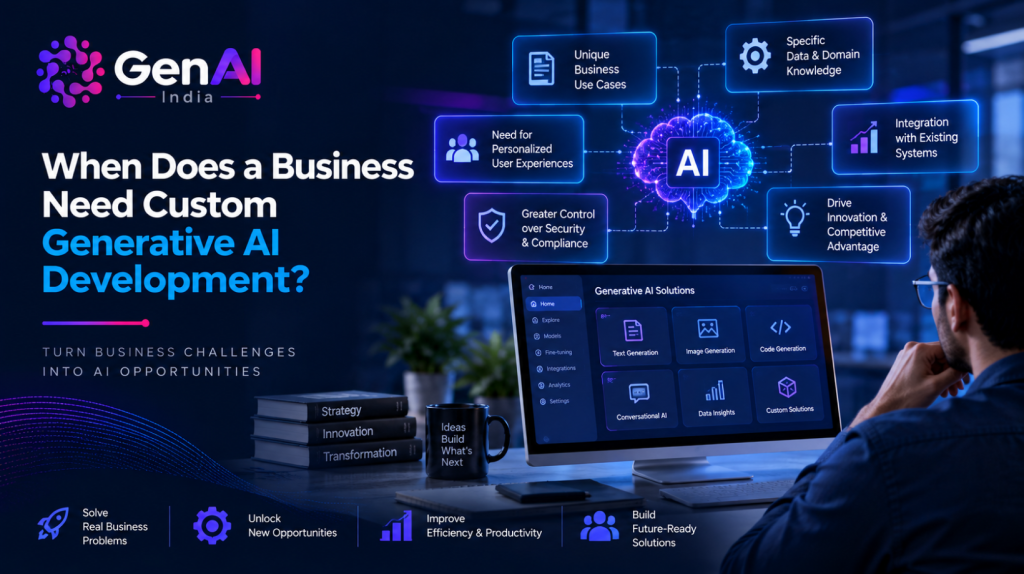
Custom Generative AI becomes valuable when standard AI tools cannot provide the business context, data access, security, accuracy, or workflow integration you need. The right approach is to customize only as much as the use case requires.
- Use custom GenAI when generic AI lacks your business context and domain knowledge.
- Choose RAG, fine-tuning, AI agents, or integrations based on the actual business requirements.
- Custom GenAI can improve workflows by connecting AI with CRM, ERP, and other business systems
- Businesses handling sensitive or high-risk information need stronger controls for security reasons.
- Don’t build custom AI unless there is a measurable ROI and a strong reason to go beyond off-the-shelf tools.
Generative AI has made it surprisingly easy for businesses to experiment with artificial intelligence. A team can open ChatGPT, connect an API, deploy a chatbot, or add an AI assistant to an existing application in a relatively short time.
Custom Generative AI becomes more valuable when the business has proprietary data, specialized workflows, strict security requirements, complex integrations, domain-specific needs, or a product where AI itself creates competitive value.
Research on custom Gen AI development services also points to these factors, including proprietary data, performance limitations in regulatory requirements, and domain-specific capabilities. Let’s explore when a business needs custom Gen AI development services.
Table of Contents
What Is Custom Generative AI Development?
Custom Generative AI development means building an AI-powered solution around the specific data, workflows, users, systems, and business goals of an organization.
There’s an important distinction here. The global generative AI market has reached approximately $91.6 billion, with enterprise spending climbing rapidly as organizations move toward customized applications.
Custom AI does not always mean training an LLM from scratch.
A business can customize generative AI at several levels:
- Connecting an existing LLM to its applications
- Building a Retrieval-Augmented Generation (RAG) system
- Connecting AI to proprietary company data
- Fine-tuning a model for a specific task
- Building AI agents that can perform actions
- Developing a domain-specific model
- Creating an AI-powered product from the ground up
When Is an Existing AI Tool Enough?
An off-the-shelf AI tool may be the better option when the requirement is relatively simple.
Your use case is general-purpose.
If employees need help writing emails, summarizing public information, brainstorming ideas, translating text, or creating basic content, a commercial AI tool may already be sufficient.
You don’t need proprietary business data.
If the AI doesn’t need access to confidential documents, customer records, internal policies, or operational databases, there may be little reason to build a custom data layer.
You’re still testing the idea.
A company shouldn’t spend heavily on custom AI before knowing. Whether you hire Gen AI developers or customers will actually use the solution. A small proof of concept can answer that question first.
Existing AI meets your quality requirements.
If an existing model gives sufficiently accurate and useful results, rebuilding the technology may not create enough additional business value to justify the investment.
You don’t need deep system integration.
If users simply need an AI interface rather than an AI system that reads and updates CRM, ERP, databases, workflows, or other applications, a standard solution may work.
The principle is simple:
If an existing AI solution reliably solves the business problem, custom development may be unnecessary.
7 Signs Your Business May Need Custom Generative AI
Here are the top signs to get Gen AI services.
1. Generic AI Doesn’t Understand Your Business Context
A general-purpose LLM knows a tremendous amount about the world, but it doesn’t automatically understand your company.
It doesn’t know your internal terminology, pricing rules, approval processes, product structures, customer policies, or years of accumulated organizational knowledge.
That becomes a problem when the AI needs to answer questions such as:
- Which policy applies to this customer?
- Which product configuration should we recommend?
- What does this contract clause mean under our internal guidelines?
- What should an employee do when a specific exception occurs?
If the value of the answer depends heavily on your company’s context, a customized AI architecture may be justified.
2. Your AI Needs to Work With Proprietary Data
This is one of the clearest signals.
Businesses often have valuable information stored across:
- CRM systems
- ERP platforms
- Knowledge bases
- Product catalogs
- Contracts
- Financial records
- Customer interactions
- Internal documents
- Operational databases
That information may be the very thing that makes the AI useful.
Custom AI solutions can bring these data sources into an architecture where the model can retrieve relevant information when needed. Proprietary data is also a major driver behind custom AI because it can reflect workflows, customer behavior, operational constraints, and domain-specific knowledge that generic systems cannot automatically access.
3. Accuracy Matters More Than Convenience
Not every AI mistake has the same impact. If an AI generates a slightly awkward marketing headline, someone can edit it.
If an AI gives incorrect information about a financial policy, legal requirement, medical document, or compliance process, the consequences can be much greater.
Businesses operating in areas such as:
- Finance
- Healthcare
- Insurance
- Legal services
- Compliance
- Enterprise operations
may need additional controls around AI output.
These can include:
- Grounding responses in trusted data
- Source citations
- Role-based access
- Human review
- Structured outputs
- Evaluation frameworks
- Audit logs
- Guardrails
The goal isn’t necessarily to make AI perfect. It is to make the system more controlled, measurable, and appropriate for the business risk involved.
4. You Want AI Inside an Existing Business Workflow
This is one of the biggest differences between using AI and building AI into the business. Consider a customer support employee. A basic AI chatbot can answer questions.
A custom AI system could:
Read the customer’s CRM record → understand the issue → search company policies → review previous interactions → draft a response → recommend the next action → update the CRM.
Now AI is no longer just a chatbot.
It has become part of the workflow.
Generative AI tends to create stronger business value when it is embedded into existing processes rather than operating as an isolated tool.
5. Your Business Needs Greater Control Over Data and Security
Employees may already be using public AI tools. That doesn’t necessarily mean your organization has an enterprise AI strategy.
A business needs to understand:
What information can the AI access?
Who can access it?
Where is the data processed?
What information is stored?
Can AI responses be audited?
For enterprises working with sensitive information, these questions become part of the technical architecture.
A custom AI solution can provide more control over:
- Authentication
- User permissions
- Data access
- Encryption
- Logging
- Data sources
- Human approval
- Governance
This doesn’t mean custom development automatically makes AI secure. Security still depends on how the system is designed and managed.
But it gives the organization greater ability to design those controls around its own requirements.
6. You Need Consistent, Business-Specific Outputs
Generative AI development cost is designed to be flexible. Businesses sometimes need the opposite.
For example, a company may want every AI-generated report to follow:
- A specific structure
- Approved terminology
- Certain business rules
- A defined tone
- Required fields
- Specific formatting
7. AI Is Becoming Part of Your Product or Competitive Advantage
There is a major difference between:
“We want employees to use AI.”
and:
“AI is going to become part of our product.”
If AI is central to your customer experience, product functionality, revenue model, or competitive differentiation, relying entirely on a generic interface may eventually become limiting.
For example:
A manufacturer may want AI to interpret maintenance records and operational information.
In these cases, AI becomes part of the company’s digital product, which makes customization much more strategically important.
Custom GenAI Doesn’t Always Mean Building Your Own LLM
This is one of the most important things business leaders should understand.
Start with the least complex option that solves the problem
If RAG solves the problem, you may not need fine-tuning. If fine-tuning solves the problem, you may not need to build a new model. If Gen AI integration services are enough, you may not need either.
This approach can reduce unnecessary development cost while still giving the business the customization it actually needs.
What Business Problems Can Custom Generative AI Solve?
Custom GenAI can support many business functions, but the strongest use cases usually have one thing in common: there is a repetitive, information-heavy, or decision-heavy process that can be improved.
Customer Service
AI can combine customer history, product information, and company policies to help support teams respond faster and more consistently.
Knowledge Management
Employees can ask questions in natural language and retrieve information from internal documentation, policies and knowledge bases.
Sales
AI can assist with account research, proposals, meeting summaries, customer communication and sales intelligence.
Finance
AI can summarize financial documents, extract information and assist teams with reporting and analysis.
Legal and Compliance
AI can help review contracts, summarize policies and retrieve relevant information from large document collections—with human oversight where required.
Operations
AI can summarize reports, analyze operational information, assist employees and support repetitive decision-making workflows.
Software Development
Custom AI assistants can help developers understand legacy code, generate documentation, write tests, and work with internal development standards. That question usually produces better AI opportunities.
How Does Custom Generative AI Development Work?
Custom AI development should begin with the business problem, not with a model.
1. Define the Business Use Case
Identify the process, users, pain point, and expected outcome.
Instead of:
“We want an AI assistant.”
Define:
“We want to reduce the time support agents spend searching internal documentation.”
That is something a development team can measure.
2. Assess Data Readiness
Review what data exists, where it lives, how reliable it is, and who can access it.
Data quality is important because incomplete, fragmented, or unstructured information can undermine an otherwise sophisticated AI system.
3. Select the Right Architecture
The team determines whether the use case requires:
- Existing LLM integration
- RAG
- Fine-tuning
- AI agents
- Custom model development
- A combination of these approaches
4. Build a Proof of Concept
Test the most important workflow before making a large investment.
The goal is not simply to prove that AI can generate an answer.
The goal is to determine: Does AI improve the business process?
5. Integrate With Business Systems
Connect the solution with the systems employees already use, such as:
- CRM
- ERP
- Databases
- Document repositories
- APIs
- Business applications
Integration can become one of the more difficult parts of an enterprise AI project, especially where legacy systems, disconnected data, and API limitations exist.
6. Test and Add Guardrails
Evaluate accuracy, relevance, response time, security and potential failure cases. For sensitive use cases, human review and traceability may be essential.
7. Deploy, Monitor and Improve
AI development doesn’t end at deployment. Models, data, user behavior, and business requirements change. Monitoring helps identify performance problems and changing data patterns over time.
Custom Generative AI vs. Off-the-Shelf AI: Which Should You Choose?
The important point is that custom doesn’t automatically mean better.
It means the solution can be designed around requirements that standard tools cannot adequately address.
When Should a Business NOT Build Custom Generative AI?
Sometimes the smartest AI decision is not to build custom AI.
Avoid custom development when:
- A commercial AI tool already solves the problem
- The use case is too small to justify development
- There is no clear business owner
- ROI cannot be measured
- The company has no usable data
- Employees are still testing basic AI use cases
- Customization is being pursued simply because “everyone is doing AI”
The Future of Custom Generative AI Is About Integration
The next stage of enterprise AI is unlikely to be defined simply by which company uses the biggest model.
The more important question is how well AI fits into the organization.
Businesses are moving from standalone chatbots toward systems that combine LLMs with enterprise data, retrieval, workflows, applications and AI agents. RAG-based architectures, for example, are increasingly relevant where businesses need answers grounded in approved information rather than relying solely on a model’s training knowledge.
That means the competitive advantage may come less from owning an AI model and more from building the right AI architecture around proprietary knowledge and business processes.
Want to get the custom Gen AI development services for your business?
Conclusion:
Custom Generative AI development makes sense when standard AI tools don’t provide the context, control, accuracy, integration, or specialization your business requires. But custom development doesn’t necessarily mean training your own LLM. Before asking “Which AI model should we build?”, ask “What should AI help our business do better?”
That answer will tell you how much customization you actually need.
FAQs
1. What is custom Generative AI development?
Custom Generative AI development involves building an AI-powered solution around a company’s specific data, workflows, systems, users, and business requirements rather than relying entirely on a generic AI product.
2. Does custom GenAI mean training an LLM from scratch?
No. Custom GenAI can involve API integration, RAG, fine-tuning, AI agents, or custom model development. Training an LLM from scratch is only appropriate for a relatively small set of highly specialized requirements.
3. When should a company use RAG?
RAG is useful when an AI system needs to retrieve information from trusted business sources and use that information to generate responses. It is particularly useful for enterprise knowledge bases, internal documentation, and large document repositories.
4. Is custom AI better than ChatGPT?
Not necessarily. ChatGPT or another commercial AI tool may be the better choice for general-purpose requirements. Custom AI becomes more useful when the business needs proprietary data, specialized behavior, deep integrations, stronger control, or AI-powered product differentiation.
5. How much does custom Generative AI development cost?
There is no universal price because costs depend on the model or API, data quality, RAG or fine-tuning requirements, integrations, security, infrastructure, user volume, and ongoing maintenance.
6. How long does it take to build custom Generative AI?
A simple AI-powered application can be developed much faster than an enterprise AI platform involving proprietary data, multiple integrations, security controls and extensive testing. The timeline should therefore be estimated after the use case and architecture are defined.