Artificial Intelligence is a foundational business capability. From fraud detection to content creation, AI technologies are reshaping operations. However, not all AI systems function the same way. Today’s AI landscape is largely defined by two distinct paradigms: Traditional AI and Generative AI. While both fall under the broader AI umbrella, they differ in how they work and the value they create. Understand that the Generative AI consulting services help business leaders who aim to invest wisely and maximize ROI.
Let’s explore Generative AI vs. Traditional AI and their capabilities, use cases, challenges, and how enterprises can choose the right approach.
A Look Around the AI growth around the globe
- 40% of enterprise applications are projected to include task-specific AI agents by the end of 2026.
- Long-term forecasts push the boundaries even further, with Bloomberg estimating the Gen AI market will surpass $1.3 trillion globally by 2032.
- The U.S. sector alone is set to exceed $302.31 billion by 2034, with a CAGR of 44.90% from 2025 to 2034.
- 92% of Fortune 500 firms have adopted the technology, including major brands like Coca-Cola, Walmart, Apple, General Electric, and Amazon.
What Is Traditional AI?
Traditional AI refers to artificial intelligence systems designed to perform predefined tasks. It follows the structured rules, logic, or statistical models created by humans. These systems don’t generate new ideas or content. Instead, they analyze input data, recognize patterns, and produce consistent results within a fixed scope.
Traditional AI models rely on structured datasets and are built using algorithms. Such as decision trees, linear regression, classification models, and rule-based engines. It includes customer support chatbots, credit risk assessment, fraud detection, and predictive maintenance tools.
In Generative AI vs. Traditional AI, it excels in environments where accuracy is non-negotiable. However, its biggest limitation is adaptability; it moves beyond what it was explicitly trained to do.
Core Characteristics of Traditional AI
Here are the characteristics of traditional AI for businesses.
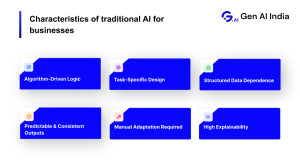
Algorithm-Driven Logic
Traditional AI follows explicit, human-defined rules or mathematical logic. The system operates strictly within boundaries set by developers. A tax calculation engine applies predefined regulations without deviation.
Task-Specific Design
These systems are optimized to solve one problem extremely well. A fraud detection model can identify suspicious transactions accurately. But it can’t generate insights outside its trained domain.
Structured Data Dependence
Traditional AI vs. Generative AI performs best when working with clean, organized, labeled datasets. Such as transaction records, sensor data, or patient histories.
Predictable & Consistent Outputs
Given the same input, traditional AI always produces the same output. This determinism is essential in industries like finance, healthcare, insurance, and government.
Manual Adaptation Required
When business rules change or new scenarios emerge, the system must be updated by engineers.
High Explainability
Because decisions are rule-based, outputs can be easily audited for regulatory compliance. Despite the rise of more advanced AI models, traditional AI remains the backbone of enterprise operations worldwide.
What Is Generative AI?
Generative AI represents a fundamentally different approach. Instead of analyzing data to make decisions within fixed rules. Generative AI creates original content based on patterns learned from massive datasets.
These systems use advanced deep learning techniques. Especially, transformer-based models to generate text, images, audio, video, code, and synthetic data. In Generative AI vs. Traditional AI, both work effectively with unstructured data and adapt dynamic outputs.
From a business standpoint, generative AI introduces creativity, flexibility, and personalization. You can hire Generative AI engineers for more consultation. It unlocks new opportunities in innovation, customer engagement, and product development.
Key Characteristics of Generative AI
Generative AI systems help in several critical ways.
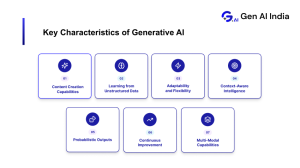
Content Creation Capabilities
Generative AI can produce articles, marketing copy, images, videos, music, design concepts, and software code, dramatically accelerating creative workflows.
Learning from Unstructured Data
These models process text, images, audio, and other unstructured data without relying solely on labeled datasets.
Adaptability and Flexibility
The same prompt can generate multiple valid outputs in different styles, tones, or formats, enabling personalization at scale.
Context-Aware Intelligence
Generative AI vs. traditional AI, the former understands relationships between data points, maintaining coherence across complex tasks.
Probabilistic Outputs
Unlike deterministic traditional AI, generative AI in fintech produces variable outputs, introducing creativity and novelty.
Continuous Improvement
With fine-tuning and feedback loops, generative AI models improve alignment with business goals over time.
Multi-Modal Capabilities
Advanced models can generate images from text, videos from storyboards, and mixed data sources. These capabilities make generative AI a transformational force across industries.
Generative AI vs. Traditional AI: Strategic Differences Every Business Must Understand
Here is the detailed comparison of traditional AI vs. generative AI.
| Comparison Area | Traditional AI | Generative AI |
| Core Purpose & Intent | Designed to analyze data, identify patterns, and make decisions within predefined boundaries. | Designed to create new content, ideas, and solutions. Extends beyond optimization into innovation, personalization, and experimentation. |
| Intelligence Design & Learning Approach | Operates on deterministic logic using rules, algorithms, and human-defined models. Behavior is predictable and stable once deployed. | Uses probabilistic intelligence powered by deep learning and transformers. Adapts outputs dynamically based on prompts, intent, and context. |
| Data Requirements & Flexibility | Performs best with structured, well-labeled data such as transactional, operational, or sensor datasets. | Thrives on structured and unstructured data including text, images, audio, documents, and conversations. |
| Output Predictability | Delivers consistent, repeatable outputs for the same input. Ideal for compliance-heavy and risk-sensitive environments. | Produces variable outputs by design. Enables creativity and personalization but requires governance controls. |
| Explainability & Regulatory Alignment | Highly explainable decision paths. Easier to audit and align with regulations in finance, healthcare, insurance, and government. | Less transparent “black-box” behavior. Requires explainable AI frameworks, ethical policies, and human oversight. |
| Business Value Delivered | Improves operational efficiency, reduces costs, minimizes risk, and strengthens core business systems. | Creates new value streams through innovation, differentiation, and enhanced customer experiences. |
| Ideal Business Use Cases | Fraud detection, credit scoring, demand forecasting, predictive maintenance, workflow automation, diagnostics. | Content generation, conversational AI, product design, personalized recommendations, strategic ideation. |
| Role in Enterprise AI Strategy | Acts as the foundation for compliance, governance, and operational reliability. | Serves as an accelerator for innovation, growth, and competitive differentiation. |
| Recommended Adoption Model | Best suited for structured decision-making and mission-critical systems. | Most effective when paired with traditional AI in a hybrid enterprise AI strategy. |
Core Purpose and Intent
Traditional AI is designed with a clear, predefined objective. It helps to analyze data, identify patterns, and make decisions within a fixed scope. It’s to optimize and improve accuracy, efficiency, and speed in existing processes. Businesses rely on traditional AI to automate repetitive tasks, detect anomalies, and make decisions.
In Generative AI vs. traditional AI, the former helps to create rather than merely analyze. Its purpose extends beyond optimization into innovation. Instead of decisions based on historical patterns, generative AI develops new content and solutions. This makes it particularly valuable for businesses aiming to differentiate through creativity, personalization, and rapid experimentation.
Intelligence Design and Learning Approach
Traditional AI operates on deterministic logic. Its intelligence is encoded through rules, algorithms, or trained models designed by humans. These systems follow a predictable path, and their behavior remains stable.
Generative AI relies on probabilistic intelligence powered by deep learning architectures. It learns complex patterns from massive datasets and uses contextual reasoning to determine outputs. It allows generative AI systems to adapt responses based on prompts, intent, and context. Also, it makes them far more flexible and less rigidly controlled than traditional AI.
Data Requirements and Flexibility
Traditional AI performs best with structured and well-labeled data. It depends on clean datasets where variables are clearly defined and is ideal for enterprise environments. Such as finance, supply chain, and operations, where structured data dominates.
Generative AI vs. Traditional AI, the former thrives in semi-structured data environments. It can process natural language, images, audio, and mixed data formats without manual labeling. This capability allows businesses to extract value from previously underutilized data sources. Such as documents, emails, customer conversations, and creative assets.
Output Predictability and Variability
A defining strength of traditional AI is predictability. Given the same input, it will consistently deliver the same output. This repeatability is crucial in regulated industries where consistency and auditability are non-negotiable.
Generative AI produces variable outputs by design. Even with the same prompt, responses may differ slightly based on probability and context. While this variability fuels personalization, it needs businesses to implement governance frameworks.
Explain ability and Regulatory Alignment
Traditional AI systems are generally easier to interpret. Their decision paths can be traced back to rules, making them suitable for compliance-driven environments. Such as banking, insurance, healthcare, and government.
In discriminative models vs. Generative AI models, the latter function more like black boxes. Their internal reasoning is complex, raising concerns around regulatory compliance. Organizations that adopt generative AI must invest in explainable AI practices and ethical governance.
Business Value and Strategic Impact
Traditional AI delivers value by improving what already exists. It enhances operational efficiency, reduces costs, and strengthens risk management. For many enterprises, traditional AI forms the backbone of mission-critical systems.
In Generative AI vs. Traditional AI, the former creates new value streams. It enables businesses to innovate, personalize customer experiences, and explore ideas. Its impact is most visible in growth-focused initiatives. Such as marketing, product development, customer engagement, and research.
Ideal Business Use Cases
Traditional AI is best suited for scenarios requiring precision, consistency, and control. These include fraud detection, credit scoring, demand forecasting, predictive maintenance, and workflow automation.
Generative AI is ideal for use cases where creativity and adaptability matter. It includes content generation, conversational AI, product design, personalized advice, and strategic ideation.
Role in Enterprise AI Strategy
In modern enterprises, traditional AI ensures compliance and operational efficiency. Generative AI acts as an accelerator to drive innovation and long-term growth.
Most forward-thinking organizations adopt a hybrid approach. Traditional AI handles structured decision-making and risk-sensitive processes. Generative AI augments human capabilities by generating insights and new possibilities. This balance allows enterprises to innovate without compromising control.
Challenges and Key Considerations in AI Integration
Here are the numerous challenges faced while integrating AI.
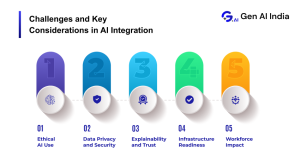
Ethical AI Use
In Generative AI vs. Traditional AI, the former raises concerns around misinformation and deepfakes. Traditional AI, while more controlled, can reinforce bias if trained on skewed historical data. Organizations implement ethical AI frameworks, monitoring mechanisms, and human oversight.
Data Privacy and Security
AI systems require large volumes of data, often including sensitive or regulated information. Without strong data governance, encryption, and access controls, organizations risk breaches and non-compliance. This challenge is in generative AI for its reliance on massive datasets and external integrations.
Explain ability and Trust
Traditional AI offers higher transparency to explain decisions to stakeholders. Generative AI models often function as “black boxes,” making explain ability more complex. Enterprises must invest in explainable AI practices to build trust and meet compliance standards.
Infrastructure Readiness
AI adoption requires skilled teams, scalable infrastructure, and continuous model monitoring. In Generative AI vs. Traditional AI, the former demands advanced expertise in model fine-tuning and prompt engineering.
Workforce Impact
AI may automate certain tasks, raising concerns about job displacement. However, it also creates new roles in AI strategy, governance, and development. Businesses that focus on upskilling and human-AI collaboration for long-term success. Addressing these challenges early ensures AI delivers sustainable business value.
Real-World Applications: Traditional AI vs. Generative AI in Action
Here are the distinct use cases of the AI types.
Traditional AI Use Cases
Traditional AI thrives in data-driven environments where decisions are accurate. For Generative in fintech, it powers fraud detection systems that analyze transactions to flag anomalies. In lending, it enables credit scoring models that assess risk using historical financial data. Retailers and logistics companies rely on traditional AI for demand forecasting.
In healthcare, diagnostic systems analyze medical images and lab data to support clinical decisions. Manufacturing firms use predictive maintenance models to reduce downtime and operational costs. These use cases emphasize efficiency, reliability, and risk reduction.
Generative AI Use Cases
In Agentic AI vs. Generative AI vs. Traditional AI, the former is most impactful in innovation-driven domains. Marketing teams use it to generate personalized content, ad copy, and campaign visuals. Product teams leverage it to explore design variations and accelerate prototyping. Media and entertainment companies create characters, scripts, and digital assets faster than ever.
In healthcare, generative AI accelerates drug discovery to simulate molecular structures. User service platforms use AI-generated responses to deliver human-like interactions. These applications focus on creativity, speed, personalization, and differentiation.
Conclusion
Traditional AI vs. Generative AI serve different but complementary business purposes. Traditional AI strengthens operational excellence and governance. While generative AI unlocks innovation and growth. Organizations that strategically deploy both are aligned with specific use cases. It will be best positioned to compete in an increasingly intelligent digital economy.
Want to get the professional Generative AI services for business projects?
FAQs
1. How do businesses decide between Traditional AI and Generative AI?
The choice depends on the outcome you need. If accuracy, compliance, and predictable decisions are critical, Traditional AI fits best. If innovation, personalization, or content creation drives value, Generative AI delivers greater impact.
2. Can Generative AI replace Traditional AI in enterprise systems?
No. Generative AI complements rather than replaces Traditional AI. Enterprises typically use Traditional AI for structured decision-making and Generative AI to enhance creativity, insights, and customer-facing experiences.
3. Which AI approach offers faster ROI for businesses?
Traditional AI often delivers faster ROI in operational use cases like fraud detection or forecasting. Generative AI creates long-term ROI by accelerating innovation, reducing creative effort, and enabling differentiated customer experiences.
4. Is Generative AI safe to use in regulated industries?
Yes, when implemented responsibly. Businesses must apply governance, human oversight, and data security controls. Many regulated industries use Generative AI for non-decision-critical functions such as content generation and internal knowledge support.
5. Should businesses adopt a hybrid AI strategy?
Yes, A hybrid approach combines the reliability of Traditional AI with the adaptability of Generative AI. This enables organizations to maintain control while unlocking innovation and competitive differentiation.