How Much Does It Cost to Integrate Generative AI With CRM and ERP Systems?
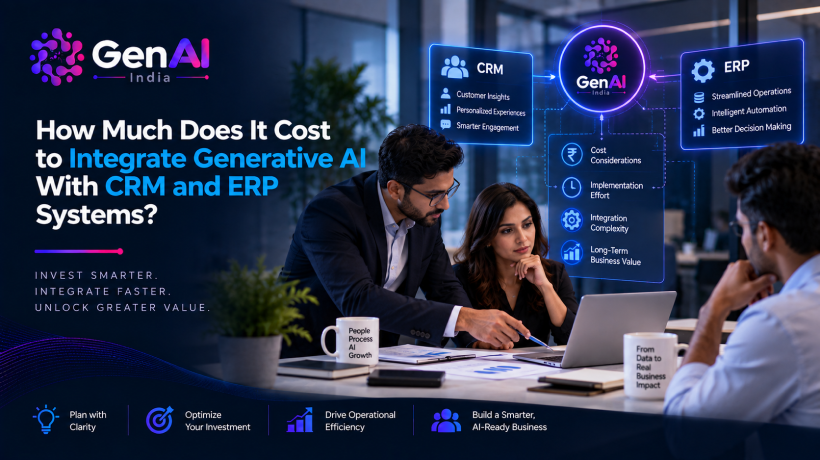
- Generative AI integration with CRM and ERP systems can cost roughly $10,000–$300,000+, while complex enterprise implementations can go beyond this range.
- The AI model is only one part of the budget. Data preparation, APIs, integrations, security, RAG, workflows, testing, and infrastructure can represent a significant share of the investment.
- CRM integrations are often focused on sales, customer service, personalization, and account intelligence.
- ERP integrations typically focus on inventory, procurement, finance, supply chain, reporting, and operational decision-making.
- Connecting CRM and ERP creates more valuable cross-system intelligence but also increases development complexity.
Generative AI is moving beyond standalone chatbots. Businesses are now connecting it directly with the systems that already run their sales, customer service, finance, inventory, procurement, and operations.
That shift creates a much more useful form of AI. A sales manager can ask for a summary of an account, while a procurement team can ask which products are approaching their reorder threshold.
The cost to integrate Generative AI with CRM and ERP systems can range from around $10,000 for a focused integration to $300,000+ for complex enterprise implementations. Large Gen AI development companies with multiple systems, real-time data, advanced RAG, AI agents, strict security, and customized workflows can spend considerably more.
There is no single price because the AI model is only one part of the project. Data preparation, APIs, integrations, security, AI architecture, user experience, testing, infrastructure, and ongoing maintenance can all influence the final budget. Let’s explore how to integrate the Gen AI with CRM & ERP.
Table of Contents
How Much Does It Cost to Integrate Generative AI With CRM and ERP?
These are planning ranges, not fixed quotations. Generative AI development company connecting an existing LLM API to one well-documented CRM will have very different costs from an enterprise connecting AI to Salesforce, SAP, a data warehouse, support systems, and internal databases.
Why Are Businesses Connecting Generative AI With CRM and ERP?
Here is why businesses are connecting AI with CM & ERP systems.
Turning Customer Data Into Actionable Insights
A sales manager may have hundreds of customer accounts but limited time to review each one.
Hire Gen AI developers can summarize account activity, identify inactive customers, highlight open opportunities, and prepare follow-up recommendations based on available CRM data.
This reduces the time employees spend collecting information before making decisions.
Automating Repetitive Sales and Service Tasks
AI can draft emails, summarize calls, classify leads, prepare customer responses, create support summaries, and recommend next actions.
The goal is not to replace the CRM. It is to reduce the manual work required to use it.
Improving ERP-Based Decision-Making
ERP systems contain operational information, but employees often need technical knowledge to extract useful insights.
Generative AI can provide a natural-language interface for questions such as:
“Which products had the highest return rate last quarter?”
or:
“Show me suppliers with delayed deliveries in the last 60 days.”
Giving Employees a Single AI Interface
Connecting CRM and ERP data allows businesses to create a single AI assistant that can work across departments.
A sales representative can access customer information. A finance employee can retrieve invoice details. A procurement manager can check supplier information.
The AI experience changes from searching for information to asking for information.
What Determines the Cost of Generative AI Integration With CRM and ERP?
Several technical and business factors influence the final budget.
Type of AI Use Case
The first factor is what you actually want AI to do.
A simple feature that summarizes CRM records is relatively straightforward. An AI agent that analyzes customer information, checks ERP inventory, creates a quotation, updates the CRM, and sends an approval request is much more complex.
Cost impact: Simple AI features may cost around $10,000–$30,000, while advanced AI workflows can exceed $100,000+.
CRM and ERP Platforms
The platforms you already use have a major effect on the project.
Cloud platforms with mature APIs can make integration easier. Highly customized or legacy systems may require additional development.
Businesses may need to work with platforms such as Salesforce, HubSpot, Microsoft Dynamics, SAP, Oracle, NetSuite, Odoo, or custom enterprise applications.
Cost impact: A single CRM or ERP integration may add roughly $5,000–$25,000+, depending on APIs, customization, authentication, and workflow complexity.
Number of Systems and Data Sources
A simple AI assistant may only need access to one CRM.
An enterprise assistant might need information from:
- CRM
- ERP
- Data warehouse
- Customer support system
- Marketing automation platform
- Document repositories
- Billing software
- Internal databases
- Business intelligence tools
Every additional connection introduces data mapping, authentication, testing, monitoring, and maintenance requirements.
Cost impact: Multiple connected systems can add $10,000–$50,000+ to the integration budget.
Data Quality and Preparation
AI is only as useful as the information it can access.
CRM and ERP databases often contain duplicate records, outdated customer information, inconsistent product names, missing fields, and conflicting records.
Before connecting them to AI, businesses may need to clean, normalize, map, enrich, and validate their data.
For larger implementations, data infrastructure can include ETL pipelines, cloud storage, data warehouses, and other processing systems.
Cost impact: Data preparation can add approximately $5,000–$30,000+, depending on data volume and quality.
AI Model Selection
A customized or self-hosted model offers greater control but introduces additional infrastructure, optimization, deployment, and maintenance requirements.
Current industry estimates similarly show that API-based approaches have lower upfront costs, while custom AI solutions require significantly higher investment.
Cost impact: API-based solutions generally have lower initial development costs, while customized or self-hosted AI can add $20,000–$100,000+.
RAG and Enterprise Knowledge Retrieval
Sometimes CRM and ERP data alone are not enough.
Businesses may also have contracts, product manuals, policies, support documentation, SOPs, and internal knowledge bases that AI needs to reference.
This is where Retrieval-Augmented Generation (RAG) can help.
Instead of relying only on the model’s existing knowledge, the system retrieves relevant business information and provides it to the model as context.
Cost impact: Adding RAG can increase development costs by approximately $15,000–$75,000+, depending on data sources, retrieval architecture, security, and scale.
AI Agents and Workflow Automation
A chatbot that answers a question is relatively simple. An AI agent that takes action is different.
For example, an agent might:
- Identify a customer.
- Review CRM activity.
- Check ERP order history.
- Analyze account value.
- Check product availability.
- Prepare a quotation.
- Request approval.
- Update the CRM.
Every additional action requires Gen AI tools & platforms, permissions, business rules, error handling, and testing.
Cost impact: Agentic AI workflows can push the project into the $50,000–$200,000+ range, depending on the number of systems and actions involved.
Security and Compliance
CRM and ERP systems often contain sensitive business information.
AI integration therefore needs to consider:
- Authentication
- Role-based access
- Encryption
- Audit logs
- Data isolation
- API security
- Access permissions
- Data retention
- Compliance requirements
Cost impact: Enterprise security and compliance requirements can add $10,000–$50,000+, especially in regulated industries.
User Experience
AI should not feel like an unrelated tool attached to an existing CRM or ERP.
Businesses may need:
- AI chat interfaces
- AI recommendation panels
- Smart dashboards
- Suggested actions
- Approval workflows
- Conversation history
- Feedback mechanisms
- Explain ability features
The goal is to place AI where employees already work.
Cost impact: AI-focused UI/UX development can add approximately $5,000–$20,000+.
Testing and AI Evaluation
Traditional software testing checks whether a feature behaves according to predefined rules.
AI introduces another challenge: the output can vary.
Teams need to evaluate:
- Response accuracy
- Data retrieval quality
- Hallucinations
- Permission handling
- Security
- Latency
- Failure handling
- Data leakage
- Scalability
AI evaluation becomes particularly important when the system influences customer interactions, financial decisions, or operational processes.
Cost impact: AI testing and evaluation can add around $5,000–$25,000+ depending on the system’s criticality and complexity.
Cost of Integrating Generative AI With CRM vs. ERP
CRM and ERP integrations can use similar AI technologies, but the business requirements are different.
These ranges are directional. Current industry estimates similarly put AI ERP integration from roughly $20,000 to $500,000+ depending on scope, while enterprise AI CRM implementations can reach $500,000+.
Generative AI Use Cases for CRM Systems
AI Sales Assistant
An AI sales assistant can summarize customer accounts, identify recent interactions, prepare meeting briefs, and suggest follow-up actions.
Instead of opening several CRM records before a customer meeting, a sales representative can ask the AI to provide the most important information.
Cost impact: A basic sales assistant may cost $10,000–$30,000, while deeply integrated assistants can exceed $50,000+.
Lead Qualification and Prioritization
AI can analyze customer information and sales activity to help teams prioritize leads.
The system can consider factors such as engagement, company size, previous interactions, purchase history, and sales activity.
Cost impact: AI-powered lead qualification can cost approximately $15,000–$50,000+, depending on the data and automation involved.
Automated Email and Proposal Generation
AI can use CRM context to draft personalized emails, follow-ups, proposals, and meeting summaries.
This saves sales teams from repeatedly writing similar communications.
Cost impact: Basic content-generation workflows may start around $5,000–$15,000, with deeper CRM-driven automation costing more.
Customer Support Copilot
A support copilot can summarize customer history, retrieve product information, suggest responses, and help agents resolve tickets faster.
The complexity increases when the AI needs access to CRM records, ticketing systems, knowledge bases, and customer-specific information.
Cost impact: An enterprise support copilot can cost around $20,000–$75,000+ depending on integrations and RAG requirements.
Generative AI Use Cases for ERP Systems
AI-Powered Inventory Insights
AI can analyze inventory information and help employees identify slow-moving products, stock shortages, and unusual demand patterns.
Cost impact: An AI inventory assistant may cost approximately $20,000–$60,000+, depending on ERP integration and analytics requirements.
Procurement Assistant
An AI procurement assistant can help employees review suppliers, purchase history, pricing, delivery information, and procurement policies.
Cost impact: A procurement-focused AI system may require $25,000–$75,000+, particularly when multiple supplier and ERP systems are involved.
Financial Data Assistant
Instead of manually searching through reports, finance teams can ask natural-language questions about revenue, invoices, expenses, and other approved financial information.
Cost impact: A finance-focused AI assistant may cost $30,000–$100,000+, especially when security, auditability, and financial controls are required.
Supply Chain Intelligence
AI can connect ERP information with logistics, inventory, supplier, and order data to help teams identify potential operational issues.
Cost impact: Supply-chain AI integrations can range from $40,000 to $150,000+, depending on real-time requirements and the number of systems involved.
How Much Does Each Level of CRM and ERP Gen AI Integration Cost?
Basic Integration: $10,000–$30,000
A basic implementation might connect one CRM or ERP with an existing LLM API.
It could include:
- AI chatbot
- Basic data retrieval
- Simple summaries
- One or two workflows
- Basic authentication
This is a good starting point for businesses testing whether AI can solve a specific problem.
Intermediate Integration: $30,000–$75,000
This level may involve:
- Multiple APIs
- CRM and ERP data
- RAG
- Custom workflows
- Role-based access
- AI dashboards
- Analytics
- More extensive testing
This is where AI starts becoming a meaningful part of the business workflow.
Advanced Enterprise Integration: $75,000–$150,000+
Advanced deployments can include:
- Multiple enterprise systems
- Enterprise RAG
- AI copilots
- Real-time data
- Advanced security
- Custom business logic
- Workflow automation
- Monitoring
Agentic Enterprise Integration: $150,000–$300,000+
Agentic implementations can go significantly higher.
They may allow AI to retrieve information, reason over it, use tools, make recommendations, and execute approved actions across CRM and ERP systems.
What Are the Hidden Costs of Gen AI Integration?
The initial development budget is only part of the total investment.
LLM API Usage
Most commercial AI models charge based on usage.
As the number of employees or customers increases, AI consumption can increase too.
Cloud Infrastructure
Gen AI integration services may need additional databases, storage, compute, monitoring, networking, and caching.
AI systems that require real-time processing or self-hosted models can create additional infrastructure costs.
Data Synchronization
CRM and ERP information changes constantly.
The AI layer needs reliable synchronization so employees are not receiving outdated information.
Monitoring and Optimization
AI performance needs to be monitored after launch.
Businesses should track response quality, latency, model usage, errors, and cost per interaction.
Model Updates
AI models evolve quickly.
Changing the underlying model may require prompt testing, regression testing, evaluation, and sometimes architecture changes.
Employee Training
Employees also need to understand how and when to use AI.
An expensive AI system can deliver poor ROI if employees do not trust it or do not understand its limitations.
Build vs. Buy vs. Customize: Which Gen AI Approach Is Right?
There are three practical options.
Use an Existing AI API
This is usually the fastest way to test an idea.
It works well for:
- Start-ups
- MVPs
- Simple assistants
- Content generation
- Basic summarization
Customize an Existing AI Solution
This approach provides more control without requiring the business to build an AI model from scratch.
RAG, custom prompts, business rules, and workflow integration can make a general-purpose model more useful for specific business needs.
Build a Custom AI Solution
A custom solution makes sense when AI itself is a strategic differentiator or when the business has specialized data, workflows, security requirements, or performance needs.
However, custom development requires a much larger investment in engineering, data, infrastructure, testing, and maintenance.
How to Reduce Generative AI Integration Costs
Start With One High-Value Workflow
Avoid trying to build an AI platform for the entire organization from day one.
Choose one workflow where the potential ROI is clear.
Use Existing APIs
Existing CRM and ERP APIs can reduce development time compared with building new data access layers.
Avoid Custom Models Too Early
A business does not necessarily need a proprietary AI model.
An existing LLM combined with RAG, business rules, and secure integrations may be enough.
Prepare Data Before Development
Poor data creates expensive rework.
A data audit early in the project can identify problems before they affect the AI architecture.
Reuse Existing Infrastructure
If the business already has a data warehouse, API gateway, identity provider, or cloud environment, use it where appropriate.
Build an MVP
An MVP gives the organization a chance to test the business case before making a larger investment.
Monitor AI Usage
Tracking token consumption, API calls, response times, and user behavior can help control recurring costs.
Common Mistakes Businesses Make When Integrating Gen AI With CRM and ERP
Choosing AI Before Defining the Problem
Technology should support a business goal.
Starting with “we need an AI chatbot” is less useful than starting with “our sales team spends four hours every week preparing account summaries.”
Ignoring Data Quality
AI cannot fix fundamentally unreliable business data.
Poor data can produce confident but incorrect answers.
Giving AI Too Much Access
An AI system should only access the information required for its assigned tasks.
Underestimating Integration Work
The LLM API might take days to connect.
The CRM, ERP, authentication, permissions, data mapping, testing, and workflow integration can take much longer.
Focusing Only on Development Cost
The total cost of ownership also includes APIs, cloud infrastructure, monitoring, maintenance, security, and optimization.
Skipping AI Evaluation
A system that technically works is not necessarily a system that gives reliable answers.
Automating High-Risk Decisions Too Early
Businesses should be cautious about allowing AI to independently make decisions involving finance, compliance, customers, employees, or other high-impact areas.
Want to get seamless Gen AI integration to your ERP system?
Conclusion
The cost to integrate Generative AI with CRM and ERP systems depends on far more than the AI model you choose.
A focused integration using an existing LLM and one well-structured CRM can potentially be delivered for tens of thousands of dollars. A sophisticated enterprise platform that connects CRM, ERP, databases, documents, customer support, and business workflows can require $100,000–$300,000+, particularly when RAG, real-time data, AI agents, security, and enterprise-scale infrastructure are involved.
FAQs
1. How much does it cost to integrate Generative AI with CRM and ERP systems?
The cost can range from $30,000 to $250,000+, depending on the AI features, number of systems, data complexity, security requirements, and level of customization.
2. What factors affect the cost of Generative AI integration?
The main cost factors include AI feature complexity, CRM/ERP integrations, data quality, API requirements, security, model selection, customization, testing, and ongoing maintenance.
3. Can Generative AI work with both CRM and ERP data?
Yes. Generative AI can connect CRM and ERP data to provide a more complete view of customers, sales, inventory, orders, finance, and business operations.
4. What Generative AI features can be added to a CRM?
Businesses can add AI-powered sales assistance, customer summaries, email generation, lead insights, sales forecasting, automated responses, recommendations, and conversational search.
5. What Generative AI features can be added to an ERP?
Generative AI can support inventory insights, financial reporting, demand analysis, procurement assistance, document processing, workflow automation, and natural-language business queries.