Generative AI has made it surprisingly easy for businesses to experiment with artificial intelligence. A team can open ChatGPT, connect an API, deploy a chatbot, or add an AI assistant to an existing application in a relatively short time.
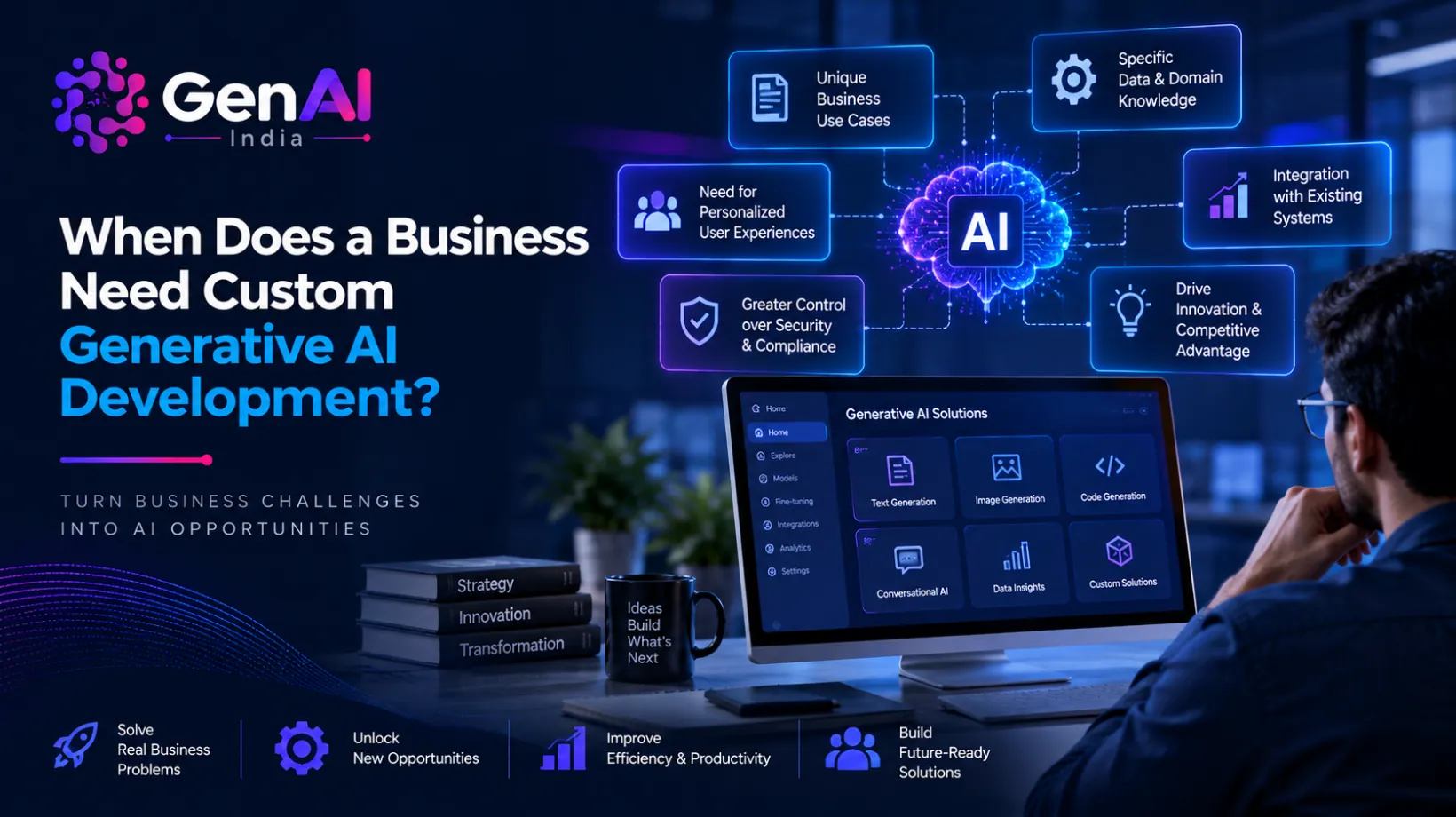
Custom Generative AI becomes more valuable when the business has proprietary data, specialized workflows, strict security requirements, complex integrations, domain-specific needs, or a product where AI itself creates competitive value.
Research on custom Gen AI development services also points to these factors, including proprietary data, performance limitations in regulatory requirements, and domain-specific capabilities. Let’s explore when a business needs custom Gen AI development services.
What Is Custom Generative AI Development?
Custom Generative AI development means building an AI-powered solution around the specific data, workflows, users, systems, and business goals of an organization.
There’s an important distinction here. The global generative AI market has reached approximately $91.6 billion, with enterprise spending climbing rapidly as organizations move toward customized applications.
Custom AI does not always mean training an LLM from scratch.
A business can customize generative AI at several levels:
Connecting an existing LLM to its applications
Building a Retrieval-Augmented Generation (RAG) system
Connecting AI to proprietary company data
Fine-tuning a model for a specific task
Building AI agents that can perform actions
Developing a domain-specific model
Creating an AI-powered product from the ground up
When Is an Existing AI Tool Enough?
An off-the-shelf AI tool may be the better option when the requirement is relatively simple.
Your use case is general-purpose.
If employees need help writing emails, summarizing public information, brainstorming ideas, translating text, or creating basic content, a commercial AI tool may already be sufficient.
You don’t need proprietary business data.
If the AI doesn’t need access to confidential documents, customer records, internal policies, or operational databases, there may be little reason to build a custom data layer.
You’re still testing the idea.
A company shouldn’t spend heavily on custom AI before knowing. Whether you hire Gen AI developers or customers will actually use the solution. A small proof of concept can answer that question first.
Existing AI meets your quality requirements.
If an existing model gives sufficiently accurate and useful results, rebuilding the technology may not create enough additional business value to justify the investment.
You don’t need deep system integration.
If users simply need an AI interface rather than an AI system that reads and updates CRM, ERP, databases, workflows, or other applications, a standard solution may work.
The principle is simple:
If an existing AI solution reliably solves the business problem, custom development may be unnecessary.
7 Signs Your Business May Need Custom Generative AI
Here are the top signs to get Gen AI services.
1. Generic AI Doesn’t Understand Your Business Context
A general-purpose LLM knows a tremendous amount about the world, but it doesn’t automatically understand your company.
It doesn’t know your internal terminology, pricing rules, approval processes, product structures, customer policies, or years of accumulated organizational knowledge.
That becomes a problem when the AI needs to answer questions such as:
Which policy applies to this customer?
Which product configuration should we recommend?
What does this contract clause mean under our internal guidelines?
What should an employee do when a specific exception occurs?
If the value of the answer depends heavily on your company’s context, a customized AI architecture may be justified.
2. Your AI Needs to Work With Proprietary Data
This is one of the clearest signals.
Businesses often have valuable information stored across:
CRM systems
ERP platforms
Knowledge bases
Product catalogs
Contracts
Financial records
Customer interactions
Internal documents
Operational databases
That information may be the very thing that makes the AI useful.
Custom AI solutions can bring these data sources into an architecture where the model can retrieve relevant information when needed. Proprietary data is also a major driver behind custom AI because it can reflect workflows, customer behavior, operational constraints, and domain-specific knowledge that generic systems cannot automatically access.
3. Accuracy Matters More Than Convenience
Not every AI mistake has the same impact. If an AI generates a slightly awkward marketing headline, someone can edit it.
If an AI gives incorrect information about a financial policy, legal requirement, medical document, or compliance process, the consequences can be much greater.
Businesses operating in areas such as:
Finance
Healthcare
Insurance
Legal services
Compliance
Enterprise operations
may need additional controls around AI output.
These can include:
Grounding responses in trusted data
Source citations
Role-based access
Human review
Structured outputs
Evaluation frameworks
Audit logs
Guardrails
The goal isn’t necessarily to make AI perfect. It is to make the system more controlled, measurable, and appropriate for the business risk involved.
4. You Want AI Inside an Existing Business Workflow
This is one of the biggest differences between using AI and building AI into the business. Consider a customer support employee. A basic AI chatbot can answer questions.
A custom AI system could:
Read the customer’s CRM record → understand the issue → search company policies → review previous interactions → draft a response → recommend the next action → update the CRM.
Now AI is no longer just a chatbot.
It has become part of the workflow.
Generative AI tends to create stronger business value when it is embedded into existing processes rather than operating as an isolated tool.
5. Your Business Needs Greater Control Over Data and Security
Employees may already be using public AI tools. That doesn’t necessarily mean your organization has an enterprise AI strategy.
A business needs to understand:
What information can the AI access?
Who can access it?
Where is the data processed?
What information is stored?
Can AI responses be audited?
For enterprises working with sensitive information, these questions become part of the technical architecture.
A custom AI solution can provide more control over:
Authentication
User permissions
Data access
Encryption
Logging
Data sources
Human approval
Governance
This doesn’t mean custom development automatically makes AI secure. Security still depends on how the system is designed and managed.
But it gives the organization greater ability to design those controls around its own requirements.
For example, a company may want every AI-generated report to follow:
A specific structure
Approved terminology
Certain business rules
A defined tone
Required fields
Specific formatting
7. AI Is Becoming Part of Your Product or Competitive Advantage
There is a major difference between:
“We want employees to use AI.”
and:
“AI is going to become part of our product.”
If AI is central to your customer experience, product functionality, revenue model, or competitive differentiation, relying entirely on a generic interface may eventually become limiting.
For example:
A manufacturer may want AI to interpret maintenance records and operational information.
In these cases, AI becomes part of the company’s digital product, which makes customization much more strategically important.
Custom GenAI Doesn’t Always Mean Building Your Own LLM
This is one of the most important things business leaders should understand.
Approach
What it means
Best suited for
LLM/API Integration
Connect an existing model to an application
General AI features
RAG
Give AI access to trusted business information at query time
Enterprise knowledge
Fine-Tuning
Adapt a model for specific behavior or tasks
Specialized outputs
AI Agents
Allow AI to reason through tasks and use tools
Multi-step workflows
Custom Model Development
Develop or train a model for highly specialized requirements
High-control, domain-specific use cases
Start with the least complex option that solves the problem
If RAG solves the problem, you may not need fine-tuning. If fine-tuning solves the problem, you may not need to build a new model. If Gen AI integration services are enough, you may not need either.
This approach can reduce unnecessary development cost while still giving the business the customization it actually needs.
What Business Problems Can Custom Generative AI Solve?
Custom GenAI can support many business functions, but the strongest use cases usually have one thing in common: there is a repetitive, information-heavy, or decision-heavy process that can be improved.
Customer Service
AI can combine customer history, product information, and company policies to help support teams respond faster and more consistently.
Knowledge Management
Employees can ask questions in natural language and retrieve information from internal documentation, policies and knowledge bases.
Sales
AI can assist with account research, proposals, meeting summaries, customer communication and sales intelligence.
Finance
AI can summarize financial documents, extract information and assist teams with reporting and analysis.
Legal and Compliance
AI can help review contracts, summarize policies and retrieve relevant information from large document collections—with human oversight where required.
Operations
AI can summarize reports, analyze operational information, assist employees and support repetitive decision-making workflows.
Software Development
Custom AI assistants can help developers understand legacy code, generate documentation, write tests, and work with internal development standards. That question usually produces better AI opportunities.
How Does Custom Generative AI Development Work?
Custom AI development should begin with the business problem, not with a model.
1. Define the Business Use Case
Identify the process, users, pain point, and expected outcome.
Instead of:
“We want an AI assistant.”
Define:
“We want to reduce the time support agents spend searching internal documentation.”
That is something a development team can measure.
2. Assess Data Readiness
Review what data exists, where it lives, how reliable it is, and who can access it.
Data quality is important because incomplete, fragmented, or unstructured information can undermine an otherwise sophisticated AI system.
3. Select the Right Architecture
The team determines whether the use case requires:
Existing LLM integration
RAG
Fine-tuning
AI agents
Custom model development
A combination of these approaches
4. Build a Proof of Concept
Test the most important workflow before making a large investment.
The goal is not simply to prove that AI can generate an answer.
The goal is to determine: Does AI improve the business process?
5. Integrate With Business Systems
Connect the solution with the systems employees already use, such as:
CRM
ERP
Databases
Document repositories
APIs
Business applications
Integration can become one of the more difficult parts of an enterprise AI project, especially where legacy systems, disconnected data, and API limitations exist.
6. Test and Add Guardrails
Evaluate accuracy, relevance, response time, security and potential failure cases. For sensitive use cases, human review and traceability may be essential.
7. Deploy, Monitor and Improve
AI development doesn’t end at deployment. Models, data, user behavior, and business requirements change. Monitoring helps identify performance problems and changing data patterns over time.
Custom Generative AI vs. Off-the-Shelf AI: Which Should You Choose?
The important point is that custom doesn’t automatically mean better.
Factor
Off-the-Shelf AI
Custom GenAI
Initial investment
Lower
Higher
Time to launch
Faster
Longer
Customization
Limited to moderate
High
Proprietary data
Limited integration options
Deep integration possible
Business workflows
Basic
Highly customized
Control
Provider-dependent
Greater architectural control
Domain specialization
Limited
High
Best for
General requirements
Specialized business needs
Competitive differentiation
Lower
Higher
It means the solution can be designed around requirements that standard tools cannot adequately address.
When Should a Business NOT Build Custom Generative AI?
Sometimes the smartest AI decision is not to build custom AI.
Avoid custom development when:
A commercial AI tool already solves the problem
The use case is too small to justify development
There is no clear business owner
ROI cannot be measured
The company has no usable data
Employees are still testing basic AI use cases
Customization is being pursued simply because “everyone is doing AI”
The Future of Custom Generative AI Is About Integration
The next stage of enterprise AI is unlikely to be defined simply by which company uses the biggest model.
The more important question is how well AI fits into the organization.
Businesses are moving from standalone chatbots toward systems that combine LLMs with enterprise data, retrieval, workflows, applications and AI agents. RAG-based architectures, for example, are increasingly relevant where businesses need answers grounded in approved information rather than relying solely on a model’s training knowledge.
That means the competitive advantage may come less from owning an AI model and more from building the right AI architecture around proprietary knowledge and business processes.
Want to get the custom Gen AI development services for your business?
Custom Generative AI development makes sense when standard AI tools don’t provide the context, control, accuracy, integration, or specialization your business requires. But custom development doesn’t necessarily mean training your own LLM. Before asking “Which AI model should we build?”, ask “What should AI help our business do better?”
That answer will tell you how much customization you actually need.
FAQs
1. What is custom Generative AI development?
Custom Generative AI development involves building an AI-powered solution around a company’s specific data, workflows, systems, users, and business requirements rather than relying entirely on a generic AI product.
2. Does custom GenAI mean training an LLM from scratch?
No. Custom GenAI can involve API integration, RAG, fine-tuning, AI agents, or custom model development. Training an LLM from scratch is only appropriate for a relatively small set of highly specialized requirements.
3. When should a company use RAG?
RAG is useful when an AI system needs to retrieve information from trusted business sources and use that information to generate responses. It is particularly useful for enterprise knowledge bases, internal documentation, and large document repositories.
4. Is custom AI better than ChatGPT?
Not necessarily. ChatGPT or another commercial AI tool may be the better choice for general-purpose requirements. Custom AI becomes more useful when the business needs proprietary data, specialized behavior, deep integrations, stronger control, or AI-powered product differentiation.
5. How much does custom Generative AI development cost?
There is no universal price because costs depend on the model or API, data quality, RAG or fine-tuning requirements, integrations, security, infrastructure, user volume, and ongoing maintenance.
6. How long does it take to build custom Generative AI?
A simple AI-powered application can be developed much faster than an enterprise AI platform involving proprietary data, multiple integrations, security controls and extensive testing. The timeline should therefore be estimated after the use case and architecture are defined.
As a leading Generative AI consulting company in India, we without a doubt think that, one of the most consequential technologies for humanity has been the rise of LLMs like ChatGPT.
As Anthropic CEO Dario Amodei puts it, AI is like “a country of geniuses in a datacenter” in an essay he wrote
Microsoft also highlighted 40 Jobs that are in critical danger in its latest research study Without a doubt, Generative AI is important for everyone, regardless of whether you are a student, teacher, coder, or business owner, you need to keep an eye on the future of generative AI.
So, we thought who would be better to talk about the future trends of generative AI and its scope than us.
First, let’s quickly cover the basics
What Is Generative AI?
Generative AIs are systems that can create new content, such as text, images, audio, or video, based on the learning patterns from data. It is an evolution of simple LLM models, which can’t create and are a sort of transformer.
Examples of Generative AI Models:
ChatGPT
DaLL-E
MidJourney
Gemini
Sora
Let’s now discuss the
The Future Scope of Generative AI: Trends & Predictions for 2026 and Beyond
There are various ethical dilemmas when it comes to implementing Generative AI in the workplace. Skill atrophy and value realization is what it is shaping the current trajectory.
Enough of the scaremongering, let’s now discuss various AI innovations and the future scope of generative AI.
1. Rise of Agentic AI and Autonomous Systems
What Is It:
As a leading Generative AI development company, our developers, team, and business leadership already know GenAI is evolving into “agentic AI”.
Compared to traditional LLM models, Agentic AI is a more autonomous form of artificial intelligence that can perceive, act, learn, and adapt to achieve goals. It is great for tasks that require minimal human oversight.
How it helps:
Agentic AI helps companies automate routine activities like customer interaction, complex work flows likes sales, and support. These Agentic AI systems can use reasoning, talk with other agents, connect with SaaS tools and leverage them to solve complex problems independently.
When it comes to providing context and a prompt to an AI model, today, every client of our GenAI development company asks us to create Multimodal capable of handling multiple data types (text, images, video, audio) more fluidly.
This enables real-time video generation, interactive simulations, and better results.
Similarly, GenAI models today can be made to be domain-specific specialists instead of generalists. These domain-specific models are the future of generative, and they ensure a more accurate response.
How it Helps:
2026 and beyond, AI will become a collaborative partner in research, security, and infrastructure, accelerating innovations in quantum computing and data science.
Domain-trained models for specialized fields like finance and Generative AI in healthcare services will dominate, with generative transformers forecasting diagnoses or treatment responses.
Moreover, the multimodal shift will also lead to “Generative UI,” where user interfaces are dynamically created by AI, prioritizing UX over raw intelligence.
It is expected that GenAI will transition from an experimental tool to a core organizational resource. Businesses and HR are expected to tackle the value realization problem through better ROI measurement.
Investment in GenAI development, training, governance, and agentic workflow is also expected to increase to remain competitive
How It Helps:
We are expecting Gen AI and agentic systems to create hyper-personalized interactions that will fill organization gaps in data and skills. Overall, AI will reshape work, combining efficiency pressures to enhance teamwork and productivity.
Today, researchers are worried about over-reliance on GenAI and how it could lead to “atrophy of critical-thinking skills,” prompting 60%+ of global organizations to mandate “AI-free” deliverables.
Community discussions highlight rapid progress, with some predicting breakthroughs in areas like singularity-level AI, though these remain speculative.
Why It Matters:
To mitigate risks, emphasis will be on ethical AI, security enhancements, and balanced governance. Call for AI governance on development is only increasing day by day from various companies like OpenAI, researchers, and policymakers.
5. Broader Impacts and Long-Term Outlook
What Is It:
GenAI is expected to slow down hiring and causing lay-off across various sectors. Various industries are bracing for impact, with Generative ready to disrupt the sector.
Category
Jobs Affected
AI Impact Description
Text-Based & Writing Jobs
– Writers, Editors, and Authors
– Proofreaders, Copy Markers, Technical Writers
– News Analysts, Reporters, and Journalists
– Public Relations Specialists
– Interpreters and Translators
Services involving translation, transcription, and simple content writing are being rapidly overtaken by AI. Basic copywriting, graphic design, and social media management are accelerating automation.
Coding & Development
– CNC Tool Programmers
– Web Developers
– Data Scientists
– Mathematicians
AI tools are accelerating the automation of entry-level programming tasks and basic coding. Routine data science and mathematical modeling tasks are at high risk.
Administrative & Data Entry
– Tele Operators
– Ticket Agents and Clerks
– Brokerage Clerks
– New Accounts Clerks (Banking)
– Statistical Assistants
– Counter and Rental Clerks
– Switchboard Operators
– Data Entry Clerks
95% of data entry roles are at risk due to AI’s ability to organize, verify, and input data. Administrative tasks like scheduling and clerical work are being automated.
Niche roles face disruption from AI in content generation and predictive modeling, especially in media and research fields.
How It Matters:
GenAI is revolutionizing sectors like education, entertainment, content creation, and environmental modelling with autonomous agents. They can help with climate forecasting, movies, VFX, and gaming development.
Our generative AI developers foresee a “next phase” where growth accelerates, but enterprises must navigate hype versus reality. In summary, the future is agentic, multimodal, and integrated, but success hinges on addressing human-AI balance.
6. Robots With Generative AI
What Is It:
Generative AI is no longer confined to screens, it’s stepping into the physical world through humanoid robots. Tesla’s Optimus Bot is one of the most talked-about examples, combining advanced motor control with generative AI reasoning to perform real-world tasks.
Unlike traditional industrial robots that follow fixed programming, these next-generation robots can interpret instructions, adapt to environments, and learn from interactions, making them capable of far more than repetitive factory tasks.
How It Helps:
Robots powered by generative AI can handle dynamic, unstructured environments, from warehouses and construction sites to homes and hospitals. Tesla Bot, for instance, is being designed to take on tasks humans find dangerous, repetitive, or undesirable.
Generative AI enables these robots to:
Understand and respond to natural language commands
Learn new tasks through observation and simulation
Collaborate safely alongside human workers
The line between digital AI assistants and physical robotic workers is blurring. Companies in manufacturing, logistics, and healthcare should begin evaluating where humanoid AI robots can complement or replace high-cost, high-risk human labour.
7. Generative AI in Defense
What Is It:
Defense and national security sectors are rapidly adopting generative AI, marking one of the most consequential, and controversial applications of the technology. OpenAI recently entered a partnership with defense stakeholders to explore how frontier AI models can be applied to national security challenges.
Meanwhile, Shield AI is developing self-piloting drones capable of operating autonomously even in GPS-denied environments, a critical capability for modern warfare and surveillance.
How It Helps:
Generative AI in defense enables capabilities that were previously impossible or cost-prohibitive:
Autonomous navigation and decision-making in communication-degraded environments
Real-time threat identification and battlefield intelligence synthesis
Accelerated mission planning through simulation and scenario modelling
Reduced risk to human personnel in high-danger operations
Organizations like Shield AI are building AI pilots that can fly fighter jets and drones without GPS or communications links, representing a fundamental shift in how militaries operate.
Defense-grade AI capabilities are beginning to cross over into commercial sectors — particularly autonomous vehicles, infrastructure protection, and cybersecurity. Businesses in these verticals should monitor how defense AI innovations translate into civilian applications in the near term.
8. Generative AI in R&D
What Is It:
Generative AI is accelerating innovation by dramatically shortening design cycles and reducing reliance on physical prototyping.
Generative AI is now capable of:
Creating multiple design iterations based on constraints and preferences
Simulating product performance under different conditions
Identifying design optimisations before production
Industries such as fashion, automotive, and electronics are using gen AI solutions to test ideas digitally, cutting time-to-market and development costs. Enterprises like Unilever leverage AI-driven analysis across connected devices and environmental data to improve forecasting and reduce waste.
How It Helps:
Organisations applying AI to product innovation report:
Faster design iteration cycles
Lower prototyping and R&D costs
Improved demand forecasting
Reduced material and manufacturing waste
Innovation will increasingly be AI-assisted by default. Businesses that integrate generative AI into design and R&D will outpace competitors in speed, efficiency, and sustainability.
9. Supply Chain and Logistics Optimization
What Is It:
The next generative AI future trend is transforming supply chain operations by enabling predictive, data-driven decision-making across complex global networks.
Generative AI is now capable of:
Forecasting demand with greater accuracy
Optimising delivery routes and fleet utilisation
Simulating supply chain disruptions and response scenarios
Enterprises are using AI development services to build solutions that analyze supplier performance, procurement contracts, and ethical sourcing indicators in real time. This enables faster, more objective procurement decisions while reducing bias in vendor selection.
Supply chains are evolving from reactive systems into predictive, adaptive networks. Companies investing in AI-powered logistics will gain efficiency, resilience, and cost advantages at scale.
Final Thoughts on the Future Scope of Generative AI
Generative AI is no longer a technology of the future; it is the technology right now, and its pace of evolution shows no signs of slowing down.
From agentic AI systems that operate autonomously to humanoid robots stepping onto factory floors, from transforming defense operations to reshaping how we discover drugs and design products, generative AI is touching every corner of human endeavor. Supply chains are becoming smarter, classrooms are becoming more personalised, and marketing is becoming more precise than ever before.
The trends discussed in this blog are not distant predictions; they are happening right now, across industries, boardrooms, and classrooms worldwide.
The question is no longer whether generative AI will reshape your industry, it is whether you will be ready when it does.
If you are looking to integrate generative AI into your business, build agentic workflows, or explore generative AI development tailored to your industry, our team is here to help you navigate what comes next.
FAQs
1. What is the future Scope of generative AI?
Generative AI is evolving into agentic AI systems and is becoming more capable everywhere. In the future, we will see the rise of specialised AI models along with multi-AI orchestrations.
2. How Generative AI is Transforming Our World?
Generative AI is improving productivity, enabling content creation, personalising education, and accelerating research and development across various fields like medicine, healthcare, and technology.
3. What are the future uses of generative AI?
Generative AI is making software development easier, accelerating drug discovery, as well as delivering tailored experiences to students, customers, and businesses.
4. What is the future Scope of generative AI in marketing?
Generative AI is used in the content creation process, it can understand your tone, audience, and dos and don’ts to create text, images, and videos as per your need. Generative AI can also help you polish or speed up internal marketing processes with ease. Brands are increasingly using models like Veo, Sora, and DALL-E in marketing.
5. What is the future of generative AI in education?
In the future, everyone will be able to get a tailored experience based on their expertise and personal level of education. No more one-size-fits-all approach.
6. The future of generative AI chatbots in higher education
Make research easier, streamline administrative tasks, structure assignments, get better class engagement ideas, and improve the overall experience.
7. Artificial Intelligence and its Impact on Human Intelligence?
Artificial intelligence can overall be a boon in terms of employee productivity, but research shows it negatively impacts decision-making capabilities and cognitive function.
8. What does the future hold for generative AI?
Multi-agent orchestration, industry-specific domain specialist AI, automated decision-making, decreased hallucination, and increased efficiency are without doubt the future of generative AI.
9. What are futuristic AI technologies ?
Agentic AI, ASI (Artificial Super Intelligence), AGI (Artificial General Intelligence), and Quantum AI are the futuristic AI technologies of the future.
10. What are the latest trends of generative AI?
Agentic AI systems, AI-native integration, and rising efficiency are the latest trends of generative AI.
Generative AI is no longer an experimental technology reserved for innovation labs. By 2026, it will become the operational backbone of modern enterprises. Businesses across industries are witnessing a fundamental shift in how work gets done. It is where intelligent systems execute tasks, make decisions, and optimize outcomes.
With AI digital employees, the future of generative AI signals a new era of business transformation. Organizations that embrace this shift early will operate faster in increasingly complex markets.
How Will Your Business Master the AI Shift in 2026?
Here is how businesses can master the AI shift.
Building Secure AI Ecosystems
Enterprises are moving toward private AI models trained on internal data. But alone, Generative AI integration can establish security; instead, it needs a strategy. It ensures data security, regulatory compliance, and better alignment with business objectives.
Adopting a Human-AI Operating Model
Integrating human labor with AI capabilities adds to your successful organizations with human oversight. AI handles execution, while humans guide strategy and make the final decisions.
Upskilling Teams for AI-First Workflows
AI adoption is as much about people as technology. Businesses investing in prompt engineering and model oversight achieve higher productivity and faster adoption.
Continuous Experimentation and Iteration
Rather than waiting for perfect solutions, leading companies test small AI use cases. This agile approach strengthens the future of generative AI and helps identify high-ROI opportunities.
Aligning AI Strategy with Business Outcomes
AI initiatives succeed when tied to clear KPIs. Such as cost reduction, revenue growth, efficiency, or customer satisfaction. A Generative AI development company can build outcome-driven AI strategies ensure sustained value creation.
Top AI Tools to Run Your Business in 2026
The next-gen AI platforms are designed to eliminate friction from daily work. These tools act as intelligent control layers across business workflows.
ChatGPT
By 2026, AI platforms like ChatGPT will function as a centralized intelligence hub. They securely manage emails, files, and workflows while coordinating tasks across systems. With multimodal understanding of text, images, and audio, businesses use these tools to automate processes. The result is substantial cost savings and faster execution of routine office work.
GitHub Copilot
Modern development teams already rely on Copilot to generate large portions of their code. Its evolving capabilities hold the key to the future of generative AI and allow it to understand entire apps. Generative AI is experiencing explosive growth, with the market expected to exceed $91 billion in 2026, growing at over 34% annually.Small companies build complex software in weeks instead of months. While non-technical users fix errors through conversational prompts. This acceleration shortens time-to-market and enables rapid product experimentation.
Synthesia
AI-generated video platforms are redefining corporate communication and training. Businesses convert text into professional videos with multilingual avatars. Enterprises report significantly higher employee engagement and dramatic reductions in video production costs.
DALL·E
Visual branding has become more accessible through AI-generated imagery. These systems create brand-consistent visuals, social media assets, and even immersive 3D environments. SMBs can now achieve visual quality once reserved for global brands. So, it enables faster campaign execution and consistent brand identity.
Descript
Content creation workflows are becoming radically simpler in the future of generative AI. Editing audio and video now feels like editing text. It removes filler words, generating highlights, and producing social-ready clips automatically. Teams save hours every week while maintaining professional production standards.
How Can Your Business Grow Money with Generative AI?
Here is how you can grow money with Gen AI tactics.
Automating High-Volume Work
Generative AI eliminates repetitive tasks. Such as customer queries, documentation, reporting, and scheduling. It reduces staffing costs while allowing teams to focus on strategic and revenue-generating activities.
Faster Time-to-Market
AI-driven design, development, and content creation dramatically shorten production cycles. Businesses for the future of generative AI launch features, campaigns, and updates faster to gain a competitive edge without overheads.
Smarter Decision-Making
Generative AI analyzes vast datasets and produces actionable insights in plain language. Leaders don’t rely on dashboards, and AI explains trends, predicts outcomes, and supports faster decisions.
Cost Reduction with Predictive Intelligence
By identifying inefficiencies, risks, and failures early. And AI helps businesses avoid costly mistakes. From fraud prevention to demand forecasting, predictive intelligence drives measurable savings.
Revenue Growth via Personalization
AI enables personalized customer experiences across marketing, sales, and support. Tailored recommendations with future scope of generative AI increase engagement, conversions, and customer lifetime value.
Latest Future Trends of Generative AI in 2026
Here are the latest trends shaping the AI future technologies.
Autonomous AI Agents
Generative AI is evolving from passive assistants into autonomous agents. So, it can plan, execute, and optimize tasks without constant human input. These systems manage workflows end-to-end to reduce operational dependency on manual supervision.
Multi-Modal Intelligence
AI models now understand and generate text, images, audio, video, and structured data. It enables businesses to automate complex workflows. Such as proposal creation, product visualization, and training content from a single prompt.
AI Integration
The future of Generative AI is extending beyond digital environments into physical spaces. Retail, logistics, and manufacturing businesses are using AI to control robots. Hire Generative AI engineers to optimize floor layouts and monitor real-time operational signals.
Rise of AI Governance
As AI systems gain autonomy, prioritizing transparency, monitoring, and ethical controls is essential. New governance layers track AI decisions, flag inconsistencies, and prevent data misuse.
Vertical-Specific AI Models
Generic AI models are giving way to industry-focused solutions trained on domain-specific data. This shift improves accuracy, compliance, and relevance in sectors like healthcare, finance, and legal services.
Building the Core of Your Digital Brain
As generative AI predictions become central to business operations. And companies need trusted partners to design, integrate, and scale intelligent systems responsibly. Custom AI solutions built with secure data pipelines, governance frameworks, and clear business objectives. It enables organizations to automate up to half of routine tasks while maintaining control and compliance.
The future of generative AI is not about replacing people. It’s about amplifying human potential, accelerating execution, and transforming how businesses operate at every level.
Conclusion:
By 2026, generative AI will no longer be a competitive advantage. Instead, it will be a baseline expectation. Businesses that act now will operate faster, serve customers better, and innovate with confidence. Those who delay risk falling behind in a world where intelligence, automation, and adaptability define success.
Want to get expert Generative AI development services to help you customizae business solutions?
Generative AI will evolve from isolated tools into enterprise-wide intelligence layers, powering autonomous workflows, predictive decision systems, and AI-driven business operations.
2. Will Generative AI replace human roles in businesses?
No. Generative AI will augment human expertise, automating repetitive tasks while enabling employees to focus on strategy, creativity, and high-value decision-making.
3. What industries will see the biggest Generative AI impact in the future?
Industries such as healthcare, finance, retail, manufacturing, logistics, and SaaS will see accelerated adoption due to high data volumes and process-driven operations.
4. How important is AI governance and security for future adoption?
AI governance will become critical. Enterprises will prioritize data privacy, model transparency, compliance, and ethical AI frameworks to ensure safe and scalable Generative AI adoption.
5. What is the Key Future of Generative AI Today?
Organizations should start by modernizing data infrastructure, piloting high-impact use cases, defining AI governance policies, and partnering with experienced AI development teams to ensure long-term success.
The business landscape is experiencing a fundamental shift. Generative AI has moved from research labs to boardrooms. It has transformed how companies operate and compete.
For business leaders, it is very important to understand this technology. It’s the way they can identify opportunities that could define your organization’s next decade.
This comprehensive guide breaks down generative AI in practical terms. We will explore how it works, what it costs, and how leading organizations are already leveraging Generative AI development to gain competitive advantages.
What is Generative AI?
Generative AI refers to artificial intelligence systems that can create new and original content. This content can be of any form. Be it text, images, code, music, video, and more.
Gen AI creates this content based on patterns learned from existing data. Where traditional AI systems classify or analyze existing information, generative AI produces novel outputs that didn’t exist before.
Let us take a simple example of this. Traditional AI might recognize a cat in a photo or predict customer churn. But Generative AI can create an entirely new image of a cat that never existed. It can write a marketing campaign from scratch or generate functional code for a new software feature.
The technology achieved mainstream awareness in late 2022 with ChatGPT’s public launch. But its foundations span decades of research in machine learning, neural networks, and natural language processing.
What changed wasn’t the core concept but the scale and accessibility of these systems.
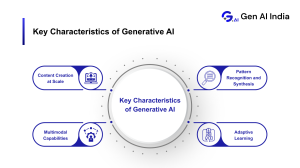
The Key Characteristics of Generative AI
Core features of Generative AI explained simply.
Content Creation at Scale:
Generative AI can produce thousands of variations in minutes. Yes, most of the content you read online is the output of Gen AI LLMs.
It can be product descriptions, design mockups, code functions, or data analysis. All these tasks that would take human teams days or weeks.
Pattern Recognition and Synthesis:
These systems learn underlying patterns from vast datasets. Then apply those patterns to generate new content that maintains coherent structure and context.
Multimodal Capabilities:
Modern generative AI can work across different content types. It can translate text to images. It can create videos from descriptions or turn sketches into professional designs.
Adaptive Learning:
The base models are pre-trained. But they can be fine-tuned for specific industries or use cases. This makes them increasingly relevant to specialized business needs.
What is the Main Goal of Generative AI?
The fundamental goal of generative AI is to augment human creativity, productivity, and decision-making by automating the creation of high-quality content and solutions. However, this broad objective manifests differently across business contexts.
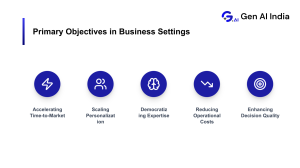
Primary Objectives in Business Settings
Business goals achieved with Generative AI.
Accelerating Time-to-Market:
In competitive industries, speed to deliver matters. Generative AI enables rapid prototyping and product development cycles.
What once took weeks can now happen in hours. With the help of Gen AI businesses can test more ideas. They can iterate faster and respond to market changes with agility.
Scaling Personalization:
Modern consumers expect personalized experiences. But delivering customization at scale has traditionally been cost-prohibitive.
Generative AI makes it economically viable to create unique customer experiences, personalized marketing content, and tailored product recommendations for millions of users simultaneously.
Democratizing Expertise:
Not every organization can hire top-tier designers, writers, or data scientists. Generative AI puts sophisticated capabilities into the hands of generalist teams.
Which means smaller companies can compete with larger enterprises and use subject matter experts to focus on strategy while AI handles execution.
Reducing Operational Costs:
By automating repetitive creative and analytical tasks, generative AI allows organizations to reallocate human talent to higher-value strategic work.
The ROI comes not just from cost reduction but from redirecting human creativity toward innovation.
Enhancing Decision Quality:
Generative AI can simulate scenarios. It can generate alternative strategies and provide data-driven insights that help executives make more informed decisions under uncertainty.
How Does Generative AI Work?
If you are able to understand the mechanics of generative AI, you will be able to make informed decisions about implementation, realistic expectations about capabilities, and strategic choices about where to invest.
The Foundation: Neural Networks and Deep Learning
Generative AI relies on artificial neural networks when you look at its core. Its computing systems are inspired by biological brains. These networks consist of layers of interconnected nodes (neurons) that process information and identify patterns.
Deep learning refers to neural networks with many layers (hence “deep”). This allows them to learn increasingly abstract representations of data. The first layers might recognize basic features (edges in an image, common word combinations in text), while deeper layers identify complex patterns (faces, sentiment, contextual meaning).
The Training Process
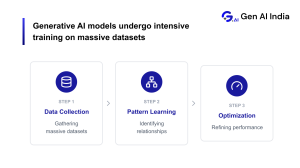
Generative AI models undergo intensive training on massive datasets:
How Generative AI models are trained on massive datasets.
Data Collection: Models are trained on billions of data points. This data can be anything like text from books and websites, millions of images, code repositories, or domain-specific datasets. The quality and diversity of this training data fundamentally determine the model’s capabilities.
Pattern Learning: During training, the model adjusts billions of internal parameters to minimize the difference between its predictions and actual outputs. It’s learning the statistical relationships that make language coherent, images realistic, or code functional.
Optimization: Through countless iterations, the model refines its understanding. For language models, this means learning grammar, context, facts, reasoning patterns, and even nuances like tone and style.
The training phase is computationally intensive. This requires week or months on specialized hardware and costing millions of dollars for state-of-the-art models. However, once trained, these models can be deployed at relatively low cost.
Generation Mechanisms
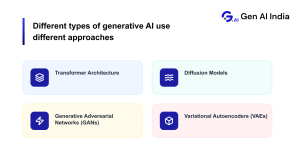
Different types of generative AI use different approaches:
Key Generative AI types and their approaches explained.
Transformer Architecture (GPT, BERT, etc.): These models are dominant in language AI. They use attention mechanisms to understand context. They predict the most likely next word (or token) based on everything that came before.
This builds coherent text one piece at a time. This same architecture now powers multimodal models that work with images, code, and other content types.
Diffusion Models (DALL-E, Stable Diffusion, Midjourney): For image generation, diffusion models start with random noise and gradually refine it into a coherent image based on text descriptions. They learn to reverse a “noise-adding” process, step by step creating increasingly detailed and accurate images.
Generative Adversarial Networks (GANs): These systems use two neural networks in competition. One generates content while the other evaluates it.
Through this adversarial process, both improve until the generator creates highly realistic outputs. GANs excel at creating photorealistic images and synthetic data.
Variational Autoencoders (VAEs): These compress data into a compact representation (encoding) and then reconstruct it (decoding). By manipulating the encoded space, they can generate variations and new examples similar to the training data.
The Inference Process
When you use a generative AI tool, the model isn’t “thinking” in the human sense. Instead, it performs probabilistic calculations. For a language model generating a response:
Your prompt is converted into numerical tokens the model understands
The model processes these tokens through its neural network layers
It calculates probability distributions for what should come next
It samples from these probabilities to select the next token
This process repeats, with each new token influencing subsequent predictions
Generation continues until a stopping condition is met
The entire process happens in milliseconds where it creates the illusion of real-time conversation or instant content creation.
Fine-Tuning and Customization
There is no doubt that base models are powerful. But still they become exponentially more valuable when customized for specific use cases:
Fine-Tuning: Training the model further on domain-specific data (legal documents, medical records, your company’s historical data) to specialize its knowledge and output style.
Prompt Engineering: Crafting instructions in ways that reliably produce desired outputs. It is a skill that’s become crucial for effective AI implementation.
Retrieval-Augmented Generation (RAG): Combining generative models with company databases or knowledge bases. This allows them to reference current, proprietary information not in their training data.
Reinforcement Learning from Human Feedback (RLHF): Using human evaluations to further refine model behaviour. We can say it helps to make outputs more helpful, accurate, and aligned with business objectives.
15+ Top Generative AI Tools in 2026
The generative AI ecosystem has exploded with hundreds of tools. But understanding the landscape helps executives identify which solutions align with their business needs.
Text and Language Models
1. ChatGPT (OpenAI):
The most recognized generative AI tool, ChatGPT excels at conversational AI, content generation, analysis, and problem-solving. To be honest, it does not need any introduction from our end.
Business applications include customer service, content creation, data analysis, and coding assistance. The enterprise version offers high level security, data privacy controls, and administrative features.
2. Claude (Anthropic):
Known for nuanced understanding, longer context windows (ability to process more information at once), and strong reasoning capabilities. This tool is particularly valuable for complex analysis, document processing, and applications requiring careful judgment.
3. Gemini (Google):
Google’s multimodal offering integrates with Google Workspace. This is a natural choice for organizations already in that ecosystem. Gemini is strong at research, analysis, and productivity enhancement.
4. Microsoft Copilot:
Embedded across Microsoft 365, this brings generative AI directly into familiar tools like Word, Excel, PowerPoint, and Teams.
Image and Design Generation
5. Midjourney:
Produces highly artistic, creative images particularly suited for marketing materials and brand visualization. The quality is exceptional, though it requires learning prompt crafting techniques.
6. DALL-E (OpenAI):
Offers precise control over image generation with strong instruction-following capabilities. Integrated into various platforms. This makes it accessible for rapid prototyping and content creation.
7. Stable Diffusion:
Open-source and highly customizable that allows organizations to run models on their own infrastructure. Ideal for companies with specific privacy requirements or those wanting to fine-tune for particular visual styles.
8. Adobe Firefly:
Designed for commercial use with commercially-safe training data, integrated into Adobe’s creative suite. Perfect for marketing teams already using Adobe tools.
Code Generation
9. GitHub Copilot:
Autocompletes code, suggests entire functions, and assists with debugging. Developer productivity tool that’s becoming standard in software teams, reportedly increasing coding speed by 30-50% for many developers.
10. Tabnine:
Offers AI code completion with strong privacy controls and the ability to train on private codebases. This makes it suitable for security-conscious enterprises.
11. Amazon Code Whisperer:
Integrated with AWS services, particularly valuable for organizations already in the Amazon cloud ecosystem.
Specialized Business Tools
12. Jasper:
Marketing-focused platform for creating brand-consistent content at scalelike blog posts, social media, ad copy, and more.
13. Copy.ai:
Sales and marketing copy generation with templates optimized for conversion and engagement.
14. Synthesia:
Creates AI-generated video content with digital avatars, useful for training materials, product demonstrations, and multilingual content without video production teams.
15. Runway:
Video editing and generation platform that can create, edit, and enhance video content using AI.
Industry-Specific Solutions
The most value comes from vertical-specific tools:
Legal: Harvey AI for legal research and document drafting
Healthcare: Nuance DAX for clinical documentation
Financial Services: Bloomberg GPT for financial analysis
Customer Service: Intercom Fin, Ada, or Zendesk AI for automated support
Build vs Buy Considerations
Executives face a crucial decision: use off-the-shelf tools or develop custom solutions.
Off-the-shelf tools offer rapid deployment, lower upfront costs, and continuous updates. They’re ideal for standardized use cases and getting quick wins.
Custom development makes sense when you need proprietary capabilities, have unique data that provides competitive advantage, require full control over data and models, or need deep integration with existing systems.
Many organizations adopt a hybrid approach. They use commercial tools for general needs while developing custom solutions for core differentiators.
Generative AI Development Cost
The understanding of the cost structure of generative AI helps executives budget appropriately and evaluate ROI realistically.
Commercial Tool Subscription Costs
1. Individual Plans:
Entry-level subscriptions typically range from $20-30 per user per month for tools like ChatGPT Plus, Midjourney, or GitHub Copilot. These work for small teams or individual power users.
2. Team Plans:
Mid-tier plans for teams of 5-50 users generally cost $25-60 per user monthly, adding collaboration features, increased usage limits, and basic administrative controls.
3. Enterprise Plans:
Large-scale deployments with enhanced security, compliance features, dedicated support, and custom integrations typically start at $500-5,000+ monthly, with pricing often negotiated based on usage volume and specific requirements.
Custom Development Costs
Building proprietary generative AI solutions involves several cost components:
Initial Development (3-6 months):
Small-scale proof of concept: $50,000-150,000
Production-ready MVP: $150,000-500,000
Enterprise-grade solution: $500,000-2,000,000+
These ranges reflect consultant/agency rates, team composition, complexity, and whether you’re fine-tuning existing models or building from scratch.
Infrastructure Costs:
Cloud computing for training: $10,000-100,000+ for one-time model training
Inference (ongoing usage): $0.001-0.10 per API call depending on model size
Storage and data processing: $500-5,000+ monthly
GPU/specialized hardware: $1,000-10,000+ monthly for dedicated resources
Ongoing Operational Costs:
Model maintenance and updates: $50,000-200,000 annually
Data scientists/ML engineers: $50,000-250,000 per engineer annually
Infrastructure scaling as usage grows: highly variable
Quality assurance and monitoring: $30,000-100,000 annually
Hidden and Indirect Costs
Change Management:
Training employees, updating processes, and managing organizational adaptation often equals or exceeds technology costs. Budget $20,000-200,000+ depending on organization size.
Data Preparation:
Generative AI is only as good as its data. Cleaning, structuring, and labeling data can cost $50,000-500,000+ for enterprise datasets.
Compliance and Legal:
Ensuring AI usage meets regulatory requirements, protecting IP, and managing liability may require legal consultation and specialized compliance tools.
Integration Complexity:
Connecting generative AI with existing systems (CRM, ERP, databases) often requires substantial development effort.
Cost-Benefit Analysis Framework
To evaluate whether generative AI investments make sense:
Calculate Current Costs: Measure the fully-loaded cost of activities you’re considering automating or augmenting (salaries, time, opportunity costs).
Estimate Efficiency Gains: Conservative estimates suggest 20-40% productivity improvements for knowledge workers using generative AI. For content creation tasks, gains can exceed 60-80%.
Consider Quality Improvements: Faster iteration, more personalization, and enhanced creativity can deliver revenue impacts beyond cost savings.
Factor in Strategic Value: Some capabilities enable entirely new business models or competitive moats that don’t fit traditional ROI calculations.
Plan for Scaling: Initial costs may seem high. But generative AI scales more economically than hiring proportionally. Costs may increase sub-linearly as usage grows.
Typical ROI Timelines
Quick wins (chatbots, content assistance): 3-6 months to positive ROI
Transformative implementations (new product features, business model changes): 12-24+ months
The key is starting with focused use cases that demonstrate value before expanding to more ambitious applications.
Best Generative AI Use Cases Across Departments
Generative AI delivers value across virtually every business function. So, it is important for you to have an idea of proven use cases to identify where to start their AI journey.
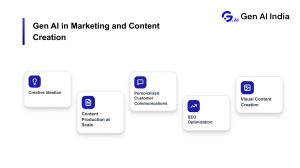
Gen AI in Marketing and Content Creation
How Generative AI boosts marketing and content creation.
Content Production at Scale: Generate blog posts, social media content, email campaigns, and product descriptions in a fraction of the time. Marketing teams report producing 5-10x more content variations for A/B testing.
Personalized Customer Communications: Create individualized email sequences, product recommendations, and messaging that adapt to customer behavior, demographics, and preferences automatically.
Creative Ideation: Generate campaign concepts, taglines, visual mockups, and creative variations that human teams can refine, accelerating the creative process from weeks to days.
SEO Optimization: Produce keyword-optimized content, meta descriptions, and structured data while maintaining quality and brand voice.
Visual Content Creation: Design social media graphics, advertising imagery, product visualizations, and marketing materials without extensive design resources.
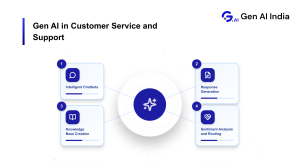
Gen AI in Customer Service and Support
Generative AI enhancing customer support and service efficiency.
Intelligent Chatbots: Deploy conversational AI that handles routine inquiries, troubleshoots problems, and escalates complex issues to humans, operating 24/7 across multiple languages.
Response Generation: Assist support agents with suggested responses, reducing handle time by 30-50% while maintaining quality and consistency.
Knowledge Base Creation: Automatically generate and update help documentation, FAQs, and training materials based on customer interactions and product changes.
Sentiment Analysis and Routing: Analyze customer communications to detect emotion, urgency, and intent, routing conversations appropriately and alerting managers to developing issues.
Gen AI in Software Development
Code Generation: Accelerate development by generating boilerplate code. Also create test cases and implement standard functions. This lets developers to focus on complex logic and architecture.
Code Documentation: Automatically generate comments, API documentation, and technical specifications from existing code, improving maintainability.
Bug Detection and Fixing: Identify potential issues, suggest fixes, and even implement solutions for common bugs and security vulnerabilities.
Legacy Code Modernization: Assist in translating old codebases to modern languages or frameworks. It lowers technical debt.
Gen AI in Data Analysis and Business Intelligence
Report Generation: Transform raw data into narrative reports, executive summaries, and data-driven insights without manual analysis.
Data Visualization: Generate appropriate charts, graphs, and dashboards based on datasets and business questions.
Predictive Modeling: Create forecasts, scenario analyses, and trend predictions from historical data.
SQL and Query Generation: Convert natural language questions into database queries, democratizing data access for non-technical users.
Gen AI in Product Development
Rapid Prototyping: Generate product concepts, user interface mockups, and feature specifications quickly for faster iteration.
User Research Synthesis: Analyze customer feedback, reviews, and research data to identify patterns and opportunities.
Requirements Documentation: Create user stories, technical specifications, and acceptance criteria from high-level product ideas.
Design Variations: Generate multiple design alternatives for products, packaging, or user experiences for testing.
Gen AI in Human Resources
Job Description Creation: Generate compelling, inclusive job postings optimized for different platforms and candidate pools.
Candidate Screening: Analyze resumes, create screening questions, and generate interview guides tailored to specific roles.
Onboarding Materials: Produce personalized training content, documentation, and welcome materials for new employees.
Performance Review Assistance: Help managers structure feedback, identify development opportunities, and document performance conversations.
Gen AI in Sales and Revenue Operations
Proposal Generation: Create customized proposals and pitch decks tailored to specific prospects.
Lead Qualification: Analyze prospect data to score leads and personalize outreach.
Sales Email Sequences: Generate personalized cold outreach, follow-ups, and nurture campaigns at scale.
Competitive Analysis: Synthesize competitor intelligence from multiple sources into actionable insights.
Gen AI in Legal and Compliance
Contract Review: Analyze agreements for risks, unusual terms, and compliance issues at a fraction of traditional review costs.
Document Drafting: Generate standard contracts, NDAs, employment agreements, and other legal documents from templates and specific requirements.
Regulatory Research: Quickly find relevant regulations, precedents, and compliance requirements across jurisdictions.
Discovery Assistance: Analyze large document sets for eDiscovery, identifying relevant materials faster than manual review.
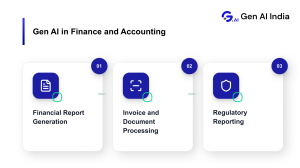
Gen AI in Finance and Accounting
How Generative AI optimizes finance and accounting tasks.
Financial Report Generation: Create management reports, variance analyses, and financial summaries from raw accounting data.
Invoice and Document Processing: Extract data from receipts, invoices, and financial documents automatically.
Risk Analysis: Generate risk assessments, scenario planning, and financial projections.
Regulatory Reporting: Assist in creating compliance reports and filings with required formats and disclosures.
The common thread across successful use cases: generative AI handles time-consuming, repetitive, or scalable tasks while humans provide strategy, judgment, and final oversight.
11 Generative AI Applications and Examples
Real-world examples bring abstract capabilities into focus. Here’s how leading organizations are deploying generative AI for tangible business outcomes. Plus, if you also want to make the best of this tech, generative AI consulting is a perfect start.
1. Enterprise Productivity: Microsoft and GitHub
Microsoft embedded generative AI across its product suite with Copilot. This move has fundamentally changed how millions work daily.
In Outlook, it drafts emails and summarizes long threads. In Teams, it captures meeting notes and action items. In Excel, it analyzes data and creates formulas from natural language.
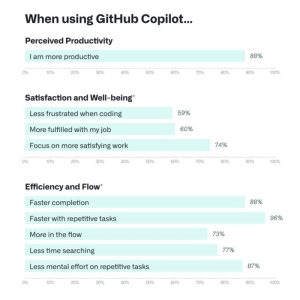
GitHub Copilot, deployed to over a million developers, demonstrates measurable impact: developers complete tasks 55% faster according to GitHub’s research.
GitHub Copilot boosts developer productivity by 55%. Image source: Github
The tool suggests entire functions, catches potential bugs, and assists with documentation.
2. Content Personalization: Spotify
Spotify uses generative AI to create personalized playlist descriptions, podcast recommendations, and user-specific marketing content at a scale impossible manually. With hundreds of millions of users, traditional personalization would require an army of content creators.
Their AI-powered DJ feature goes further. It generates personalized audio introductions and explanations for song selections, creating a customized radio experience for each listener.
Business Impact: Increased user engagement, longer listening sessions, and improved retention through ultra-personalized experiences.
3. Customer Service: Klarna
Financial technology company Klarna deployed generative AI for customer service, handling two-thirds of customer conversations. The AI assistant manages 2.3 million conversations monthly. This is equivalent to 700 full-time agents.
The implementation reduced average resolution time from 11 minutes to under 2 minutes while operating in 23 markets and 35 languages simultaneously.
Business Impact: $40 million in annual savings, faster customer resolution, 24/7 availability, and freed human agents for complex, high-value interactions.
4. Creative Production: Coca-Cola
Coca-Cola partnered with OpenAI to create personalized marketing campaigns and product innovation. They used DALL-E and ChatGPT to generate advertising creative, product concepts, and consumer-facing content.
Their “Create Real Magic” campaign invited consumers to create Coca-Cola artwork using generative AI. They produced over 120,000 unique pieces.
Coca-Cola generated over 120,000 unique AI artworks. Image and data source: Coca Cola
Business Impact: Reduced creative production costs, faster campaign iteration, and novel consumer engagement opportunities.
5. Drug Discovery:Insilico Medicine
Pharmaceutical company Insilico Medicine uses generative AI to design new drug candidates, drastically compressing timelines for drug discovery. Their AI generated a novel drug for idiopathic pulmonary fibrosis in under 18 months. This process traditionally takes 4-5 years.
The AI proposes molecular structures with desired properties, predicts their effectiveness, and optimizes for manufacturability and safety.
6. Legal Services: Allen & Overy and Harvey AI
Global law firm Allen & Overy deployed Harvey AI across 3,500 lawyers to assist with contract analysis, legal research, and document drafting. The tool helps lawyers find relevant case law, identify risks in agreements, and draft standard legal documents.
Associates report saving 4-6 hours weekly on routine research and document review, redirecting that time to complex legal strategy and client relationships.
7. E-commerce: Amazon and Product Listings
Amazon uses generative AI to create and optimize product listings, generating descriptions, titles, and bullet points that improve discoverability and conversion. Sellers provide basic product information, and AI generates compelling, SEO-optimized content.
For sellers managing hundreds or thousands of products, this transforms a week-long process into minutes, while improving consistency and quality.
Business Impact: Increased seller productivity, better customer experience through clearer product information, and improved search relevance.
8. Education: Khan Academy and Khanmigo
Khan Academy developed Khanmigo, an AI-powered tutor that provides personalized instruction, answers questions, and guides students through problems without simply giving answers. The AI adapts to each student’s learning pace and style.
For teachers, it generates lesson plans, creates quiz questions, and provides administrative assistance, addressing the time constraints that limit personalized attention in classrooms.
Business Impact: Scalable personalized learning, teacher productivity gains, and improved educational outcomes through adaptive instruction.
9. Design and Architecture: Autodesk
Autodesk integrated generative design into its architecture and engineering software. This help designers to input constraints (space requirements, materials, costs, structural loads) and receive optimized design alternatives.
The AI generates hundreds of options that human designers might never consider. It explores design spaces beyond human intuition while respecting engineering and budget constraints.
10. Financial Services: Bloomberg GPT
Bloomberg trained a large language model specifically on financial data – news, analyst reports, market data, and regulatory filings. Bloomberg GPT assists financial professionals with research, analysis, and decision support.
It can analyze market sentiment, summarize earnings calls, identify emerging trends, and answer complex financial questions drawing from Bloomberg’s vast proprietary datasets.
Business Impact: Faster investment research, improved analyst productivity, and enhanced decision-making through rapid synthesis of complex financial information.
11. Internal Knowledge Management: Notion AI
Notion AI helps organizations manage institutional knowledge by summarizing meeting notes, extracting action items, answering questions from company wikis, and generating status updates from project databases.
For distributed teams, it acts as an always-available knowledge assistant, reducing the time spent searching for information and keeping everyone aligned.
Top Generative AI Models as Per 2026
This is another important section of our blog. The right knowledge of generative AI models helps you choose the right foundation for their applications.
Large Language Models (LLMs)
GPT-5(OpenAI): The most capable publicly available language model, GPT-5.x demonstrates strong reasoning, creativity, and knowledge across domains.
The Turbo variant offers faster response times at lower cost, while GPT-4o (optimized) provides multimodal capabilities processing text, images, and audio.
Claude (Anthropic): Known for nuanced understanding and reduced hallucination rates, Claude excels at complex analysis and instruction-following.
Claude 4.x represents the high-capability tier, while Sonnet balances performance and cost, and Haiku offers fast, economical processing for simpler tasks.
Gemini (Google): Google’s latest generation model features massive context windows (processing up to a million tokens), strong multimodal capabilities, and deep integration with Google’s ecosystem.
Gemini 3 pro represents maximum capability, Pro balances performance and efficiency, and Nano runs on-device for mobile applications.
LLaMA (Meta): An open-source model family that organizations can run on their own infrastructure, offering customization and data privacy. While requiring more technical expertise, it provides full control and cost predictability.
Mistral AI: European open-source models offering strong performance with lower computational requirements, appealing to organizations with infrastructure constraints or regulatory considerations around data sovereignty.
Image Generation Models
DALL-E 3 (OpenAI): Integrated with ChatGPT, DALL-E 3 creates detailed images from text descriptions with improved instruction-following and fewer artifacts than previous versions.
Midjourney: Particularly strong at artistic and stylized imagery, Midjourney v6 produces photorealistic results and handles complex prompts effectively, though it operates primarily through Discord rather than standard APIs.
Stable Diffusion: Open-source with versions optimized for different use cases (speed, quality, specific content types). Organizations can fine-tune it on proprietary image datasets for brand-specific generation.
Adobe Firefly: Trained on Adobe Stock and public domain content, ensuring commercial safety. Deeply integrated with Adobe Creative Cloud, making it practical for professional creative workflows.
Code Generation Models
Codex (OpenAI): Powers GitHub Copilot, specialized for code completion and generation across dozens of programming languages.
CodeLlama (Meta): Open-source code generation model built on LLaMA, offering capabilities for code completion, debugging, and explanation without commercial licensing restrictions.
StarCoder: Open-source code model trained on permissively licensed code from GitHub, designed for transparency and avoiding license complications.
Multimodal Models
GPT-4V (Vision): Extends GPT-4 with image understanding, enabling applications that combine visual and textual analysis from medical image interpretation to retail product analysis.
Gemini Pro Vision: Google’s multimodal offering processes images, video, and audio alongside text, enabling comprehensive content understanding and generation.
Claude 3 Models: All Claude 3 variants (Opus, Sonnet, Haiku) include vision capabilities, processing images alongside text for integrated analysis.
Specialized and Domain-Specific Models
Med-PaLM (Google): Medical domain-specific model achieving expert-level performance on medical licensing exam questions, designed for healthcare applications with appropriate guardrails.
BloombergGPT: Financial domain model trained on extensive financial data, optimized for market analysis, financial document understanding, and industry-specific tasks.
LegalBERT: Legal domain model fine-tuned on legal texts, contracts, and case law for specialized legal applications.
BioGPT: Trained on biomedical literature for pharmaceutical research, drug discovery, and medical research applications.
Embedding and Retrieval Models
While not generative in the traditional sense, embedding models are crucial for retrieval-augmented generation (RAG):
OpenAI Embeddings: Convert text into numerical representations for semantic search and retrieval, enabling systems to find relevant information from company knowledge bases.
Cohere Embed: High-quality embeddings optimized for enterprise search and retrieval applications.
Sentence Transformers: Open-source embedding models offering flexibility and cost control for organizations building proprietary search systems.
Model Selection Considerations
Performance vs. Cost: Larger models (GPT-4, Claude Opus, Gemini Ultra) deliver superior quality but cost 10-50x more than smaller alternatives. Many applications work well with mid-tier models (GPT-3.5, Claude Haiku, Gemini Pro).
Latency Requirements: Real-time applications need fast response times. Smaller models or optimized variants respond in milliseconds versus seconds for larger models.
Context Window Size: Tasks involving long documents require models with large context windows (Claude 3 handles 200,000 tokens, Gemini 1.5 reaches 1 million tokens, while GPT-4 manages 128,000 tokens).
Privacy and Data Residency: Regulations may require data to stay in specific geographic regions or prevent cloud processing entirely, favoring open-source models you can host locally.
Customization Needs: Fine-tuning capabilities vary. Open models (LLaMA, Stable Diffusion) offer maximum flexibility, while commercial APIs limit customization to prompt engineering and retrieval augmentation.
Multimodal Requirements: If your application processes images, audio, or video alongside text, multimodal models are essential rather than chaining separate specialized models.
Licensing and Commercial Use: Open-source licenses vary. Some allow unrestricted commercial use while others impose restrictions. Commercial APIs include licensing in their pricing but may have usage restrictions.
The Evolution of Model Capabilities
Generative AI models improve rapidly. GPT-4 was considered cutting-edge in March 2023; by late 2024, multiple comparable or superior models existed. This pace of advancement has important implications:
Avoid Over-Customization: Today’s custom fine-tuning may become obsolete when next-generation base models exceed your specialized model’s capabilities.
Build Flexible Architectures: Design systems that can swap underlying models as better options emerge without rebuilding entire applications.
Focus on Data and Process: Your proprietary data, processes, and domain expertise create more durable competitive advantages than model selection alone.
Plan for Capability Growth: Applications that seem impossible today may become trivial next year. Design roadmaps with this acceleration in mind.
Moving Forward with Generative AI
Generative AI represents a fundamental shift in how businesses operate. The question isn’t whether to adopt generative AI, but how to do so strategically and effectively.
Key Takeaways for Business Leaders
Start with Business Problems:
The most successful implementations begin with clear business challenges. Then apply generative AI as a solution.
Embrace Experimentation:
Unlike traditional IT projects requiring extensive upfront planning, generative AI favors rapid experimentation. Start small, measure results, iterate quickly, and scale what works.
Invest in Data and Infrastructure:
Model capabilities improve constantly. But your data and systems provide enduring competitive advantage. Quality data pipelines, robust evaluation frameworks, and integration architecture matter more than choosing the perfect model today.
Build AI Literacy Organization-Wide:
The companies seeing the greatest returns don’t limit AI to technical teams. They educate employees across functions, encouraging responsible exploration and frontline innovation.
Establish Governance Early:
Implement guidelines around data privacy, quality standards, human oversight, and ethical use before problems emerge. Strong governance enables faster, more confident scaling.
Measure Rigorously:
Track both quantitative metrics (time saved, costs reduced, revenue increased) and qualitative outcomes (employee satisfaction, customer experience, innovation quality). Generative AI’s impact often extends beyond traditional ROI calculations.
Prepare for Change Management:
Technology implementation is straightforward compared to organizational adaptation. Allocate resources for training, process redesign, and cultural transformation.
The organizations that thrive in the generative AI era won’t necessarily be those with the largest AI budgets or the most sophisticated models. They’ll be the ones that thoughtfully do generative AI integration into their strategic vision, empower their teams to leverage these capabilities, and maintain focus on creating genuine value for customers and stakeholders.
FAQs
1. What’s the difference between generative AI and traditional AI?
Traditional AI analyzes, classifies, or predicts based on existing data. It can recognize a face in a photo, forecast sales, or detect fraud. Generative AI creates entirely new content in form of text, images, code, designs.
2. How do I know if my company’s data is safe when using generative AI tools?
Data security depends entirely on which tools you choose and how you configure them. Consumer tools like free ChatGPT may use your inputs for model training unless you opt out. Enterprise versions offer stronger guarantees and compliance with regulations like GDPR and SOC 2. For highly sensitive data, you have options: use enterprise agreements with strict data handling provisions, deploy open-source models on your own infrastructure, or implement on-premises solutions where data never leaves your servers.
3. How quickly is generative AI technology changing, and will my investment become obsolete?
Generative AI is evolving at an unprecedented pace. Models that seemed cutting-edge six months ago are now considered standard. This creates both opportunity and risk. The good news: capabilities improve constantly, often at no additional cost if you’re using API-based services. New models frequently offer better performance at lower prices. Our recommendation is to build flexible architectures that can swap underlying models as technology improves.